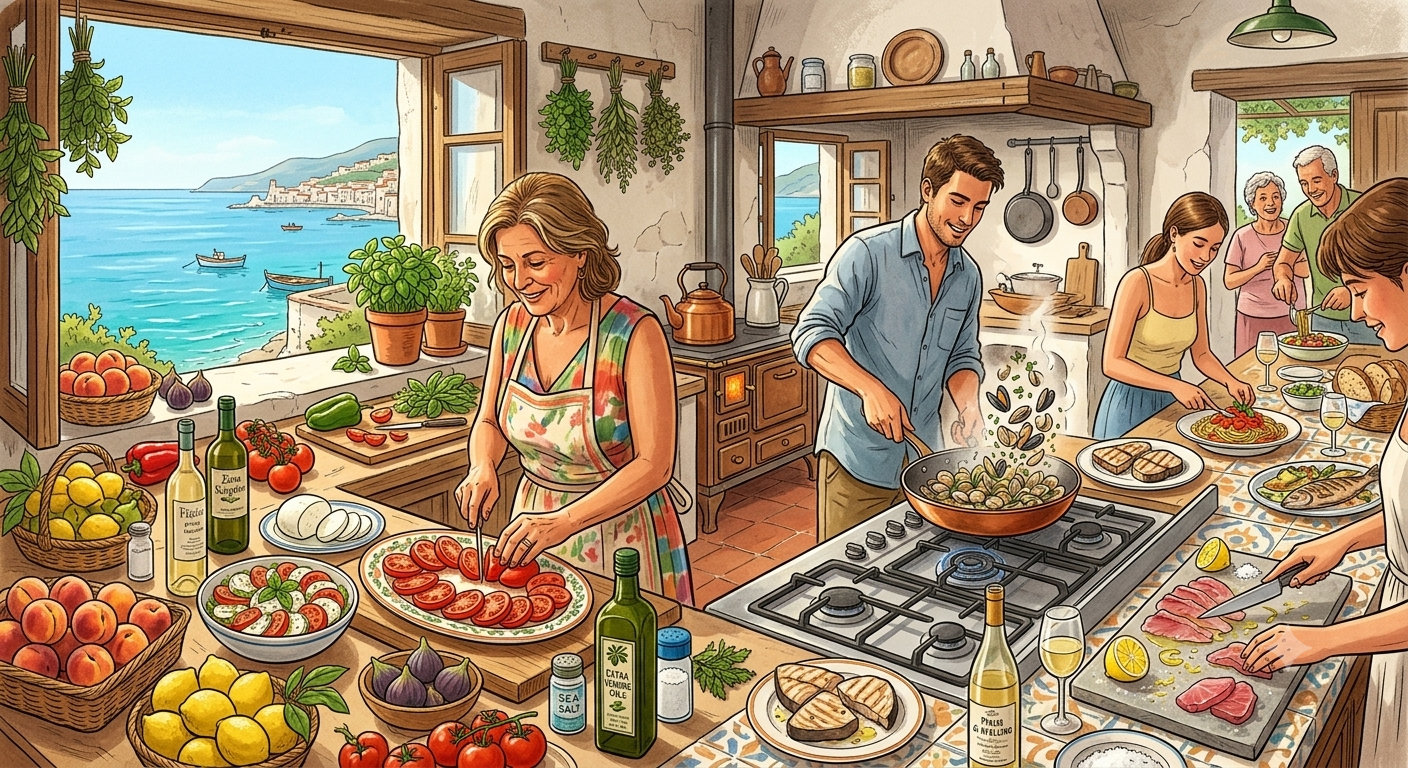
If autumn cooking in Italy retreats into the woods and winter braises simmer for hours on the stove, summer does the opposite entirely. The heat pushes cooks out of the kitchen and towards the coast, the market stall, and the herb pot on the windowsill. Dishes get lighter, faster, and more reliant on the quality of a handful of ingredients rather than the skill of transforming them. Three things define this shift more than any others: tomatoes at their peak, seafood pulled straight from the coast, and a growing reliance on techniques that require no cooking at all.
Tomatoes: Finally Worth Celebrating
Italian cooking treats tomatoes almost reverently in summer, and for good reason — a tomato grown and eaten in July tastes like an entirely different ingredient from the pale, watery version available the rest of the year. Sun-ripened tomatoes carry a natural sweetness and acidity that needs almost no help, which is precisely why summer’s best tomato dishes tend to involve the least cooking.
The technique here is really about restraint. A proper Caprese salad asks for nothing beyond good tomatoes, fresh mozzarella, basil, and olive oil, because at peak ripeness, the tomato genuinely doesn’t need anything else. Salting sliced tomatoes and letting them sit for ten to fifteen minutes draws out excess liquid and concentrates their flavour before dressing, a small step that makes a noticeable difference. Even when tomatoes are cooked, as in a quick summer sauce, the cooking time shrinks dramatically compared to a winter ragù — often just long enough to soften them and release their juices, preserving their brightness rather than reducing them down into something deep and jammy.
Seafood: A Coastline of Options
With over 7,500 kilometres of coastline, it is no surprise that Italian summer cooking leans heavily on seafood, particularly along the country’s southern regions and islands. Clams, mussels, anchovies, swordfish, and countless varieties of small, oily fish appear constantly on summer menus, prized for how little they need to shine.
The technique that matters most with seafood is speed and restraint. Clams and mussels need only a few minutes over high heat, just until their shells open, and any pause here toughens the meat inside. Fish is often grilled simply, brushed only with olive oil, and finished with lemon rather than a heavy sauce, letting the freshness of the catch speak for itself. Anchovies, often preserved in oil or salt, are used as a seasoning as much as an ingredient, dissolved into sauces to add a savoury backbone without ever tasting overtly fishy. Across the board, the guiding principle is to cook seafood as briefly as possible and season it as simply as possible.
Raw and No-Cook Techniques: Letting Ingredients Speak
Perhaps the clearest sign of summer’s arrival in an Italian kitchen is the shift towards dishes that require no stove at all. Crudo — Italy’s answer to sashimi, thin slices of raw fish dressed with olive oil, lemon, and salt — becomes common along the coast. Carpaccio, thinly sliced raw beef or fish, follows a similar logic. Even pasta gets a raw treatment in dishes like pasta al pomodoro crudo, where chopped raw tomatoes, garlic, and basil are tossed directly with hot pasta, wilting just slightly from the residual heat rather than being cooked in a pan.
The technique behind these dishes is less about active cooking and more about precision elsewhere: a sharp knife for clean slices, properly timed salting and dressing, and above all, genuinely excellent raw ingredients, since there is no cooking process left to disguise anything mediocre. This is where Italian cooking’s obsession with ingredient quality becomes most visible — in summer, the cook’s real skill lies in knowing when to leave something alone.
A Season of Fewer Steps, Higher Stakes
What ties tomatoes, seafood, and raw preparations together is a shared philosophy: summer cooking in Italy strips things back rather than building them up. There are fewer steps, shorter cooking times, and far less room to hide behind technique. The trade-off is that ingredient quality becomes non-negotiable — a dish with only three or four components has nowhere for a mediocre tomato or a not-quite-fresh clam to hide.
Spaghetti alle Vongole
Serves 4
Ingredients
- 1kg fresh clams, scrubbed and rinsed
- 350g spaghetti
- 4 tbsp olive oil, plus extra to finish
- 4 garlic cloves, thinly sliced
- ½ tsp chilli flakes
- 150ml dry white wine
- A handful of fresh parsley, chopped
- Salt, to taste
- Lemon wedges, to serve
Method
- Bring a large pot of well-salted water to the boil and cook the spaghetti until just shy of al dente.
- While the pasta cooks, heat the olive oil in a wide, deep pan over medium heat. Add the garlic and chilli flakes, and cook gently for 1 minute, without browning.
- Add the clams and white wine, raise the heat to high, and cover. Cook for 3–5 minutes, shaking the pan occasionally, until the clams open. Discard any that remain closed.
- Using tongs, transfer the drained spaghetti directly into the pan with the clams, along with a splash of pasta water.
- Toss everything together over high heat for 1–2 minutes, allowing the pasta to absorb the clam liquid.
- Stir in the parsley, drizzle with a little extra olive oil, and serve immediately with lemon wedges.