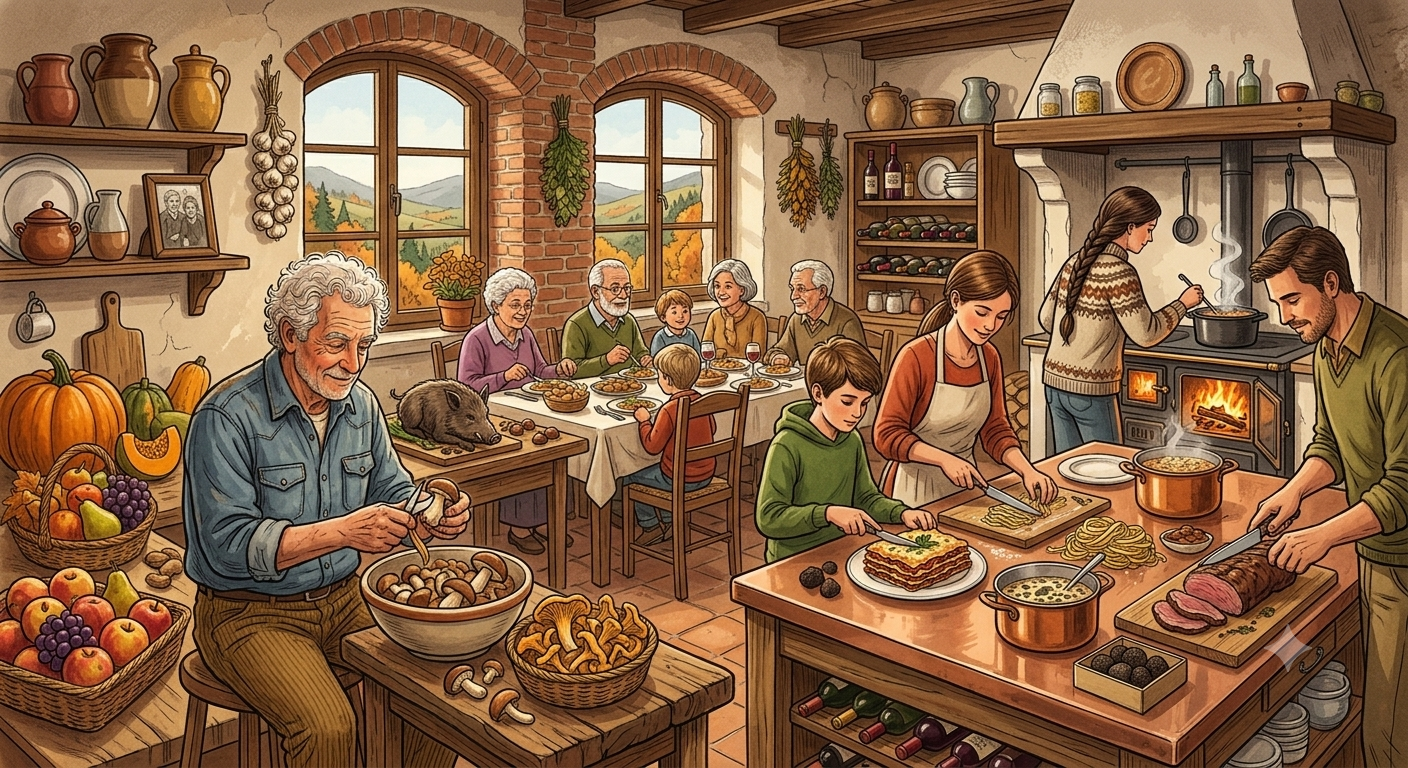
There is a particular smell that marks the start of autumn in Italy’s forested regions — damp earth, fallen leaves, and the faint, earthy sweetness of porcini pushing up through the undergrowth. Autumn is when Italian cooking turns inward, towards the woods and hills rather than the coast or the garden. Three ingredients define the season more than any others: wild mushrooms, chestnuts, and game. Together, they form a trio built on deep, earthy flavour and slow, deliberate cooking — a far cry from summer’s bright acidity and quick preparations.
Mushrooms: Hunted, Not Just Bought
Few ingredients carry as much reverence in Italian autumn cooking as the porcini mushroom. In regions like Piedmont, Tuscany, and Emilia-Romagna, mushroom foraging is practically a seasonal ritual, with dedicated hunters heading into the forest at dawn in search of prized specimens. Porcini, along with chanterelles and other wild varieties, bring a dense, meaty flavour that cultivated mushrooms rarely match.
The key technique with mushrooms is understanding moisture. Wild mushrooms hold a surprising amount of water, and cooking them in an overcrowded pan causes them to steam rather than brown, producing a rubbery texture instead of the deep, savoury caramelisation that makes them worthwhile. Cooking in batches over high heat, without stirring too frequently, allows real colour to develop. Dried porcini, rehydrated in warm water, offer an accessible alternative outside of fresh mushroom season — and the soaking liquid itself, strained of any grit, becomes a valuable ingredient, adding concentrated mushroom flavour to risottos, sauces, and braises.
Chestnuts: Autumn’s Natural Sweetness
Chestnuts occupy a unique place in Italian cooking, straddling the line between a starchy vegetable and a subtly sweet ingredient. Historically, in mountainous regions like Tuscany and Liguria where wheat was scarce, chestnut flour served as a genuine dietary staple, ground down and used in place of grain for polenta, pasta, and bread. Today, whole roasted chestnuts remain a beloved street food and seasonal treat, while chestnut flour and purée continue to appear in both savoury and sweet autumn dishes.
Working with fresh chestnuts requires a bit of technique. Scoring an X into the flat side of the shell before roasting prevents them from bursting under pressure, and roasting at a high heat allows steam to build inside, making the shell far easier to peel while still warm. Chestnuts pair naturally with rich, savoury dishes — their gentle sweetness balances fatty meats, brown butter sauces, and the earthiness of mushrooms, making them a natural bridge between the season’s other defining ingredients.
Game: Rich, Lean, and Built for Slow Cooking
Wild boar, venison, pheasant, and hare all find their way onto Italian tables as the weather cools, particularly across Tuscany and Umbria, where hunting traditions run deep. Game meat tends to be leaner and more assertively flavoured than farmed meat, and it demands a different approach in the kitchen.
Because game lacks the marbled fat of farmed meat, it dries out easily under high, quick heat. Slow, moist cooking methods — braising, stewing, and long-simmered ragùs — suit it best, allowing the meat to tenderise gradually while its stronger flavour mellows and rounds out. Marinating game overnight in wine, juniper berries, and aromatics before cooking is a traditional step that both tenderises the meat and tempers its more pronounced, sometimes slightly gamey character. Wild boar ragù, simmered for hours with tomato, red wine, and warming spices, remains one of the most iconic autumn dishes across central Italy, traditionally served over wide pappardelle noodles built to catch its rich sauce.
Where the Three Meet
Mushrooms, chestnuts, and game are rarely confined to separate dishes in Italian autumn cooking — they overlap constantly. A venison braise might be finished with roasted chestnuts. A wild boar ragù might include a handful of rehydrated porcini for extra depth. A pheasant might be roasted alongside chestnuts and mushrooms in the same pan, their flavours mingling in the drippings. This overlap is precisely what makes autumn cooking in Italy feel so cohesive: three ingredients, each earthy and rich in their own way, built to work together rather than compete.
Braised Venison with Chestnuts and Porcini
Serves 4
Ingredients
- 15g dried porcini mushrooms
- 200ml warm water
- 800g venison shoulder, cut into large chunks
- 2 tbsp olive oil
- 1 onion, diced
- 2 carrots, diced
- 2 celery stalks, diced
- 3 garlic cloves, minced
- 250ml red wine
- 300ml beef or venison stock
- 2 bay leaves
- 4 juniper berries, crushed
- 150g cooked, peeled chestnuts, roughly chopped
- Salt and freshly ground black pepper
Method
- Soak the dried porcini in warm water for 20 minutes. Drain, reserving the liquid, and roughly chop the mushrooms.
- Season the venison generously. Heat the olive oil in a heavy-based pot over high heat and brown the meat in batches, setting aside once coloured.
- Lower the heat, add the onion, carrots, and celery, and cook for 8–10 minutes until softened. Add the garlic and cook for 1 minute more.
- Return the venison to the pot. Pour in the red wine and let it reduce for a few minutes, scraping up any browned bits.
- Add the stock, reserved porcini liquid (leaving any grit behind), chopped porcini, bay leaves, and juniper berries.
- Cover and simmer gently, on the stovetop or in a 150°C oven, for 2 to 2½ hours, until the venison is tender.
- Stir in the chestnuts for the final 20 minutes of cooking, allowing them to warm through and soften slightly.
- Season to taste and serve with soft polenta or mashed potato.