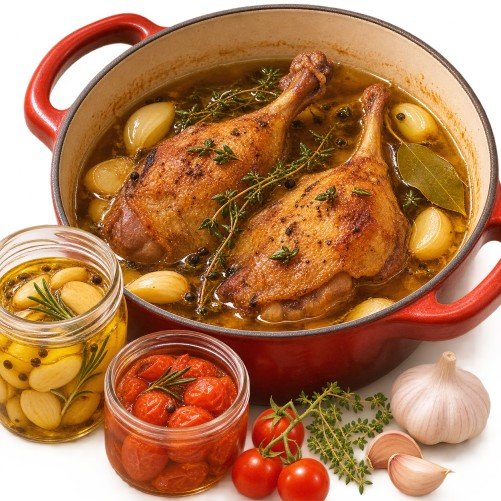
What if the secret to incredibly tender food was cooking it in fat without ever letting it fry?
The first time you hear about confit cooking, it sounds a little excessive. Submerging garlic in olive oil? Cooking duck legs in their own fat for hours? Surely there must be an easier way to make something tender.
But then you taste a clove of garlic that’s been slowly cooked in oil. Instead of the sharp, pungent flavour of raw garlic, it’s soft, mellow, and almost buttery. You can spread it over warm bread with the back of a spoon. It’s the same ingredient, but the transformation is remarkable.
That’s what makes confit so interesting. It’s a cooking technique built around patience, gentle heat, and the surprising things that happen when ingredients spend a long time surrounded by warm fat.
What Does Confit Actually Mean?
The word confit comes from the French verb confire, meaning to preserve. Traditionally, confit was a method of preserving food, particularly meat, by slowly cooking it in fat and storing it under a protective layer of that fat.
Duck confit, or confit de canard, is probably the most famous example. Duck legs are seasoned, often cured with salt, and gently cooked in duck fat until the meat becomes exceptionally tender.
Today, confit is also used as a cooking technique rather than strictly a preservation method. Chefs prepare confit garlic, tomatoes, potatoes, and even certain types of fish using gently heated oil or fat.
The defining feature is temperature. Unlike deep-frying, which typically uses oil around 160–190°C, confit cooking often takes place at much lower temperatures, commonly around 80–120°C, depending on the ingredient and recipe.
Why Doesn’t the Food Become Crispy?
This is probably the most interesting part of confit cooking. You can surround an ingredient with oil for hours and still end up with something soft rather than crunchy.
The difference comes down to heat.
When you deep-fry food, the high temperature rapidly evaporates moisture from the surface, encouraging the development of a crisp exterior. In confit cooking, the fat is kept much cooler, so the food cooks gently without the aggressive bubbling and dehydration associated with frying.
Think about garlic. Drop a clove into very hot oil, and it quickly browns, potentially becoming bitter. Cook the same clove slowly in warm olive oil, and it gradually softens while developing a sweeter, more rounded flavour.
The oil also carries flavours from herbs, spices, and other aromatics, making the finished dish especially fragrant.
The Secret Is Keeping the Temperature Low
One mistake that’s easy to make is treating confit like ordinary frying. You heat the oil, see a few bubbles, and assume everything is going according to plan. But if the fat becomes too hot, delicate ingredients can brown before they’ve had time to soften.
For many confit recipes, the goal is gentle, controlled heat. You might notice occasional small bubbles as moisture escapes from the ingredients, but the oil shouldn’t be vigorously bubbling like a deep fryer.
A cooking thermometer is particularly useful because oil doesn’t behave like boiling water. You can’t reliably judge its temperature simply by looking at the surface.
An oven can also make temperature control easier. A heavy, oven-safe dish helps distribute heat, while a carefully selected low oven setting allows the food to cook gradually. Remember that the oven temperature and the actual temperature of the oil aren’t necessarily identical.
The ideal temperature depends on what you’re preparing, so use a tested recipe rather than assuming one setting works for everything.
Duck Confit: The Classic Example
Traditional duck confit is a beautiful example of how gentle cooking transforms tougher meat.
Duck legs contain connective tissue that benefits from slow cooking. They’re usually seasoned with salt and aromatics, refrigerated for a curing period, then gently cooked while submerged in rendered duck fat.
Over several hours, the meat becomes tender enough to pull away from the bone with little effort. The fat helps transfer heat evenly, while the long cooking time softens connective tissue.
Once cooked, duck confit is often finished in a hot pan or oven to crisp the skin. This creates a wonderful contrast between the crunchy exterior and the soft meat underneath.
Although traditional confit was developed as a preservation technique, homemade duck confit should not be assumed shelf-stable. Safe storage requires appropriate refrigeration or freezing, and cooking times and temperatures should follow a reliable, food-safe recipe.
Garlic Confit: Small Ingredient, Big Transformation
Garlic confit has become popular because it turns an everyday ingredient into something wonderfully versatile.
Whole peeled garlic cloves are placed in a small oven-safe dish and covered with olive oil. Herbs such as thyme or rosemary can be added for extra flavour. The garlic is then cooked gently until the cloves become completely soft.
The finished garlic can be mashed into potatoes, spread over toast, stirred into sauces, or mixed with butter.
But there’s an important food-safety detail that shouldn’t be overlooked. Garlic stored in oil can create conditions suitable for the growth of Clostridium botulinum, the bacterium responsible for botulism. Slow cooking in oil does not automatically make the mixture safe for storage.
For homemade garlic confit, use a tested preparation method, refrigerate promptly, and follow conservative storage guidance. A practical recommendation is to use refrigerated homemade garlic-in-oil preparations within four days or freeze them for longer storage. Never leave homemade garlic confit at room temperature for storage.
Can You Confit Vegetables?
Absolutely, and some vegetables respond beautifully to this technique.
Cherry tomatoes are a particularly good example. When cooked gently in olive oil with garlic and herbs, they soften, become more concentrated in flavour, and release some of their juices into the surrounding oil. They’re lovely spooned over pasta, toast, or grilled vegetables.
Potatoes can also be cooked slowly in fat until tender. Unlike roasted potatoes, which develop a crisp exterior during cooking, confit potatoes initially become soft and rich. They can then be browned separately if you want a golden crust.
The same idea works with onions and certain other vegetables. The important thing is choosing ingredients that benefit from gentle cooking and understanding that different vegetables release different amounts of moisture.
As with garlic, vegetables stored under oil are not automatically preserved. Refrigerate promptly and follow safe storage guidance.
Is Confit Cooking the Same as Deep-Frying?
Although both techniques use fat as a cooking medium, the results are quite different.
Deep-frying relies on high temperatures to cook food quickly and develop a crisp surface. Confit uses much gentler heat over a longer period, usually producing a soft, tender texture.
The amount of fat can look similar, but the cooking process isn’t.
A potato cooked in hot frying oil becomes a French fry. A potato gently cooked in fat can become tender and creamy, ready to be crisped later in a pan or oven.
Neither method is inherently better. They simply produce different textures and flavours.
Common Confit Cooking Mistakes
The biggest mistake is using too much heat. If garlic is turning dark brown or delicate vegetables are frying aggressively, the temperature is probably too high for the result you’re trying to achieve.
Another mistake is assuming that confit always requires enormous amounts of expensive oil. A small, narrow cooking vessel can reduce the amount of fat needed to cover the ingredients.
It’s also important not to confuse tenderness with food safety. Meat must be cooked using a validated time-temperature combination, and low-temperature cooking requires particular care.
Finally, don’t treat the layer of fat as a guarantee of preservation. Homemade confit can still support harmful microbial growth if it’s stored incorrectly. Cool and refrigerate food promptly, and don’t rely on traditional storage methods without proper food-safety controls.
Why Confit Is Worth Understanding
There’s something almost surprising about the results of confit cooking. You begin with ingredients that are completely familiar, surround them with gently heated fat, and give them time. What emerges can taste and feel remarkably different.
Garlic becomes soft and mellow. Tomatoes turn tender and intensely savoury. Duck legs develop that wonderful texture that makes the meat fall away from the bone.
What I like most about confit is that it teaches a lesson that applies to so many cooking techniques: more heat doesn’t always mean better cooking.
Sometimes, lowering the temperature and allowing the ingredients to change gradually produces something far more interesting.
And once you’ve tasted a warm clove of properly prepared garlic confit spread over a piece of toasted bread, you’ll understand why cooks have been fascinated by this technique for centuries.