
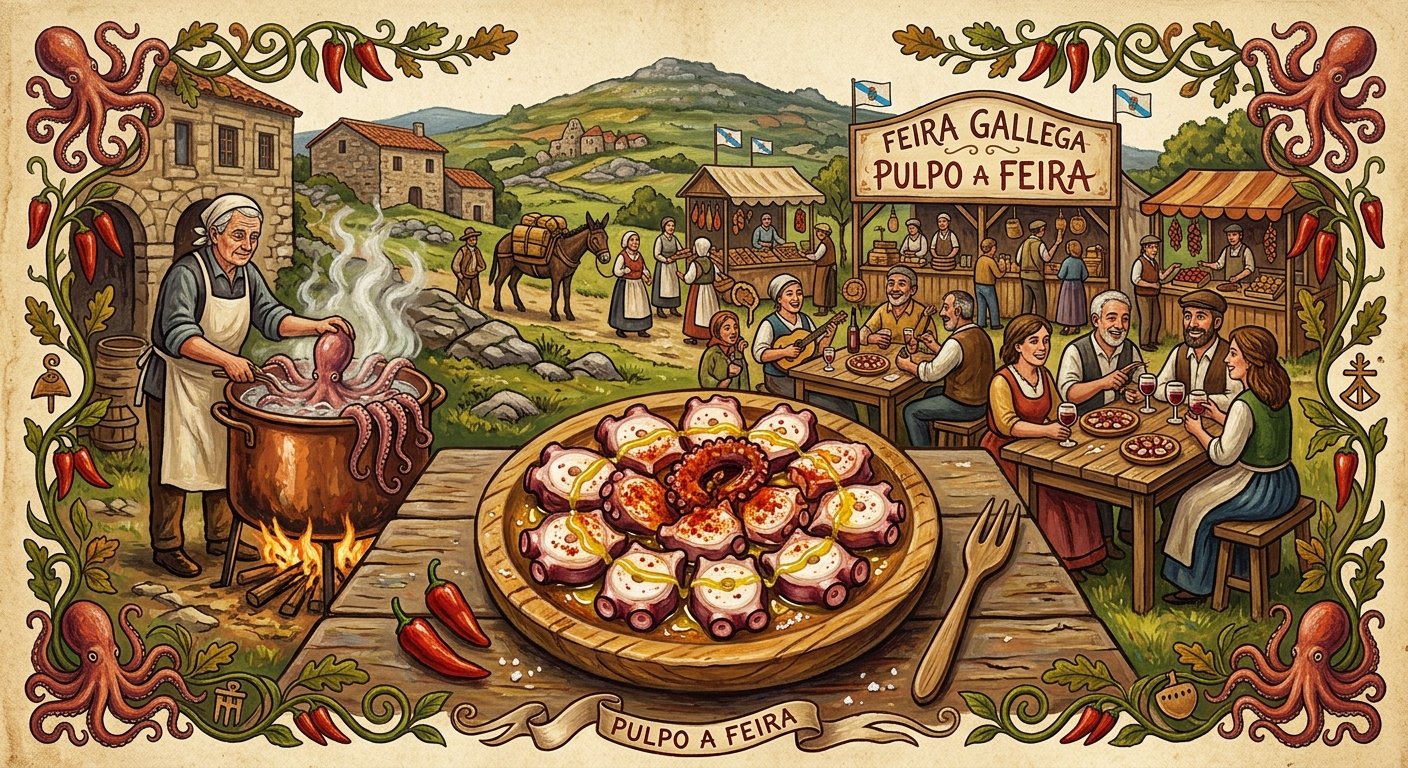
Pulpo a Feira is one of Galicia’s most recognizable dishes, made with tender boiled octopus, olive oil, coarse salt, and paprika. There is no complicated sauce and little decoration. Instead, the dish depends on careful cooking and a handful of good ingredients. Traditionally served on wooden plates and eaten at fairs and festivals, this humble octopus preparation has become a symbol of Galician food culture.
Its name gives away part of the story. Feira means “fair” in Galician, so Pulpo a Feira can be understood as fair-style octopus or fairground octopus. To understand why octopus became associated with inland fairs, however, we need to look beyond Galicia’s famous coastline.
What Is Pulpo a Feira?
Pulpo a Feira, also written pulpo á feira in Galician, is a traditional dish of boiled octopus cut into bite-sized pieces and seasoned simply.
After cooking the octopus until tender, cooks traditionally cut the tentacles into pieces with scissors. They then arrange them on a round wooden plate and season them with coarse salt, paprika, and a generous drizzle of olive oil.
The paprika may be sweet, spicy, or a mixture of both.
As a result, the finished dish offers several clear flavors rather than hiding the octopus beneath a heavy sauce. The seafood brings a mild ocean character, while olive oil adds richness. Meanwhile, paprika contributes warmth and earthy depth, and coarse salt provides occasional bursts of salinity.
Its simplicity means there is nowhere for poor ingredients or bad technique to hide.
Why Is Pulpo a Feira Called Fairground Octopus?
The name Pulpo a Feira comes from its close connection with traditional Galician fairs.
Historically, fairs were important social and commercial events. People gathered to trade livestock and goods, meet neighbors, conduct business, and, naturally, eat.
Food vendors became an essential part of these gatherings.
Among them were specialist octopus cooks, traditionally known as pulpeiras. They prepared large quantities of octopus in big copper pots and served portions to fairgoers.
Consequently, octopus became closely linked with the experience of attending a Galician fair.
The tradition proved so enduring that the place of consumption eventually became part of the dish’s identity.
The Surprising Inland History of Galician Octopus
Galicia has an extensive Atlantic coastline, so it seems natural to assume that Galician octopus began as a coastal specialty.
However, the history is more interesting.
Pulpo a Feira became particularly important in inland Galicia, including areas of Ourense and Lugo. Historically, preserving seafood allowed products from the coast to travel farther inland.
Octopus could be dried, making transportation and storage easier before refrigeration.
Trade networks then carried it toward inland communities, fairs, monasteries, and markets. As a result, people far from the fishing ports developed their own strong traditions around octopus.
Therefore, Pulpo a Feira demonstrates how preservation and trade can shape regional cuisine just as strongly as geography.
Who Are the Pulpeiras?
You cannot tell the story of Pulpo a Feira without mentioning the pulpeiras.
Traditionally, these specialist cooks prepared octopus at fairs, markets, and festivals. Their work required experience because achieving tender octopus consistently—especially in large quantities—depends on timing and judgment.
Large copper pots became closely associated with the profession.
Once the octopus reached the desired tenderness, pulpeiras lifted it from the cooking water, cut the tentacles quickly with scissors, and arranged the pieces on wooden plates.
Next came salt, paprika, and olive oil.
The process looks remarkably simple. Nevertheless, experienced pulpeiras can judge texture and portion the octopus rapidly while serving crowds of customers.
Their knowledge helped transform a basic preparation into a recognizable Galician culinary tradition.
Why Pulpo a Feira Uses Paprika
Paprika, or pimentón, gives Pulpo a Feira much of its visual and aromatic character.
Without it, the dish would consist mainly of pale octopus, oil, and salt. A dusting of red paprika immediately changes both its appearance and flavor.
Sweet paprika contributes earthy warmth without significant heat. Hot paprika, meanwhile, gives the octopus a chilli kick.
Many preparations combine the two.
Paprika also works especially well with olive oil because its aromatic compounds spread through the fat, helping the seasoning coat the pieces of octopus.
Therefore, paprika does more than add color. It forms an essential part of the dish’s flavor structure.
Traditional Pulpo a Feira Recipe
A classic Pulpo a Feira recipe uses very few ingredients. Consequently, cooking the octopus correctly becomes the most important part.
Ingredients
- 1 whole cleaned octopus, about 1.5–2 kg
- Coarse sea salt
- Sweet Spanish paprika
- Hot Spanish paprika, optional
- Extra virgin olive oil
- Water for cooking
How to Prepare Pulpo a Feira
1. Prepare the Octopus
Traditionally, cooks needed to tenderize fresh octopus before boiling it. Freezing and thawing can also help break down its muscular structure, which makes modern preparation easier.
If using frozen octopus, thaw it completely in the refrigerator before cooking.
2. Bring the Water to a Boil
Fill a large pot with water and bring it to a strong boil.
Traditionally, cooks often use large copper pots. However, a normal large cooking pot works for home preparation.
3. Dip the Octopus
Holding the octopus by the head, dip the tentacles into the boiling water and lift them out again. Repeat this a few times before lowering the entire octopus into the pot.
This traditional technique causes the tentacles to curl attractively.
4. Cook Until Tender
Allow the octopus to cook at a steady simmer until tender.
Cooking time varies according to size, so texture provides a better guide than the clock alone. A knife or skewer should enter the thickest part of a tentacle with relatively little resistance.
After cooking, allow the octopus to rest briefly.
5. Cut and Season
Cut the tentacles into bite-sized rounds, traditionally using kitchen scissors.
Arrange them in a single layer on a plate.
Next, sprinkle with coarse salt and paprika. Finally, drizzle generously with extra virgin olive oil.
Serve while warm.
Why Pulpo a Feira Comes on a Wooden Plate
One of the most recognizable features of Pulpo a Feira is its traditional wooden serving plate.
These round plates, often called platos de madera, became closely associated with pulpeiras and fairground service.
Wood created a practical surface for serving quickly in busy outdoor environments. Moreover, the rustic presentation became part of the experience.
The warm octopus sits directly on the plate before cooks add paprika, salt, and olive oil.
Over time, this presentation became so closely linked with the dish that many restaurants continue to use wooden plates today.
Therefore, the plate is not simply decoration. It connects modern servings with the dish’s fairground heritage.
Pulpo a Feira vs. Pulpo a la Gallega
People often use Pulpo a Feira and pulpo a la gallega interchangeably, although the terminology can vary depending on context.
Both generally refer to Galician-style octopus seasoned with olive oil, salt, and paprika.
However, some modern presentations of pulpo a la gallega include boiled potatoes, while the classic fair-style serving may focus primarily on octopus itself.
Potatoes certainly make a natural companion. Their mild starchiness absorbs the paprika-colored olive oil and balances the octopus.
Nevertheless, understanding the fairground tradition helps explain why the simplest Pulpo a Feira presentation remains so important.
Pulpo a Feira in Galician Food Culture
Pulpo a Feira is more than a seafood recipe. It represents a social way of eating.
Fairs brought communities together for commerce, conversation, entertainment, and food. Therefore, eating octopus became connected with gatherings rather than formal dining.
Even today, octopus plays a prominent role at festivals and celebrations throughout Galicia.
People commonly enjoy it with bread and local wine. Meanwhile, shared wooden plates encourage diners to eat together rather than treating the dish as an individual restaurant course.
This communal character helps explain why Pulpo a Feira remains emotionally connected with Galician identity.
What Makes Good Galician Octopus?
Excellent Galician octopus depends primarily on texture.
Undercooked octopus can feel unpleasantly tough. However, excessive cooking can leave it too soft and remove some of its satisfying bite.
Ideally, the pieces should feel tender while retaining enough structure to remain pleasantly substantial.
Seasoning also requires restraint.
Too much paprika can overwhelm the seafood, while insufficient salt can make the dish taste flat. Likewise, good olive oil should enrich the octopus rather than drown it.
The best versions achieve balance with very few ingredients.
Why Pulpo a Feira Remains a Galician Icon
Pulpo a Feira shows how geography, trade, preservation, and social traditions can come together on a single plate.
Octopus came from Galicia’s Atlantic waters, yet inland fairs helped turn it into a regional icon. Pulpeiras developed specialist skills for preparing it in large copper pots, while paprika, salt, and olive oil created the unmistakable finishing flavors.
Furthermore, the traditional wooden plate preserved a visual connection with the fairs where generations gathered to eat it.
Today, the recipe remains remarkably uncomplicated.
Octopus. Olive oil. Paprika. Salt.
Yet behind those four ingredients lies a story of coastal fishing, inland trade, preservation, skilled cooks, fairs, and community life.
That is what makes Pulpo a Feira much more than boiled octopus. It is a dish that captures a piece of Galicia’s history—and still brings people together around the same simple wooden plate.


