
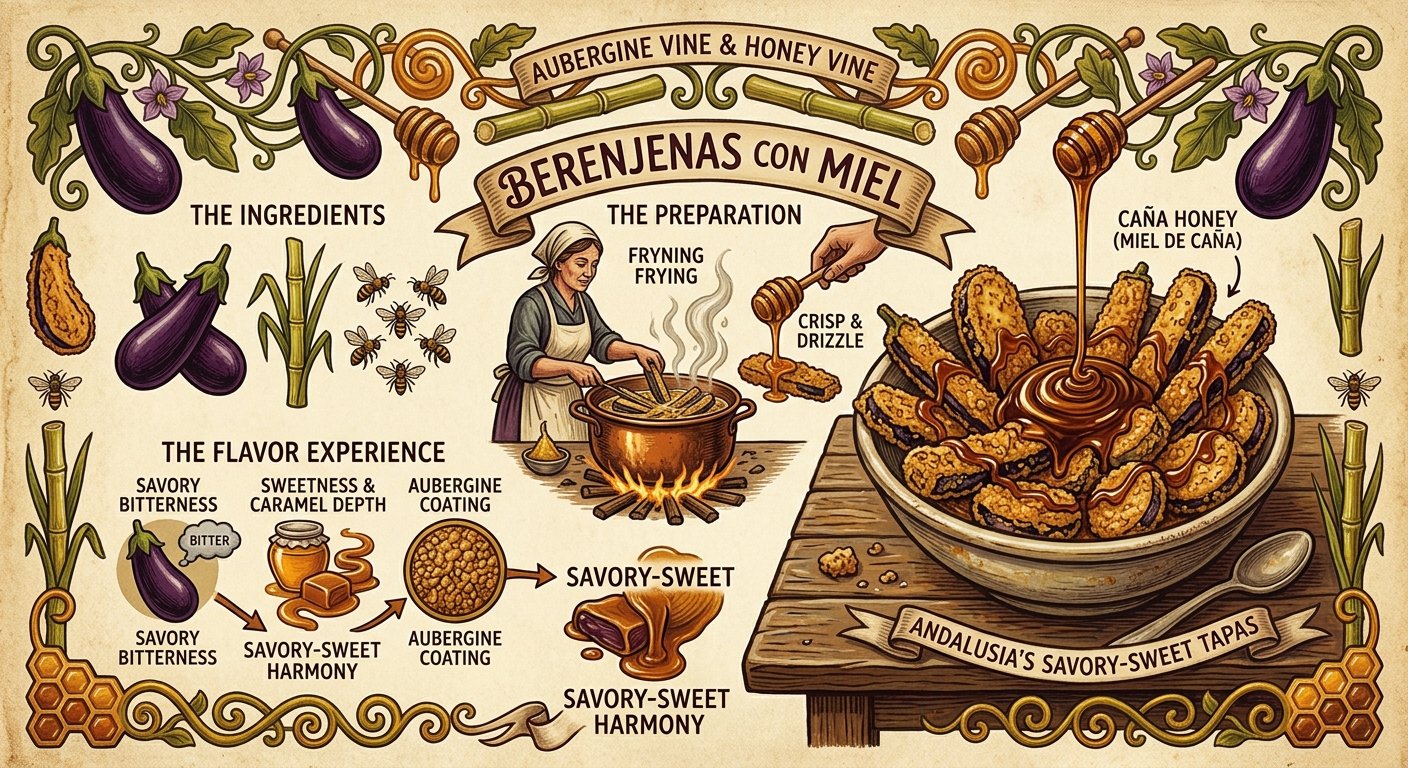
Berenjenas con Miel is one of Andalusia’s most surprising tapas: crisp pieces of fried aubergine finished with a dark, sweet drizzle of cane honey. At first, aubergine and syrup may sound like an unusual partnership. However, one bite explains why it works. The delicate bitterness of aubergine meets a crisp fried coating, while the syrup brings sweetness and a rich caramel-like depth. As a result, the dish moves effortlessly between savory and sweet.
Popular especially in southern Spain, Berenjenas con Miel also opens a window into Andalusia’s agricultural history. Its two main characters—aubergine and sugar cane—tell a much bigger story about cultural exchange, farming, and the lasting influence of Al-Andalus on Spanish food.
What Are Berenjenas con Miel?
Berenjenas con Miel literally translates as “aubergines with honey.” However, the name can cause some confusion.
In many traditional Andalusian versions, the topping is not ordinary bee honey. Instead, cooks use miel de caña, a dark sugar-cane syrup with a flavor somewhat similar to molasses.
The aubergine is usually sliced into thin rounds or cut into sticks. Next, cooks coat the pieces lightly in flour and fry them until golden and crisp.
Finally, they drizzle the hot aubergine with miel de caña.
This combination creates several contrasts at once: crisp and soft, savory and sweet, mild and intense. That contrast forms the heart of the dish.
The Andalusian History of Berenjenas con Miel
The history of Berenjenas con Miel connects closely with Andalusia and the agricultural changes that transformed medieval Iberia.
Aubergines originated in Asia and gradually traveled west through trade and migration. Eventually, they became established throughout parts of the Mediterranean world and gained an important place in the cooking traditions of Al-Andalus, the Muslim-ruled territories of medieval Iberia.
Sugar cane also followed a remarkable journey.
Cultivators grew it across warm regions before sugar-cane agriculture expanded into parts of southern Iberia. The subtropical coastal areas around Granada and Málaga offered suitable conditions for its cultivation.
Therefore, the pairing of aubergine with cane syrup represents more than a clever tapas combination. It brings together ingredients shaped by centuries of agricultural movement and cultural exchange.
Why Berenjenas con Miel Uses Miel de Caña
One of the most important things to understand about fried aubergine with cane honey is the meaning of miel de caña.
Despite its name, it is not honey produced by bees.
The Spanish phrase means “cane honey.” Producers create it by concentrating sugar-cane juice into a thick, dark syrup.
Its flavor differs noticeably from ordinary honey.
While floral honey can taste light and aromatic, cane honey has a darker personality. It offers caramelized, slightly bitter, almost molasses-like notes.
Consequently, it works particularly well with fried aubergine.
The syrup adds sweetness, but its deep flavor prevents the dish from tasting like dessert. Instead, it complements the aubergine’s gentle bitterness and savory fried coating.
Why Fried Aubergine with Cane Honey Works
Berenjenas con Miel provides an excellent lesson in balancing contrasting flavors.
Aubergine itself has a relatively subtle taste. However, frying transforms its texture dramatically.
The exterior becomes golden and crisp, while the inside turns soft and almost creamy. Meanwhile, the flour coating adds another delicate layer of crunch.
Then comes the miel de caña.
Its sweetness contrasts with the savory fried exterior. At the same time, its slightly bitter, caramelized character complements the natural flavor of the aubergine.
Furthermore, the sticky syrup creates an interesting contrast with the crisp coating.
Therefore, the pleasure of this Spanish fried eggplant dish does not come from sweetness alone. Instead, it develops through the interaction of sweetness, bitterness, salt, fat, and texture.
Preparing Aubergine for Berenjenas con Miel
Traditional recipes often recommend salting aubergine before frying.
First, salt draws some moisture toward the surface. After resting, cooks can pat the slices dry before coating them with flour.
Historically, salting also helped reduce bitterness in certain aubergine varieties. Modern aubergines tend to taste less bitter, so this step is not always essential for flavor.
Nevertheless, many cooks continue the practice because it can help prepare the surface for frying.
The key is to dry the aubergine thoroughly afterward. Excess moisture can interfere with crispness and may also cause hot oil to splatter.
Traditional Berenjenas con Miel Recipe
A traditional Berenjenas con Miel recipe requires surprisingly few ingredients. Therefore, good technique matters much more than complexity.
Ingredients for Fried Aubergine with Cane Honey
- 1 large aubergine
- 100 g plain flour
- Salt, to taste
- Olive oil or another suitable frying oil
- 2–3 tablespoons miel de caña
- Cold water or milk for soaking, optional
How to Make Berenjenas con Miel
1. Cut the Aubergine
First, wash the aubergine and remove the stem.
Cut it into thin rounds or finger-sized sticks. Try to keep the pieces similar in size so they cook evenly.
2. Salt and Rest the Aubergine
Place the pieces in a colander and sprinkle them lightly with salt.
Allow them to rest for around 20–30 minutes. Alternatively, some Spanish recipes soak the aubergine in milk or lightly salted water.
Afterward, drain and dry the pieces thoroughly.
3. Coat the Aubergine with Flour
Place the flour in a shallow dish.
Next, lightly coat each aubergine piece and shake away the excess flour. A thin coating works better than a heavy layer because the goal is to create a delicate, crisp exterior.
4. Fry Until Golden and Crisp
Heat enough oil for frying in a deep pan.
Once hot, add the aubergine in small batches. Avoid overcrowding the pan because doing so lowers the oil temperature and can produce greasy results.
Fry until the pieces become crisp and golden.
Then remove them and allow excess oil to drain.
5. Finish Berenjenas con Miel with Cane Honey
Arrange the fried aubergine on a serving plate.
Finally, drizzle miel de caña over the top immediately before serving.
Adding the syrup at the last moment helps preserve the crisp texture.
How to Make Berenjenas con Miel Crispy
Getting the right texture is essential when preparing Berenjenas con Miel.
Aubergine can absorb plenty of oil because of its porous structure. Therefore, poor frying technique can quickly turn the dish heavy and greasy.
Temperature makes a major difference.
If the oil is not hot enough, the aubergine absorbs excessive fat before the exterior becomes crisp. However, excessively hot oil can brown the coating before the center becomes tender.
Cooking in small batches helps maintain a more stable temperature.
Moreover, a light flour coating creates a delicate barrier around the aubergine and develops the crisp crust that makes this dish so enjoyable.
Finally, serve it quickly. Fried aubergine gradually loses its crunch, especially after you add the cane syrup.
Berenjenas con Miel in Andalusian Tapas Culture
Berenjenas con Miel feels particularly at home in Andalusia, where tapas culture encourages diners to experience contrasting dishes during one meal.
A plate of sweet-savory aubergine can sit alongside olives, fried fish, jamón, croquetas, cheeses, or seafood.
Furthermore, its unusual sweetness provides a welcome contrast to salty and savory tapas.
After several intensely savory dishes, the gentle sweetness of cane syrup changes the direction of the meal. However, the fried aubergine keeps the dish firmly connected to the savory side of the table.
Its uncomplicated presentation also reflects an important characteristic of traditional tapas: excellent ingredients do not always need elaborate decoration.
Berenjenas con Miel: Cane Honey or Bee Honey?
If you want the characteristic Andalusian flavor of Berenjenas con Miel, miel de caña is the better choice.
Ordinary bee honey can certainly taste pleasant with fried aubergine. However, it creates a noticeably different result.
Cane honey tastes darker, less floral, and more reminiscent of molasses or deeply caramelized sugar. Consequently, it balances the aubergine without pushing the dish too far toward dessert.
If miel de caña is unavailable, a dark, robust honey can work as an alternative. Nevertheless, the flavor will not completely reproduce the traditional combination.
Understanding this distinction matters because the word miel can easily lead cooks to assume that ordinary honey is always the traditional ingredient.
Why Berenjenas con Miel Matters in Spanish Cuisine
Berenjenas con Miel shows how a simple plate can carry a surprisingly complex culinary story.
Aubergine traveled west from Asia and eventually became deeply connected with Mediterranean and Andalusian cooking. Meanwhile, sugar-cane cultivation left its own historical mark on southern Spain.
Over time, these two ingredients found harmony on the same plate.
Today, fried aubergine with cane honey remains wonderfully straightforward: aubergine, flour, oil, salt, and a drizzle of dark cane syrup.
Yet every bite delivers several contrasts—crisp against creamy, savory against sweet, and delicate aubergine against intense cane honey.
More importantly, Berenjenas con Miel demonstrates an enduring lesson from Andalusian cooking. Complexity does not always require a long ingredient list. Sometimes, two contrasting flavors are enough to create a dish that generations continue to remember.


