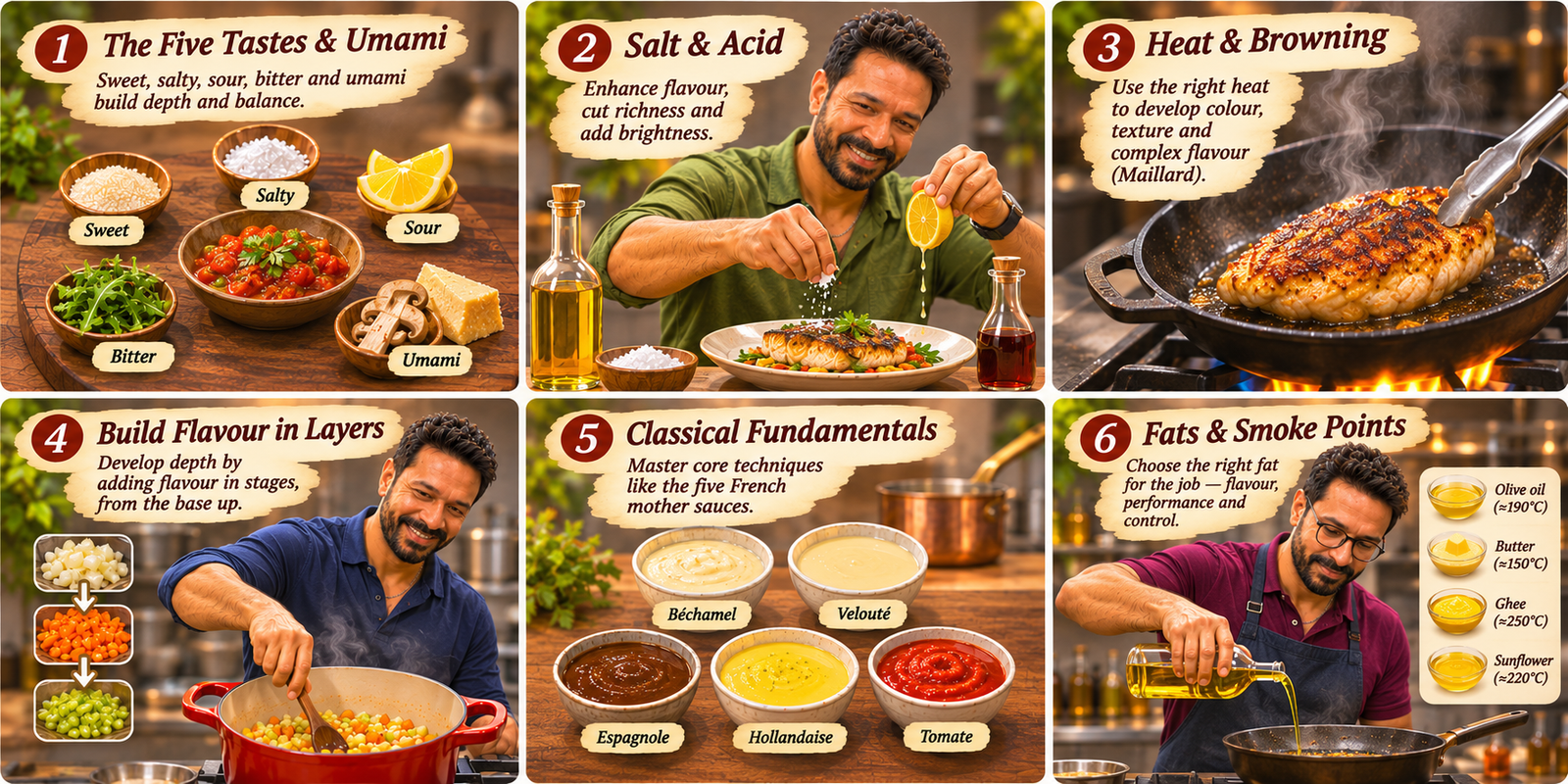
There’s a line every finance person knows: you don’t really understand a business until you understand the drivers — the handful of forces underneath all the numbers that explain why everything moves the way it does. I spent fifteen years hunting for drivers in spreadsheets. What took me embarrassingly long to realise, once I started cooking seriously, is that food has drivers too. Behind every dish I’d ever loved — the pintxo in San Sebastián, the plate in a three-star dining room, the bowl of noodles from a Bangkok cart — sat the same small set of principles, quietly doing the work. Salt. Fat. Acid. Heat. Browning. Balance. The recipes were just surface. These were the drivers. And the day I stopped collecting recipes and started studying these, cooking stopped being something I did by instruction and became something I understood from the inside.
This is the pillar that separates people who follow recipes from people who cook. It’s the why underneath everything else in this whole guide — the principles that let you walk up to any dish, in any cuisine, and know what it needs. You don’t memorise these the way you memorise a recipe. You absorb them until they become instinct, and then you never cook the same way again.
The Grammar of Flavour
Every cuisine is a language, and these are its grammar. Understanding Umami and the Five Tastes is where I’d start, because once you can name what you’re tasting — sweet, salty, sour, bitter, and that savoury fifth — you can diagnose any dish that falls flat. From there, Balancing Sweet, Salty, Sour, Bitter is the single most useful idea in cooking: almost every ‘something’s missing’ moment is really an imbalance, and the fix is usually acid or salt. That flows straight into How to Pair Flavours That Work, understanding why certain combinations sing and others clash — knowledge that turns guesswork into judgement.
The Two Forces That Season Everything: Salt and Acid
If I could give a beginner only two ideas, it would be these. How Salt Works in Cooking explained why my early food was flat despite following recipes exactly — salt isn’t a flavour so much as a volume knob for every other flavour, and most home cooks drastically underuse it. Its partner is How Acids Brighten a Dish: that squeeze of lemon, splash of vinegar, or spoon of yoghurt that makes a rich dish suddenly feel alive. Pull them together with How to Season Food Properly — seasoning in layers, throughout the cook, not as a panicked correction at the end — and your cooking will leap forward overnight. It did for me.
The Magic of Heat and Browning
So much of what we call ‘delicious’ is really just chemistry we can taste. The Maillard Reaction Explained is the big one — the browning that gives seared steak, roasted coffee, and toasted bread their deep savoury complexity — and The Science of Browning shows how to chase it and, just as importantly, when to avoid it. Heat does more than brown, though: How Temperature Changes Texture is why the same egg can be silky or rubbery, and How Resting and Carryover Cooking Work is the quietly crucial idea that food keeps cooking after it leaves the heat — the knowledge that stops you overcooking a beautiful piece of meat.
Building Flavour from the Ground Up
Great dishes are constructed, not assembled, and these are the techniques of construction. How to Build Layers of Flavour is the architect’s view — flavour added in stages, each building on the last — and it almost always starts with Building a Flavour Base: Mirepoix and Sofrito, the slow-cooked foundation of aromatics beneath countless dishes across every cuisine. Understanding your ingredients deepens this: Understanding Fats and Their Smoke Points tells you which fat to cook in and why, The Role of Sugar Beyond Sweetness reveals sugar as a balancing and browning tool rather than just a sweetener, and Understanding Fresh vs Dried Herbs explains why timing and form change everything about how herbs behave.
The Classical Backbone
Some fundamentals are old because they work. The Five French Mother Sauces is the classical framework Escoffier codified and every culinary school still teaches — not because you’ll make them nightly, but because understanding them unlocks the logic behind hundreds of sauces. In the same vein, Cooking with Wine and Spirits is a technique with real rules: alcohol deglazes, concentrates, and carries flavour in ways water never can. And binding the whole professional approach together is Mise en Place: The Chef’s Secret — everything prepped and in its place before the heat goes on, the single habit that most changed how calm and capable I felt in a kitchen.
From Rules to Instinct
The final fundamentals aren’t about ingredients at all — they’re about you. How to Taste Critically is the skill underneath all the others: tasting with attention, naming what’s wrong, and knowing which lever to pull. Practise it long enough and you arrive at the real destination, From Recipe to Instinct: Cooking by Feel — the point where you no longer need the recipe because you understand what it was trying to do. That, in the end, is what fundamentals buy you. Recipes tell you what to do once. Fundamentals tell you what to do forever.
The Drivers Beneath Everything
I think about that first finance lesson all the time now, standing over a pan. Find the drivers, and the numbers explain themselves. Learn these fundamentals, and the recipes explain themselves too — you stop obeying instructions and start understanding food, which means you can cook anything, adapt anything, rescue anything, and eventually invent your own. It’s the most valuable trade I know of in the kitchen: a few weeks spent studying why buys you a lifetime of cooking without a map. Master the drivers, and you’ll never be lost in front of a stove again.