
Your food is trying to tell you when it’s ready. You just need to know what to look for, and Reading Doneness is the key to understanding these signs. There are many ways of reading doneness without a thermometer to ensure your food is perfectly cooked.
Have you ever stood over a frying pan, staring at a piece of chicken or a pancake, wondering whether it needed another minute? The outside looks cooked, the recipe says the time is up, but something makes you hesitate. You flip it again, poke it with a fork, and hope for the best.
It’s one of the most familiar moments in home cooking. Recipes give us cooking times, but food rarely follows a clock perfectly. A thick potato takes longer to cook than a thin one. A pancake browns differently depending on the pan, and vegetables can go from pleasantly tender to disappointingly soft while you’re distracted by something else.
Learning to recognise doneness is one of the most useful skills you can develop in the kitchen. Experienced cooks pay attention to colour, texture, aroma, moisture, and the way food responds when touched. These small observations help them decide when something is ready, even when a recipe’s timing isn’t quite right.
There’s one important distinction, though. Visual and sensory clues can help you judge texture and cooking progress, but they cannot reliably establish whether meat, poultry, or seafood has reached a safe internal temperature. For foods where temperature determines safety, a food thermometer remains the dependable method.
With that in mind, let’s look at what your food can tell you.
Why Cooking Times Aren’t Always Reliable
A recipe might tell you to sauté mushrooms for five minutes, boil potatoes for fifteen, or bake a cake for thirty. Those timings are useful starting points, but they’re based on conditions that may differ from your kitchen.
The thickness of an ingredient, its starting temperature, the type of cookware, and the amount of heat all influence how quickly food cooks. Even the number of ingredients in a pan can change the result. A crowded frying pan loses heat when food is added, while a heavy cast-iron pan retains heat differently from a thin stainless steel one.
This explains why following a recipe’s timing exactly doesn’t always produce the expected result. Your vegetables might need another two minutes, or your cake might be ready slightly earlier than suggested.
Instead of treating cooking time as a deadline, think of it as a reminder to begin checking. If a recipe says something should be ready in twenty minutes, start observing it shortly before then. The more often you cook, the easier it becomes to recognise the changes that matter.
Colour Is Often the First Clue
One of the easiest ways to recognise cooking progress is to watch how food changes colour. Raw onions begin opaque and firm, then gradually become translucent as they soften. Mushrooms lose some of their pale appearance and develop darker surfaces as moisture evaporates and browning begins. Pancakes turn golden as their surfaces cook, while bread develops a brown crust in the oven.
These changes happen because heat affects pigments, proteins, sugars, and other compounds within food. Browning reactions, particularly the Maillard reaction, contribute to the familiar golden appearance and roasted flavours of many cooked foods.
But colour doesn’t always tell the whole story. A pancake can become dark on the outside while its centre remains wet. A thick piece of meat can develop an attractive crust before its interior reaches a safe temperature. Conversely, some foods can be fully cooked without developing much colour at all.
Use appearance as one clue among several, especially when judging foods such as vegetables, bread, pancakes, and roasted potatoes.
Texture Tells You What Colour Cannot
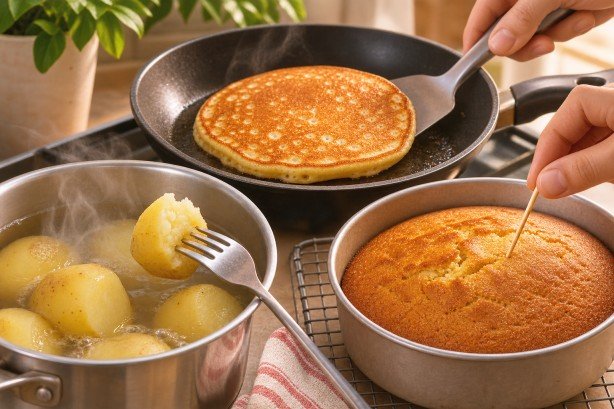
If you’ve ever boiled potatoes, you probably already know one of the simplest ways to test doneness. Push a fork or thin knife into the centre of a potato. If it slides through easily, the potato is usually tender enough for mashing or serving. If you meet firm resistance, it needs more time.
This works because heat softens the potato’s structure and causes its starch to gelatinise. As cooking continues, the potato becomes progressively easier to pierce.
The same principle applies to many vegetables. Carrots soften as they cook, broccoli stems become easier to pierce, and green beans lose some of their raw firmness. The ideal texture depends on what you’re making. Vegetables for a salad might need a little bite, while vegetables for a smooth soup can be cooked until very soft.
Texture is particularly useful because it allows you to judge whether food has reached the consistency you want, rather than simply whether it has spent enough time on the stove.
Listen to What Happens in the Pan
Cooking has a soundtrack, and some of those sounds are surprisingly informative.
When vegetables first enter a hot pan, you’ll often hear vigorous sizzling as moisture begins evaporating. As the surface becomes drier, the sound may change. Mushrooms are a good example. They initially release water, which can collect in the pan and simmer. Once much of that moisture evaporates, the sound becomes more like frying, and the mushrooms can begin browning more effectively.
The sound of frying can also tell you when the oil temperature is changing. Food added to hot oil produces bubbles as water escapes, but the intensity of bubbling depends on several factors, including the ingredient’s moisture content and the oil temperature.
These sounds are useful for monitoring the cooking process, although they aren’t precise measurements of doneness. Quieting bubbles don’t necessarily mean a food is fully cooked, and vigorous sizzling doesn’t guarantee that the inside is ready.
Think of sound as another way to notice changes rather than a final test.
How to Tell When Vegetables Are Done
Vegetables are an excellent place to practise recognising doneness because you can usually check them through appearance, texture, and taste.
Take broccoli, for example. When cooked briefly, it becomes a brighter green and begins to soften while retaining some firmness. Continue cooking, and it becomes increasingly tender. Eventually, prolonged heating can leave it duller in colour and unpleasantly mushy.
Carrots offer a different experience. Their colour may not change dramatically, but their texture becomes softer as they cook. A fork or knife helps you judge whether they’re ready for your intended dish.
For sautéed vegetables, pay attention to moisture and browning. Courgettes release water as they heat, onions become translucent, and mushrooms develop a deeper flavour once their surfaces begin to brown.
The most useful habit is to taste a small piece when it’s safe to do so. You’ll quickly discover that vegetables don’t have one universal point of doneness. The right texture depends on whether you’re preparing a stir-fry, soup, curry, or roasted side dish.
How to Check Pasta and Rice Without Guessing
Pasta is one of the easiest foods to check because you can simply taste it.
When pasta is described as al dente, it should be tender but still offer a slight resistance when bitten. It shouldn’t have a hard, chalky centre, nor should it feel excessively soft.
The cooking time printed on the packet is a useful guide, but the final texture is worth checking yourself. Taste a piece shortly before the recommended time and continue cooking if necessary.
Rice requires a slightly different approach. Properly cooked rice should have absorbed enough water for the grains to become tender. Depending on the variety, the grains may remain separate or develop a stickier texture.
If the rice is still firm in the centre, it may need additional cooking time and possibly a little more water. If it has become mushy, it may have absorbed too much water or cooked for too long.
Once you become familiar with a particular rice variety, you’ll begin recognising its ideal texture more easily.
Reading Doneness in Pancakes and Eggs
Pancakes provide several visible clues as they cook. Small bubbles often appear on the surface, the edges begin to look set, and the underside develops a golden colour. These signs usually indicate that it’s time to consider flipping.
After turning the pancake, the second side generally cooks more quickly. The finished pancake should feel springy and have a set centre rather than a wet, batter-like interior.
Eggs are another useful example because their appearance changes noticeably during cooking. Egg whites become opaque as their proteins coagulate, while yolks thicken as they heat. Scrambled eggs gradually change from a liquid mixture into soft curds.
The texture you want depends on the dish, but appearance alone isn’t a reliable food-safety test. For people who need to avoid undercooked eggs, including pregnant people, older adults, young children, and those with weakened immune systems, eggs should be cooked thoroughly or prepared using pasteurised egg products where appropriate.
Practising with pancakes and eggs can help you understand how quickly proteins and starches change when exposed to heat.
How to Tell When a Cake Is Baked
Baking is where recognising doneness becomes especially interesting because you can’t continuously stir or taste what’s happening inside the oven.
A cake usually provides several clues as it approaches completion. The surface becomes set, the edges may begin pulling slightly away from the pan, and the centre often springs back gently when touched.
One of the most familiar tests involves inserting a toothpick or thin skewer into the centre. For many standard cakes, a clean toothpick or one carrying a few moist crumbs suggests that the batter has set. If it comes out coated in wet batter, the cake generally needs more time.
However, this test doesn’t apply equally to every baked dessert. Brownies are often intentionally moist, while cheesecakes can retain a slight wobble even when properly baked.
The key is understanding what the finished texture should be. A light sponge cake should behave differently from a dense chocolate brownie, and a recipe’s specific doneness instructions should always take priority.
Bread Has Its Own Signs of Doneness
Fresh bread is one of the most satisfying things to remove from an oven, but its golden crust can sometimes make it appear ready before the inside has finished baking.
As bread bakes, the dough expands, moisture evaporates, and the crust develops colour. A well-baked loaf often feels lighter than expected and develops a firm exterior.
You may have heard the advice to tap the bottom of a loaf and listen for a hollow sound. This traditional test can be useful for some crusty breads, but it isn’t reliable for every loaf, particularly dense or enriched breads.
A food thermometer provides a more dependable way to check the internal temperature when a recipe specifies one. Without it, use the recipe’s baking guidance alongside the loaf’s crust, structure, and overall appearance.
Allowing bread to cool is also important. The crumb continues setting as moisture redistributes, and cutting into a hot loaf too early can leave the interior gummy.
Can You Tell When Chicken or Meat Is Cooked Without a Thermometer?
This is where an important food-safety distinction needs to be made.
Many traditional cooking tips suggest checking meat by pressing it, looking at the colour of its juices, or cutting into the centre. You may have heard that chicken is ready when its juices run clear or that steak doneness can be determined by comparing its firmness to your hand.
These methods are not reliable ways to confirm food safety.
Chicken can appear white before it reaches a safe internal temperature, and cooked poultry may sometimes retain a pink colour. Similarly, the firmness of meat depends on its cut, thickness, and other factors.
For poultry, the recommended safe internal temperature is 74°C (165°F). Whole cuts of beef, pork, lamb, and veal generally require 63°C (145°F), followed by a three-minute rest, under USDA guidance. Ground meats generally require 71°C (160°F), while fish is generally recommended to reach 63°C (145°F).
These temperatures cannot be confirmed accurately by appearance or touch alone.
If you regularly cook meat, poultry, or fish, a simple digital food thermometer is one of the most useful kitchen tools you can own. It removes much of the uncertainty and helps prevent both undercooking and unnecessary overcooking.
The Difference Between Cooked and Overcooked
Recognising when food is ready also means understanding when to stop cooking.
Vegetables gradually lose firmness as their cell structures soften. Pasta can move from pleasantly tender to mushy. Eggs become firmer and may turn rubbery when exposed to excessive heat, while cakes can lose moisture and become dry.
The tricky part is that food doesn’t always stop cooking the moment you turn off the heat. A hot pan continues transferring energy to whatever is inside it, and larger foods can continue warming internally after being removed from the oven.
This is known as carryover cooking, and it can affect the final texture of meat, baked foods, and other dishes.
When something has reached the texture you’re aiming for, consider whether it needs to be removed from the pan or transferred to a cooler surface. Leaving delicate foods in hot cookware can push them beyond the point you wanted.
Practise With Foods That Give Clear Clues
If you’re beginning to learn how to judge doneness, start with foods that provide obvious visual and textural changes.
Boil potatoes and test them with a fork at different intervals. Cook pasta and taste a piece every minute as it approaches the recommended time. Sauté mushrooms and observe how they release water before developing colour. Make pancakes and watch how their surfaces change before flipping.
These small exercises teach you to connect what you see and feel with what’s happening inside the food.
Over time, you’ll begin recognising familiar patterns. You’ll know when vegetables have softened enough, when a sauce has reduced to the right consistency, and when a cake looks ready for its final check.
You won’t need to keep staring at the clock quite so anxiously.
Learning to Read Your Food Takes Practice
There’s a moment in learning to cook when you realise you’re no longer following recipes quite as mechanically as before. You notice that the onions need another minute, the pasta is ready slightly early, or the cake needs a little longer in the oven.
These decisions come from experience, and experience begins with paying attention.
Colour can reveal browning, texture can show tenderness, sound can indicate moisture loss, and aroma can tell you when flavours are developing. Together, these clues help you understand the cooking process and produce food with the texture you actually want.
Just remember that recognising culinary doneness and confirming food safety are different skills. Your senses are excellent tools for judging many cooking changes, but they cannot replace a thermometer when a safe internal temperature matters.
The next time you’re standing over a pan wondering whether something is ready, look beyond the timer. Notice how the food has changed since you started cooking.
You may be surprised by how much it has been telling you all along.


