One small cut can make chopping potatoes, carrots, and onions much easier. And it has nothing to do with how sharp your knife is.
A carrot rolls across the cutting board just as you’re about to slice it. A potato rocks beneath your knife. You try to hold a tomato steady, but it slips sideways before the blade reaches the skin.
Round vegetables can be surprisingly awkward to cut. Their curved surfaces make them unstable, especially when you’re trying to produce neat, even pieces.
Fortunately, there’s a simple trick that professional cooks use: create a flat surface before you start cutting.
Once the vegetable has a stable base, everything becomes easier. Your knife moves more predictably, your cuts become more consistent, and you spend less time chasing ingredients around the board.
Why Are Round Vegetables Difficult to Cut?
Unlike ingredients with flat sides, round vegetables naturally roll or rock when pressure is applied.
Think about cutting a whole potato. As your knife presses downward, the potato may shift slightly, changing the angle of your cut.
This makes it harder to produce uniform slices and increases the risk of the blade slipping.
The same problem occurs with carrots, onions, beetroot, and other curved ingredients.
A stable cutting surface helps you maintain control, while evenly sized pieces cook at similar rates.
That’s particularly useful when roasting vegetables, preparing soups, or making a stir-fry.
The Flat-Side Trick Every Home Cook Should Know
The easiest way to stabilise a round vegetable is to create a flat base.
Place the vegetable on a secure cutting board and hold it firmly. Carefully remove a thin slice from one side, using a controlled movement.
Turn the vegetable so the freshly cut surface rests against the board.
Instead of rolling, it should now sit more securely while you make the remaining cuts.
For larger vegetables, cutting them into halves or manageable sections may be safer than trying to trim a whole, unstable piece.
You don’t need to remove much flesh. The goal is simply to create enough contact with the board to prevent unwanted movement.
And don’t waste the trimmings. They can usually be added to soups, stocks, or other dishes.
How to Cut Round Vegetables Evenly: Step by Step
The exact technique depends on the ingredient, but the basic principles remain the same.
Step 1: Prepare Your Cutting Board
Start with a clean, stable cutting board.
If it slides across the countertop, place a slightly damp kitchen towel or non-slip mat underneath.
Choose a sharp knife suitable for the vegetable you’re cutting.
A chef’s knife works well for most potatoes, onions, and larger vegetables, while a smaller knife may offer better control for delicate ingredients.
Step 2: Create a Stable Base
Wash the vegetable and peel it if your recipe requires it.
For a potato or beetroot, carefully cut it in half and place the flat side down. For a carrot, you can trim a thin strip from one side or divide it into shorter sections first.
With onions, cut them in half from root to stem and place the cut sides against the board.
The important thing is to prevent the ingredient from rolling while you work.
Step 3: Cut Into Even Slices
Hold the vegetable using a claw grip, with your fingertips curled away from the blade.
Make controlled cuts at consistent intervals.
If you’re preparing potato slices for a gratin, you might aim for approximately 3 mm thickness. For roasted vegetables, thicker pieces are often more practical.
Focus on consistency rather than speed.
Step 4: Turn the Slices Into Smaller Pieces
Once you’ve created even slices, you can cut them into strips or cubes.
For diced potatoes, stack a small number of stable slices, cut them into even strips, then turn those strips and cut across them.
For carrots, you might prefer half-moons, quarter-rounds, or sticks, depending on the recipe.
Keep stacks low and avoid cutting pieces that are too small to hold securely.
How to Cut Different Round Vegetables
Although the flat-side principle works for many ingredients, a few vegetables benefit from slightly different approaches.
Potatoes
Potatoes are ideal for practising uniform cuts.
Cut larger potatoes in half lengthwise and place the flat side down. From there, you can make slices, wedges, sticks, or cubes.
For roasted potatoes, try to keep the pieces similar in size so they cook evenly.
Carrots
Carrots are long and cylindrical, making them prone to rolling.
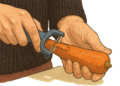
Trim the ends and divide large carrots into shorter sections. Create a flat side when needed, then cut into sticks or slices.
For round slices, hold the carrot securely using a claw grip and work slowly. If it feels unstable, cut it lengthwise into halves and make half-moons instead.
Onions
Cut an onion in half from root to stem after trimming the stem end.
Place each half cut-side down, then peel away the papery skin.
The flat surface makes it easier to slice or dice the onion while keeping the layers together.
Tomatoes
Tomatoes are round, soft, and sometimes slippery.
Use a sharp serrated knife or a very sharp chef’s knife. For greater stability, cut the tomato in half and place the cut side down before slicing.
Avoid pressing too hard, as this can crush the flesh and release excess juice.
Why Even Cuts Make Food Taste Better
Uniform cutting affects more than appearance.
When vegetables are similar in size, they’re more likely to finish cooking at roughly the same time.
Imagine roasting potatoes cut into completely different shapes. The smallest pieces may become overly browned before the largest ones are tender.
Even cuts make the cooking process more predictable.
They also improve texture. In a vegetable soup, for example, evenly diced carrots and potatoes create a more consistent bite.
And when preparing a salad or stir-fry, neat pieces make the finished dish easier to eat and more appealing.
Common Mistakes When Cutting Round Vegetables
The biggest mistake is trying to slice a rolling vegetable without stabilising it first.
Another is applying too much pressure with a dull knife. A dull blade may struggle to penetrate firm skins, encouraging you to push harder than necessary.
Cutting too quickly can also cause uneven results, particularly when you’re still learning.
Pay attention to the position of your guiding hand. Keep your fingertips tucked away from the cutting edge, and stop when an ingredient becomes too small to hold safely.
Finally, avoid stacking too many slices together. If the stack shifts, your cuts become less accurate and harder to control.
A Simple Practice Exercise
If you’d like to improve your knife skills, try practising with one medium potato.
Cut it in half and place one half flat-side down.
Slice it into pieces approximately 1 cm thick, taking your time to maintain consistent spacing.
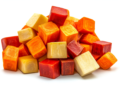
Next, cut those slices into 1 cm strips, then into roughly 1 cm cubes.
Spread the cubes across the cutting board and compare their sizes.
You don’t need perfect measurements. Look for pieces that are reasonably similar in width, height, and length.
Repeat the exercise occasionally, and you’ll gradually become more comfortable judging thickness by eye.
Better Knife Skills Start With Stability
It’s tempting to think that better knife skills come from chopping faster or learning complicated cuts.
But often, the biggest improvement comes from something much simpler: making sure the ingredient stays where you put it.
Creating a flat surface gives you better control, helps produce even pieces, and makes everyday preparation safer.
The next time you’re cutting a potato, carrot, onion, or tomato, pay attention to how it rests on the board before making your first cut.
That small adjustment can make the entire task feel easier.