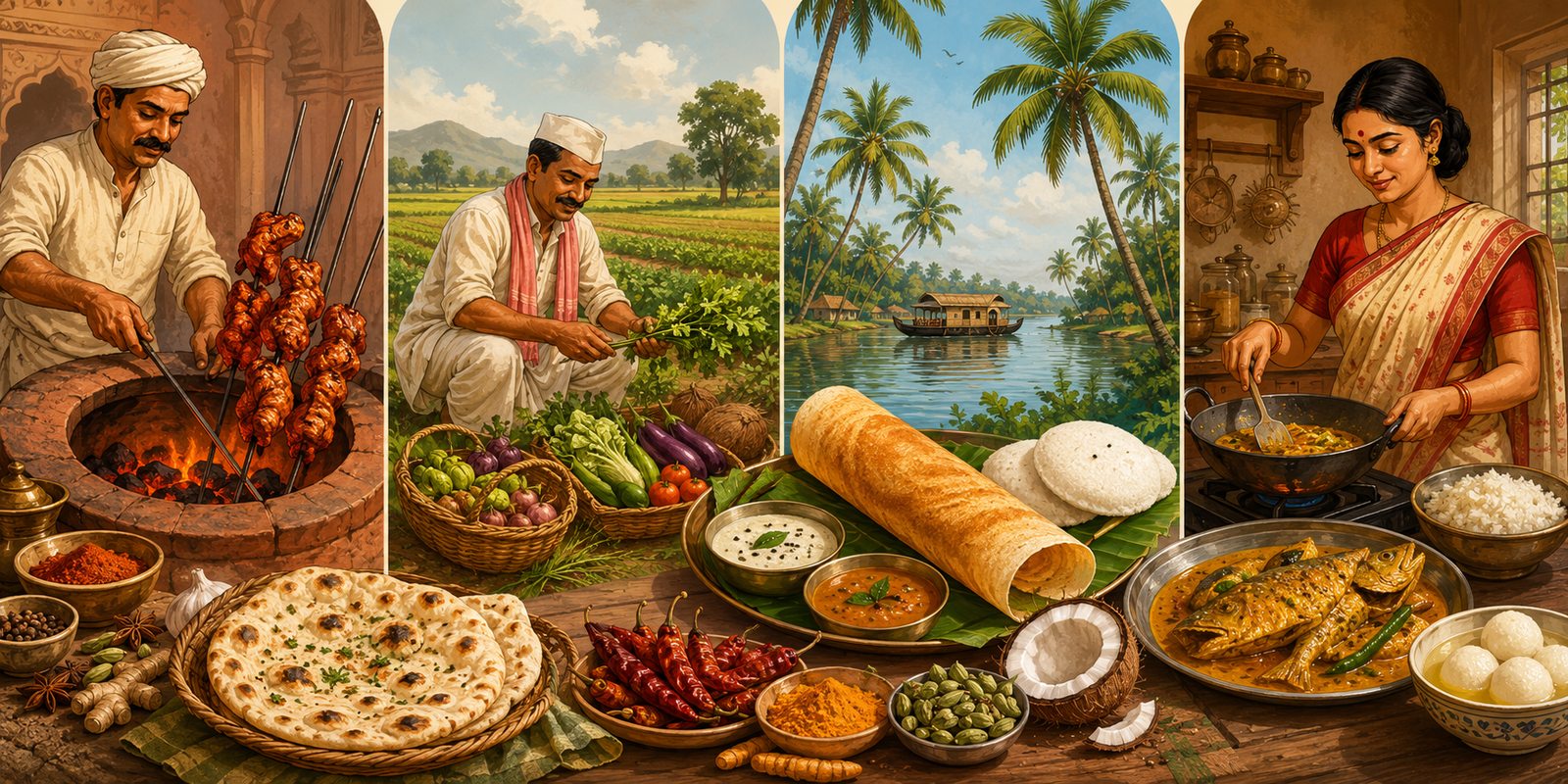
Indian cooking is not one cuisine. It is a vast, layered, regional food culture shaped by climate, religion, trade, agriculture, migration, caste, empire, coastline, forests, rivers and home kitchens. To speak of Indian food as one single thing is a little like speaking of European food as if Spanish tapas, French sauces, Italian pasta and Polish stews all came from the same pot.
And yet, there are threads that run across many Indian kitchens. Spices are used with intention. Rice, wheat, lentils, vegetables, fish, meat, dairy, coconut, chillies and pickles appear in countless forms. Food is often built in stages, with flavour developed through tempering, roasting, grinding, slow cooking, frying, steaming and fermentation. A meal can be simple and austere, or festive and extravagant. It can be vegetarian, seafood-heavy, meat-led, dairy-rich, coconut-based, mustard-scented, chilli-hot, gently spiced or deeply smoky.
This article is an introduction to the cuisines of India: the building blocks, the techniques, the ingredients and the regional traditions that make Indian cooking one of the world’s richest culinary landscapes.
India Is Not One Kitchen
India’s food changes every few hundred kilometres. Geography plays a huge role. Coastal regions cook with fish, prawns, coconut, kokum, tamarind and rice. Northern plains lean more heavily on wheat, dairy, lentils, ghee and tandoor cooking. Eastern India uses mustard oil, freshwater fish, rice, leafy greens and poppy seeds. Western India brings together dry desert cooking, sweet-sour vegetarian food, seafood, peanuts, jaggery and fierce chilli heat. South India is home to rice, coconut, curry leaves, black pepper, tamarind, fermented batters and a dazzling range of chutneys, stews and spice pastes.
Religion and community also shape what people eat. Some regions have strong vegetarian traditions. Others have long histories of meat cookery, game cookery, fish cookery and offal cookery. Muslim royal courts influenced Mughlai food, Awadhi food and Delhi food. Portuguese influence, Arab influence, Persian influence, Tibetan influence, Chinese influence and British influence have all left marks on Indian cooking.
So Indian cuisine is best understood as a conversation between region, household and technique.
The Indian Pantry
The Indian pantry is built around grains, pulses, spices, fats, souring agents, dairy, fresh aromatics and seasonal produce. Rice, wheat and millets form the base of many meals. Lentils, beans and peas provide protein and structure. Spices bring fragrance, warmth, bitterness, sweetness, colour and heat. Fresh herbs, chillies, ginger, garlic and onions create layers of flavour.
A typical pantry might include turmeric, cumin, coriander seed, mustard seed, fenugreek, cardamom, cloves, cinnamon, fennel, black pepper, dried red chillies, asafoetida, bay leaves, curry leaves and garam masala. But no serious Indian cook uses all spices in the same way. A Bengali fish curry, a Punjabi chole, a Tamil sambar and a Gujarati dal may all contain cumin or turmeric, but their flavour profiles are completely different.
Spices: Not Just Heat
One of the biggest misconceptions about Indian cooking is that spices are used simply to make food hot. In reality, spices are used to create aroma, balance and depth.
Turmeric gives earthiness and colour. Cumin gives warmth. Coriander seed gives citrusy roundness. Mustard seed gives sharpness. Fenugreek can be bitter and maple-like. Fennel adds sweetness. Black pepper provides heat without the brightness of chilli. Cardamom, clove and cinnamon can push a dish towards sweetness, luxury and warmth. Asafoetida gives an onion-garlic depth, especially in vegetarian cooking.
Spices may be used whole, cracked, ground, roasted, fried in fat or added at the end. The same spice can taste completely different depending on how it is treated. Raw ground cumin is dusty and earthy. Toasted cumin is nutty and fragrant. Cumin fried in hot ghee becomes deep, smoky and savoury.
Fresh Chillies and Dried Chillies
Chillies are central to many Indian cuisines, but they are not one-dimensional. Fresh green chillies bring grassy heat and sharp freshness. They can be slit into dals, crushed into chutneys, chopped into fritters or ground into masalas. Dried red chillies bring deeper heat, colour and smokiness. Some are mild and used mainly for colour; others are fiercely hot.
Kashmiri chilli is valued for its red colour and moderate heat. Guntur chillies are much hotter and are common in parts of Andhra cooking and Telangana cooking. Byadgi chillies from Karnataka are prized for their colour and aroma. In the north-east of India, chillies can be extremely intense, while in some Gujarati dishes chilli heat is balanced with sweetness.
Chilli in Indian food is not always about aggression. Often, it is part of a larger balance: heat, sourness, sweetness, fat, salt and aroma.
The Role of Coconut
Coconut is one of the great tropical ingredients of Indian cooking. It appears across Kerala, Tamil Nadu, Karnataka, Goa, coastal Maharashtra, Bengal, Odisha and parts of the north-east.
Fresh grated coconut may be used in chutneys, vegetable stir-fries, fish curries and festive sweets. Coconut milk creates creamy gravies and stews. Coconut oil gives Kerala cooking its distinctive aroma. Dried coconut is used in masala pastes, especially in parts of Maharashtra and Karnataka. In some dishes, coconut provides sweetness and body. In others, it softens chilli heat or carries the fragrance of curry leaves, mustard seeds and black pepper.
Coconut-based food can be delicate or fiery. A Kerala vegetable stew may be pale, mild and perfumed with coconut milk. A coastal fish curry may be sharp with tamarind and hot with red chilli. A Maharashtrian coconut masala may be deeply roasted and almost smoky.
Fats: The Flavour Carriers
Indian cooking fats are not interchangeable. Each brings its own identity.
Ghee is perhaps the most famous. It is clarified butter, nutty and aromatic, used in dals, rice dishes, Indian sweets, Indian breads and festive cooking. Mustard oil is pungent and sharp, especially important in Bengal, Bihar, Odisha and parts of north India. Coconut oil defines much of Kerala’s cooking. Sesame oil is important in Tamil cooking, especially in pickles and tamarind-based dishes. Groundnut oil is widely used in western India. Neutral oils are common in modern urban kitchens.
Fat is not just a cooking medium. It carries spice flavour. When whole spices are added to hot fat, their essential oils bloom. This is why a tadka can transform a simple pot of lentils into something fragrant and complete.
Dairy in Indian Cooking
Dairy is central to many Indian food traditions, particularly in the north and west. Milk, yoghurt, paneer, cream, butter, ghee, khoa and chhena are used in savoury and sweet dishes.
Punjabi food uses butter, ghee, paneer and yoghurt generously. Awadhi cooking and Mughlai cooking may use yoghurt to tenderise meat and enrich gravies. Bengali sweets rely heavily on chhena, a fresh acid-set cheese. North Indian chaats use yoghurt for cooling contrast. Rajasthani cuisine uses yoghurt and buttermilk in gravies, especially where fresh vegetables were historically limited.
Dairy can soften heat, add richness, provide acidity or create body. It is also central to Indian sweets, from rabri and rasgulla to peda, payesh and kulfi.
The Culture of Snacks
India is a snacking civilisation. Between meals, around tea, during festivals, at railway stations, on office breaks and at street corners, snacks are everywhere.
Samosas, pakoras, kachoris, vada pav, dhokla, chaat, cutlets, rolls, idli, dosa, bhajiya, momos, kebabs, patties and farsan are not side notes. They are a major part of Indian food culture. Many snacks are textural: crisp, soft, fluffy, spongy, chewy, crunchy, saucy. Many are assembled to order, with chutneys, sev, yoghurt, onions, coriander, chillies, lime and spice powders added at the last moment.
Indian snacks often show the full intelligence of the cuisine: contrast, speed, freshness and intensity.
Street Food: Fast, Loud and Brilliant
Indian street food is regional, inventive and deeply competitive. Mumbai street food has vada pav, pav bhaji, bhel puri and Bombay sandwiches. Kolkata street food has kathi rolls, phuchka, telebhaja and Mughlai paratha. Delhi street food has chole bhature, aloo tikki, golgappa, kebabs and chaats. Chennai street food has idli, dosa, sundal and bajji. Lucknow street food has kebabs and basket chaat. Ahmedabad street food has khaman, fafda and jalebi.
Street food often depends on assembly rather than long cooking. A vendor may spend hours preparing components, but the final dish comes together in seconds. The pleasure lies in immediacy: hot fried food, cold yoghurt, sharp chutney, crunchy sev, fresh coriander, chilli, lime and spice.
Meat and Seafood
Indian food is often stereotyped as vegetarian, but meat and seafood have deep histories across the subcontinent.
Goa, Bengal, Kerala, Tamil Nadu, Maharashtra, Karnataka and Odisha all have rich seafood traditions. Fish may be steamed in banana leaves, fried with spices, simmered in coconut milk, cooked with mustard paste or soured with tamarind, kokum or raw mango. Prawns, crabs, clams and dried fish are central to many coastal communities.
Meat traditions vary widely. Punjab is known for tandoori chicken and rich meat curries. Kashmir has rogan josh and wazwan dishes. Awadh is famous for kebabs, kormas and slow-cooked biryanis. Mughlai cooking celebrates lamb, chicken, cream, nuts and aromatic spices. Kerala has beef fry, mutton curry and Syrian Christian meat dishes. Rajasthan has laal maas, a fiery mutton preparation associated with royal hunting traditions.
Indian meat cooking is not only about curry. It includes grilling, smoking, frying, dum cooking, mincing, skewering, roasting and slow braising.
Tadka: The Signature Technique
Tadka, also called tempering, chaunk, phoron, baghar or talimpu, is one of the most important techniques in Indian cooking. It involves heating fat and adding spices, aromatics or chillies to release their flavours.
A tadka can begin a dish or finish it. At the start, it builds the flavour base. At the end, it adds a final burst of aroma. Mustard seeds may crackle, cumin seeds may darken, curry leaves may splutter, dried chillies may smoke slightly, garlic may turn golden, and asafoetida may bloom in hot fat.
A simple dal with salt and turmeric becomes alive when finished with ghee, cumin, dried chilli and garlic. A coconut chutney becomes complete with mustard seeds, urad dal and curry leaves fried in oil. Tadka is small, but it carries enormous power.
Other Core Indian Cooking Techniques
Indian cooking uses a wide range of techniques. Bhuna means frying or sautéing a masala until moisture evaporates and the fat separates. Dum cooking refers to sealed, slow cooking, often used for biryani and meat dishes. Tandoor cooking uses intense heat from a clay oven. Fermentation is key to idli, dosa, dhokla and many regional batters. Steaming is used for idli, puttu, pathiri, pitha and modak. Pickling preserves seasonal produce in oil, salt, acid and spice. Grinding fresh masalas is central to coastal and southern cooking.
The best Indian cooking is often about sequencing. When to add the spice, when to add water, when to cover the pot, when to reduce, when to finish with herbs — these decisions define the final dish.
Major Cuisines of India
Bengali Cuisine
Bengali cuisine is shaped by rivers, rice, fish, mustard, vegetables and a love of subtle bitterness and sweetness. The Bengali meal is often structured in courses: bitter vegetables, leafy greens, dal, fried items, vegetable dishes, fish or meat, chutney and sweets.
Mustard oil is a defining fat. Mustard paste, poppy seed paste, panch phoron, green chillies and fresh fish are central ingredients. Dishes such as shorshe ilish, chingri malaikari, macher jhol, shukto, chholar dal, luchi, kosha mangsho and posto-based vegetables show the range of the cuisine.
Bengali food can be delicate, sharp, sweet, bitter, pungent and deeply seasonal.
Maharashtrian Cuisine
Maharashtrian cuisine is extremely varied, stretching from the Konkan coast to the Deccan plateau. It uses peanuts, sesame, coconut, jaggery, tamarind, goda masala, kokum, dried coconut and a wide range of lentils and vegetables.
The food can be earthy and robust. Varan bhaat, misal pav, bharli vangi, pithla bhakri, sabudana khichdi, kothimbir vadi and puran poli are iconic dishes. In coastal Maharashtra, seafood becomes central, often cooked with coconut, kokum and chilli.
Maharashtrian food is also one of India’s great snack traditions, from vada pav to thalipeeth and poha.
Punjabi Cuisine
Punjabi cuisine is generous, hearty and strongly associated with wheat, dairy, tandoor cooking and robust gravies. Butter, ghee, yoghurt, paneer, cream and lentils are important. The tandoor gives us naan, roti, kulcha and tandoori meats.
Classic dishes include sarson da saag, makki di roti, chole, rajma, dal makhani, butter chicken, paneer tikka and amritsari fish. Punjabi cooking often celebrates richness, smoke and abundance.
It is also one of the Indian cuisines that has most strongly shaped global perceptions of Indian restaurant food.
Tamil Cuisine
Tamil cuisine is built around rice, lentils, tamarind, curry leaves, mustard seeds, dried chillies, black pepper and sesame oil. It includes both everyday vegetarian meals and powerful meat and seafood traditions.
Idli, dosa, sambar, rasam, kootu, poriyal, vadai, pongal and curd rice are central to many Tamil meals. Chettinad cuisine, from the Chettiar community, is famous for its complex spice blends, black pepper, fennel, star anise, stone flower and meat dishes.
Tamil cooking has a remarkable understanding of sourness, heat and texture. A meal can include crisp papad, soft rice, tangy sambar, peppery rasam, cooling curd and multiple vegetable preparations.
Kerala Cuisine
Kerala cuisine is shaped by coconut, rice, seafood, black pepper, curry leaves, coconut oil and centuries of spice trade. The food varies across Hindu food traditions, Muslim food traditions and Christian food traditions.
Vegetable stew, appam, puttu, kadala curry, avial, olan, thoran, fish molee, meen curry, beef fry and Malabar biryani all belong to this rich culinary landscape. Coconut appears as coconut milk, coconut oil, grated coconut and coconut paste. Black pepper, once one of the world’s most valuable spices, remains central.
Kerala food can be gentle and coconut-rich, or fiery, sour and deeply spiced.
Rajasthani Cuisine
Rajasthani cuisine reflects desert cooking, royal kitchens and resourceful preservation. Because fresh vegetables were historically limited in some areas, the cuisine uses dried lentil dumplings, gram flour, yoghurt, dried spices, pickles and long-lasting ingredients.
Dal baati churma is perhaps the most famous Rajasthani meal. Gatte ki sabzi, ker sangri, papad ki sabzi, laal maas and mirchi vada are also iconic. The cuisine often uses ghee generously and can be intensely spiced.
Rajasthani cooking shows how scarcity can produce extraordinary creativity.
Gujarati Cuisine
Gujarati cuisine is famous for its balance of sweet, sour, salty and spicy flavours. It has strong vegetarian traditions and a sophisticated snack culture.
Dhokla, khandvi, thepla, undhiyu, handvo, dal dhokli, kadhi, fafda, sev tameta and Gujarati dal show the cuisine’s range. Jaggery, yoghurt, gram flour, sesame, peanuts and seasonal vegetables are widely used.
A Gujarati thali often contains many small dishes, creating variety through texture, temperature and taste. Sweetness is not accidental; it is part of the cuisine’s balancing logic.
Uttar Pradesh, Awadh and the Ganga Plains
Uttar Pradesh cuisine contains many food traditions, from everyday vegetarian cooking along the Ganga plains to the refined courtly cuisine of Awadh. Wheat, lentils, dairy, seasonal vegetables, meat, kebabs, breads and sweets all play important roles.
Awadhi cuisine, especially from Lucknow, is known for kebabs, kormas, biryanis, sheermal, nihari and slow dum cooking. The food is aromatic rather than aggressively hot, using spices with elegance and restraint.
At the same time, UP is also home to chaats, pooris, kachoris, aloo sabzi, bedmi, peda and a vast culture of temple food, street food and home cooking.
Karnataka and the Coastal Konkan
Karnataka cuisine ranges from the rice-based dishes of the south to the millet traditions of the north and the seafood-rich cooking of the coast. Coconut, curry leaves, tamarind, jaggery, chillies and lentils appear in many forms.
Mysore masala dosa, bisi bele bath, ragi mudde, neer dosa, akki rotti, saaru, palya and Mangalorean fish curry show the state’s diversity. Udupi cuisine has had a huge influence on vegetarian restaurant food across India. Coastal Karnataka uses coconut, dried red chillies, tamarind and seafood with great skill.
The Konkan belt, stretching along the western coast, brings together fish, coconut, kokum, rice and sour-spicy gravies.
Sikkimese and Nepalese Influences
The food of Sikkim and neighbouring Himalayan communities has strong Tibetan, Nepalese and north-eastern Indian influences. It is distinct from the spice-heavy image of Indian food.
Momos, thukpa, phagshapa, gundruk soup, kinema, sel roti and noodle-based dishes are important. Fermentation, pork, leafy greens, chillies, radish, buckwheat and warming broths are common. The food reflects mountain climates, border cultures and migration.
This cuisine reminds us that Indian food is not only curry, rice and roti. It can also be dumplings, soups, fermented greens and chilli pastes.
Indian Chinese
Indian Chinese food is one of India’s great modern urban cuisines. What started developed through Chinese communities in Kolkata and then spread across restaurants, canteens, street stalls and home kitchens.
It is not the same as Chinese food in China. It is a hybrid cuisine using soy sauce, vinegar, garlic, ginger, green chillies, spring onions and Indian-style heat. Chilli chicken, gobi Manchurian, hakka noodles, fried rice, chilli paneer and hot-and-sour soup are beloved dishes.
Indian Chinese food is loud, addictive and completely its own thing.
Mughlai Cuisine
Mughlai cuisine reflects Persianate influence, Central Asian influence and north Indian courtly cooking. It is associated with richness, refinement, meat, nuts, dried fruit, aromatic spices, slow cooking and layered rice dishes.
Korma, qorma, biryani, pulao, seekh kebab, shami kebab, nihari, rezala, pasanda and rich breads all belong to this world. Almonds, cashews, yoghurt, cream, saffron, cardamom and rose water may be used to create luxury and aroma.
Mughlai food has strongly influenced restaurant cooking in India and abroad, but its best versions are subtle, fragrant and carefully balanced.
Delhi Cuisine
Delhi cuisine is a collision of empire, migration, street food, Punjabi refugee cooking, Mughlai traditions and modern cosmopolitan appetite.
Old Delhi food is famous for kebabs, nihari, korma, biryani, jalebi, paratha and chaat. Post-Partition Delhi absorbed Punjabi food culture, bringing chole bhature, butter chicken, tandoori dishes, kulcha and rich dals into the city’s identity. Modern Delhi also loves momos, rolls, Indo-Chinese food, café food and regional restaurants from across India.
Delhi is less a single cuisine than a city of appetites — layered, noisy, indulgent and constantly changing.
The Indian Meal
A traditional Indian meal is not usually built around one central dish. It is a composition. Rice or bread provides the base. Dal or legumes bring comfort and protein. Vegetables add seasonality. Pickles and chutneys bring sharpness. Yoghurt cools. Fried items add texture. Fish, meat or paneer may provide richness. Sweets mark celebration.
The beauty lies in balance. A spoonful of rice with dal tastes different when eaten with pickle. A rich meat curry feels lighter with raw onions and lime. A spicy sambar is softened by curd rice. A fried snack becomes brighter with coriander chutney.
Indian cooking is therefore not only about recipes. It is about relationships between dishes.
Why Indian Cooking Matters
Indian cooking teaches us that flavour can be layered, not rushed. A dish can begin with a spice, deepen with onions, sharpen with sourness, soften with dairy, brighten with herbs and finish with hot fat. It teaches us that vegetarian food can be complex and satisfying. The flavours and contexts show how climate and culture shape technique. It turns humble ingredients — lentils, rice, potatoes, greens, chickpea flour, yoghurt — into extraordinary meals.
Most of all, Indian cooking rewards curiosity. There is always another region, another spice blend, another bread, another pickle, another fish curry, another dal, another festive sweet, another street snack.
To learn Indian cooking is not to memorise one “curry”. It is to enter a world of many kitchens, many histories and many ways of building flavour.