I could read a balance sheet in my sleep. As a finance controller at Cisco, I lived inside numbers — forecasts, variances, month-end closes — and I was fluent in a language most people find terrifying. So it came as a genuine shock, the first time I tried to cook seriously at home, to discover that I could not read a recipe. Oh, I could follow the words. But I didn’t understand them. ‘Season to taste’ — with how much? ‘Medium-high heat’ — medium-high compared to what? ‘Cook until done’ — done how? I had spent fifteen years mastering one kind of literacy and I was, in the kitchen, functionally illiterate. This article is for the person I was then: standing in a kitchen, capable and accomplished everywhere else in life, quietly baffled by a pan.
Eventually I did go all in — I left Cisco, enrolled at Le Cordon Bleu, and spent the years since in professional kitchens. But culinary school assumes you already know how to boil water, and I want to talk about the part before that: the months at home when I taught myself the absolute basics, badly, from the internet, with no one to tell me what mattered. If I could send one guide back to that version of myself, it would be this one. Not recipes — foundations. The handful of unglamorous skills that everything else is built on, the ones no one teaches you because everyone assumes you already know them.
First, Learn to Actually Read a Recipe
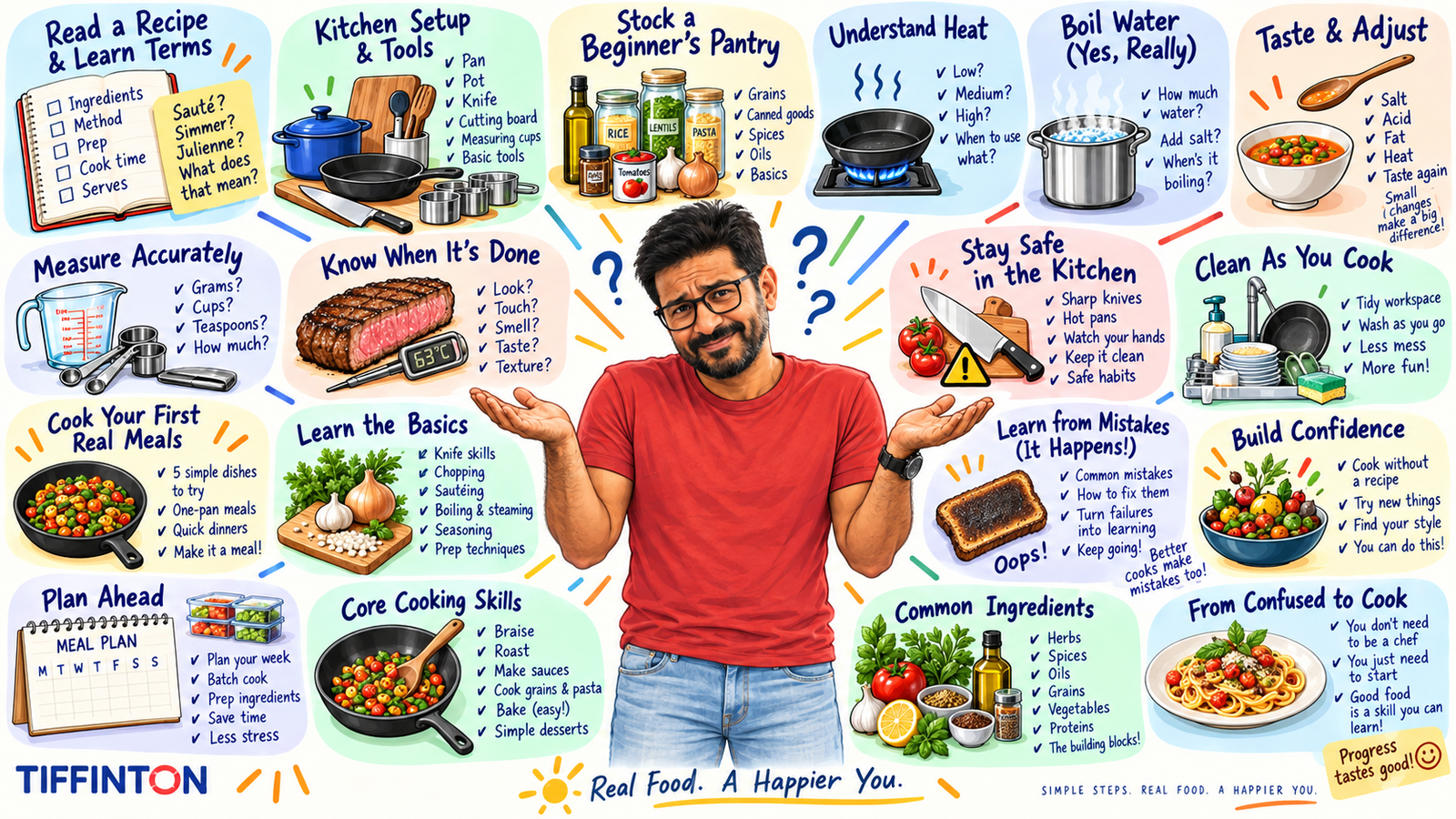
My very first lesson was humbling: I didn’t know how to How to Read and Follow a Recipe. I’d dive in at step one with half my ingredients still in the fridge, then panic three steps later when two things needed doing at once. A recipe isn’t a to-do list you work through top to bottom — it’s a set of instructions you read completely, first, like a flight plan. Part of my confusion was simply vocabulary, so I also had to sit down and learn Understanding Cooking Terms and Jargon — what ‘fold,’ ‘sweat,’ ‘deglaze,’ and ‘reduce’ actually mean. Once the words made sense, the recipes stopped feeling like they were written in code.
Set Up a Kitchen That Doesn’t Fight You
You cannot cook well in a kitchen that’s working against you, and mine was a mess of gadgets I’d bought and never used. What I actually needed was in Setting Up Your First Kitchen: Essential Tools — a good knife, a heavy pan, a board that doesn’t slide, a few honest basics — and a pantry I could actually cook from, which is its own skill: Stocking a Beginner’s Pantry. The day I stopped shopping for single recipes and started keeping a real pantry was the day cooking stopped feeling like a special event and started feeling like something I could just… do.
Understand Heat — It’s the Whole Game
If I could go back and drill one thing into my beginner self, it would be heat. I burned things on the outside and left them raw within because I didn’t grasp Understanding Heat: Low, Medium, and High — that the dial isn’t decoration, it’s the single most important variable you control. I’m only half joking when I say the most useful thing I learned early was How to Boil Water Properly (Yes, Really); knowing when water is simmering versus at a rolling boil, and why it matters, quietly fixed half my failures. Heat is to cooking what interest rates are to finance: everything downstream moves because of it.
Learn to Taste — and to Measure When It Counts
The most important tool in any kitchen is your own mouth, and as a beginner I never used it. I’d cook a whole dish without tasting once, then serve something under-seasoned and sad. Learning How to Taste and Adjust as You Cook — tasting constantly, correcting as you go — was the moment my food started tasting like it came from a restaurant rather than a recipe. That said, cooking and baking aren’t the same beast: some things you season by feel, others demand precision, which is why you also need How to Measure Ingredients Accurately and, underpinning all of it, the framework that finally made flavour click for me — Salt, Fat, Acid, Heat: The Four Pillars Explained.
Know When It’s Actually Done
For a long time, doneness was pure anxiety. Was the chicken cooked? Was the cake set? I either overcooked everything out of fear or served things half-raw out of hope. Learning Reading Doneness Without a Thermometer — the visual and touch cues that tell you when something is ready — replaced that anxiety with something like calm. A thermometer helps, but your eyes, your nose, and the feel of a piece of meat under your finger will carry you further than you’d think.
Stay Safe, and Stop Making a Disaster of the Kitchen
Nobody warns you that home cooks get hurt — until you grab a hot handle bare-handed, as I did, memorably. Kitchen Safety Basics for Beginners covers the unglamorous stuff that keeps you out of A&E: hot oil, sharp knives, raw chicken, wet boards. And the habit that changed my life more than any technique was learning to How to Clean As You Cook. As a finance guy I loved a tidy desk; it turned out a tidy bench is the same instinct. Cook in chaos and you’ll cook badly. Cook in order and everything gets easier.
Cook Your First Real Meals
Confidence comes from finishing things, so you need a few wins early. I’d point my old self straight at Your First Five Dishes to Master — a small set of foolproof dishes you make until they’re automatic — and the humble hero of the beginner kitchen, How to Cook a Simple One-Pan Dinner. There’s a particular joy in a single pan producing a whole dinner, and it teaches you more about timing and heat than any amount of reading. Speaking of timing, How to Plan and Time a Simple Meal is the skill that stops you serving cold potatoes with hot fish — getting several things ready at the same moment, which sounds trivial and absolutely is not.
Expect to Fail — and Learn to Recover
I failed constantly, and the failing was the point. What helped was knowing that my disasters were the same disasters everyone has, laid out in Common Beginner Mistakes and How to Fix Them, and that most kitchen catastrophes are recoverable if you know the moves — which is what How to Fix a Dish That Went Wrong is all about. A sauce splits, a dish is too salty, something’s overcooked: none of it is the end. Learning to rescue dinner instead of ordering takeaway was a bigger confidence leap than any successful recipe.
From Following Recipes to Actually Cooking
The real destination — the thing that eventually took me to Le Cordon Bleu — is the day you stop needing the recipe at all. Building Confidence: Cooking Without a Recipe is about exactly that: opening the fridge and seeing a meal instead of a list of ingredients. To make home cooking sustainable rather than a nightly ordeal, I also lived on Batch Cooking for Beginners, and if you want a gentle on-ramp, Your First Week of Home-Cooked Meals maps out seven days so you’re never staring at the counter wondering where to begin.
Start Before You’re Ready
Here’s the thing I most want you to hear. I waited years to take cooking seriously because I told myself I wasn’t a ‘natural,’ that real cooks had something I lacked. That was nonsense. I was a middle-aged finance guy who couldn’t dice an onion, and I made it all the way to a professional kitchen — not because I was gifted, but because I started, badly, and kept going. You don’t need talent to begin. You need a knife, a pan, a little patience, and the willingness to make a lot of mediocre dinners on the way to good ones. Everything above is where I’d start if I were standing in your kitchen right now, apron still creased from the packaging. So put the takeaway menu down. Let’s cook.