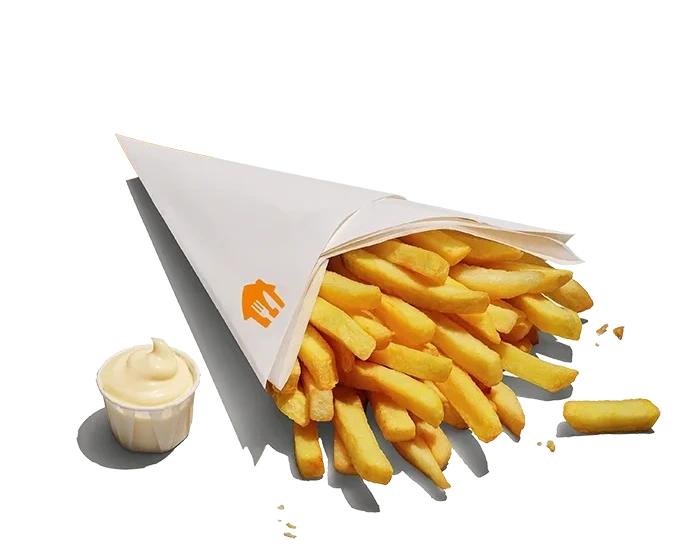
What if the secret to incredibly crispy chips isn’t hotter oil, but cooking the same potato three times? This method is famously known for making perfect Triple cooked chips.
Golden on the outside, wonderfully fluffy on the inside, and crisp enough to make an audible crunch. That’s what makes triple-cooked chips so special.
Popularised by British chef Heston Blumenthal, this cooking technique turns ordinary potatoes into something extraordinary. Instead of frying them once, the potatoes are boiled, fried at a lower temperature, and then fried again at a higher temperature.
Between these cooking stages, the chips are cooled and dried. Each stage changes their structure, moisture content, and texture.
But why does this extra work make such a difference? The answer lies in the fascinating food science of potatoes.
What Are Triple-Cooked Chips?
Triple-cooked chips are thick-cut potato chips prepared using three separate cooking stages: boiling in water, low-temperature frying, and high-temperature frying.
Unlike conventional chips, which may be fried once or twice, triple-cooked chips undergo a carefully controlled process designed to produce two contrasting textures.
The inside becomes soft, light, and fluffy, while the outside develops a thick, crisp, golden crust.
The technique is particularly associated with Heston Blumenthal, whose experiments with cooking temperatures, moisture removal, and potato structure helped popularise this style of chip.
The key principle is simple: cook the inside thoroughly, remove moisture from the surface, and then develop a crisp exterior.
How Are Triple-Cooked Chips Made?
The five-stage process: Boil → Cool & Dry → First Fry → Chill or Freeze → Final Fry
Step 1: Boil the Potatoes Until Tender
The process begins with thick-cut potatoes simmered gently in water until they are completely cooked.
The potatoes should become very tender, with their edges beginning to break down slightly. They must still remain intact enough to handle.
During boiling, water penetrates the potato and heats the starch granules inside its cells.
As the temperature rises, the starch absorbs water and gelatinises, contributing to the soft, fluffy texture associated with a properly cooked chip.
Boiling also softens the outer potato tissue, allowing the surface to develop tiny irregularities.
These rough edges are valuable because they can later form a wonderfully crisp crust.
Step 2: Cool and Dry the Potatoes
After boiling, the potatoes are carefully removed from the water and placed on a wire rack.
This stage may seem unnecessary, but it plays an important role in preparing the potatoes for frying.
As the potatoes cool, steam escapes and moisture evaporates from their surfaces.
A drier surface helps the chips develop a crisp exterior during frying.
In Heston Blumenthal’s well-known method, the boiled chips are often chilled in the refrigerator, with freezing used to encourage further moisture loss.
The potatoes must be handled gently because they are particularly fragile after boiling.
Step 3: Fry at a Lower Temperature
Once cooled and dried, the chips undergo their second cooking stage: a gentle fry at approximately 130°C.
At this temperature, the objective is not to make the chips deeply golden.
Instead, the first frying stage helps remove more water and begins developing the outer structure.
As moisture escapes from the surface, a more substantial crust starts to form.
The chips should remain relatively pale.
This lower-temperature frying stage prepares them for the final high-temperature fry, when browning and crisping become the main goals.
Step 4: Cool and Freeze Again
After the first frying stage, the chips are drained and allowed to cool.
They can then be refrigerated or frozen before their final fry.
This resting period allows the potato structure to settle and helps the surface dry further.
Cooling also makes it easier to separate the initial cooking stages from the final browning stage.
In Blumenthal’s approach, freezing is an important part of the preparation. However, freezing alone does not guarantee crispness. Moisture removal, the condition of the potato surface, and the final frying temperature all contribute to the result.
Step 5: Fry at a Higher Temperature
The final stage involves frying the chips at approximately 180°C until they become deep golden and crisp.
At this higher temperature, water rapidly evaporates from the outer layers.
As the surface dries, it becomes firmer and more brittle.
Meanwhile, browning reactions develop the characteristic golden colour and rich flavour.
The result is a chip with a crisp, textured exterior surrounding a soft, fluffy centre.
Season the chips immediately after frying and serve them hot for the best textureCooked Chips vs Regular Chips
Which Potatoes Are Best for Triple-Cooked Chips?
Potato selection has a major influence on the final texture. Floury, relatively high-starch potatoes are generally preferred because they tend to produce a fluffy interior when cooked. Popular choices include Maris Piper and King Edward potatoes in the United Kingdom. Russet potatoes are another suitable option, particularly where British varieties are unavailable. Waxy potatoes, which generally retain a firmer texture after cooking, may produce a different result. The ideal potato should soften sufficiently during boiling while remaining manageable through the cooling and frying stages.