
There’s a much easier way to cut a bell pepper, and it doesn’t involve chasing seeds around your cutting board.
Have you ever sliced open a bell pepper only to find seeds scattered everywhere? They stick to your knife, cling to the flesh, and somehow end up in places you weren’t even cutting. I used to deal with this by cutting the pepper in half, pulling out the middle, and shaking the seeds into the sink. It worked, but it always felt unnecessarily messy.
Then I learned a simpler technique: cutting around the pepper’s core before removing the seeds. It keeps most of the seeds together, gives you flatter pieces to work with, and makes dicing surprisingly straightforward.
Whether you’re preparing peppers for a stir-fry, salad, curry, or pasta sauce, this small change can make the whole process easier.
Why Is Cutting a Bell Pepper So Tricky?
Bell peppers have an unusual shape compared with most vegetables. Their rounded sides, hollow interior, and central cluster of seeds can make them awkward to handle on a cutting board.
Inside each pepper is a pale core attached to the stem, with seeds clustered around it. Thin white membranes, sometimes called ribs, extend from the core toward the outer walls.
These membranes are edible, but they can have a firmer texture than the surrounding flesh. Many cooks remove them when preparing peppers for salads or dishes requiring neat, even pieces.
The trick is to separate the usable flesh from the core without scattering the seeds or wasting too much of the pepper.
How to Deseed a Bell Pepper the Easy Way
My favourite method is to cut around the core while keeping the pepper mostly intact.
Start by washing and drying the pepper thoroughly. Place it upright on a stable cutting board, with the stem facing upward.
Using a sharp chef’s knife, carefully slice downward along one side of the pepper, following its natural curve. Keep the blade outside the central seed cluster.
Rotate the pepper and repeat, cutting away the fleshy sides in large panels.
Continue until you’re left with the stem, central core, and most of the seeds still attached.
You should now have several relatively flat pieces of pepper, ready for slicing or dicing.
Trim away any remaining white membranes with the tip of your knife. If a few seeds have escaped, simply brush them aside.
This method is particularly useful when you want clean, evenly shaped pieces for cooking.
How to Dice a Bell Pepper Step by Step
Once you’ve removed the core, dicing becomes much easier.
Step 1: Flatten the Pepper Pieces
Place one pepper panel skin-side down on your cutting board.
If the piece is particularly curved, you can divide it into smaller sections so it rests more securely.
Keeping the pepper stable is important because the smooth outer skin can make cutting difficult if the piece moves.
Step 2: Cut Into Even Strips
Hold the pepper securely with your guiding hand, keeping your fingertips tucked into a claw grip.
Slice the panel lengthwise into strips of your preferred width.
For a medium dice, aim for strips approximately 1 cm wide. If you want finely diced peppers, make the strips narrower.
Try to keep the widths reasonably consistent.
Step 3: Cut Across the Strips
Gather a few strips together and arrange them neatly on the board.
Cut across them at intervals similar to their width, creating small, roughly square pieces.
Avoid stacking too many strips at once, as they can slide around under the knife.
Repeat with the remaining pepper panels until everything is diced.
That’s all there is to it. Once the core is removed, you’re simply turning flat pieces into strips and then into cubes.
Small Dice, Medium Dice, or Large Dice?
The size of your pepper pieces should depend on what you’re cooking.
| Cut | Approximate size | Best uses |
|---|---|---|
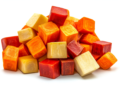
| Small dice | 5 mm | Omelettes, salsa, fillings |
| Medium dice | 1 cm | Curries, stir-fries, pasta sauces |
| Large dice | 2 cm | Roasting, kebabs, chunky stews |
Smaller pieces generally soften faster, while larger pieces retain more texture during cooking.
For example, finely diced peppers blend nicely into an omelette or tomato sauce. Larger pieces are better when you want the pepper to remain noticeable in a stir-fry or roasted vegetable dish.
You don’t need to measure every cube. Keeping the pieces similar in size is usually enough.
Another Way: Cut the Pepper in Half
If you prefer a more familiar approach, you can also deseed a pepper by cutting it in half.
Place the pepper on its side and carefully slice through it lengthwise, passing beside or through the stem.
Open the two halves and remove the core, seeds, and white membranes using your fingers or a small knife.
Shake out any remaining seeds, then place the halves cut-side down or divide them into flatter sections before slicing.
This method works well when you’re preparing pepper halves for stuffing or roasting.
However, if your goal is to dice the pepper, cutting around the core first usually creates less mess and gives you more manageable pieces.
Does Pepper Colour Make a Difference?
Red, yellow, orange, and green bell peppers can all be cut using the same technique.
Their main differences are flavour and maturity.
Green bell peppers are generally harvested before full ripeness and tend to have a slightly grassy, sometimes bitter flavour.
Red bell peppers are usually sweeter because they’ve ripened further. Yellow and orange varieties also tend to have a pleasant sweetness, although flavour depends on the variety.
For a colourful salad or stir-fry, combining different peppers can make the dish more appealing.
The cutting technique remains exactly the same, regardless of colour.
Common Mistakes When Cutting Bell Peppers
One of the most common mistakes is cutting directly through the central core when you only need diced pepper. This releases the seeds and creates extra cleaning work.
Another is trying to dice large, curved pieces without flattening them first. A pepper panel that rocks on the board can make your cuts uneven and less controlled.
Using a dull knife can also be frustrating. Bell pepper skin is smooth and slightly resistant, so a sharp blade makes clean cuts easier.
Finally, avoid rushing through the last few small pieces. Keep your fingers away from the cutting edge and stop when a piece becomes too difficult to hold securely.
What Can You Make With Diced Bell Peppers?
Diced bell peppers are incredibly versatile, which is why learning to prepare them efficiently is so useful.
Add them to scrambled eggs or omelettes for a little sweetness and crunch. Sauté them with onions and garlic as a base for pasta sauces, curries, and rice dishes.
For a fresh salsa, combine finely diced red pepper with tomatoes, onion, coriander, lime juice, and salt.
Larger diced peppers are excellent for roasting with zucchini, onions, and potatoes. They develop a sweeter flavour as they soften and begin to caramelise around the edges.
You can also freeze diced bell peppers for later use in cooked dishes. Their texture becomes softer after thawing, so they’re generally better for soups, sauces, and stir-fries than fresh salads.
A Cleaner Way to Prepare an Everyday Ingredient
Dicing a bell pepper isn’t a particularly complicated kitchen task, but it’s one of those jobs that becomes much easier when you know the right order of cuts.
Instead of slicing through the core and dealing with scattered seeds, you can remove the fleshy sides first, flatten them, and cut them into neat pieces.
It saves a little time, reduces waste, and makes your cutting board much easier to clean.
And the next time a recipe asks for a diced bell pepper, you’ll be able to prepare one without turning your kitchen counter into a collection of tiny white seeds.







Comments 1