There’s a particular kind of confidence that comes from being fluent in a difficult language. For fifteen years, mine was finance. Hand me a set of accounts at Cisco and I could read the story underneath the numbers — where the money was really going, which line was lying, what next quarter would look like. So I was completely unprepared for how illiterate I’d feel holding a recipe. Not the words themselves — I could read ‘fold in the flour’ — but the meaning behind them. How gently? For how long? Until what? A recipe, I slowly realised, is a compressed file. The author has zipped years of assumed knowledge into a few tidy lines, and if you don’t have the software to unzip it, you’re just staring at symbols. Learning to read recipes properly — really read them — was the single most useful thing I did before culinary school.
This is the guide I wish I’d had in that first bewildered year, before Le Cordon Bleu handed me the professional version of all this. It isn’t about any one dish. It’s about becoming literate in the kitchen — able to pick up any recipe, from a scribbled index card to a three-star cookbook, and know exactly what it’s asking of you, what it’s assuming, and where it’s quietly wrong. Once you can do that, you’re no longer dependent on the recipe. You’re in conversation with it.
Read It Like a Flight Plan, Not a Novel
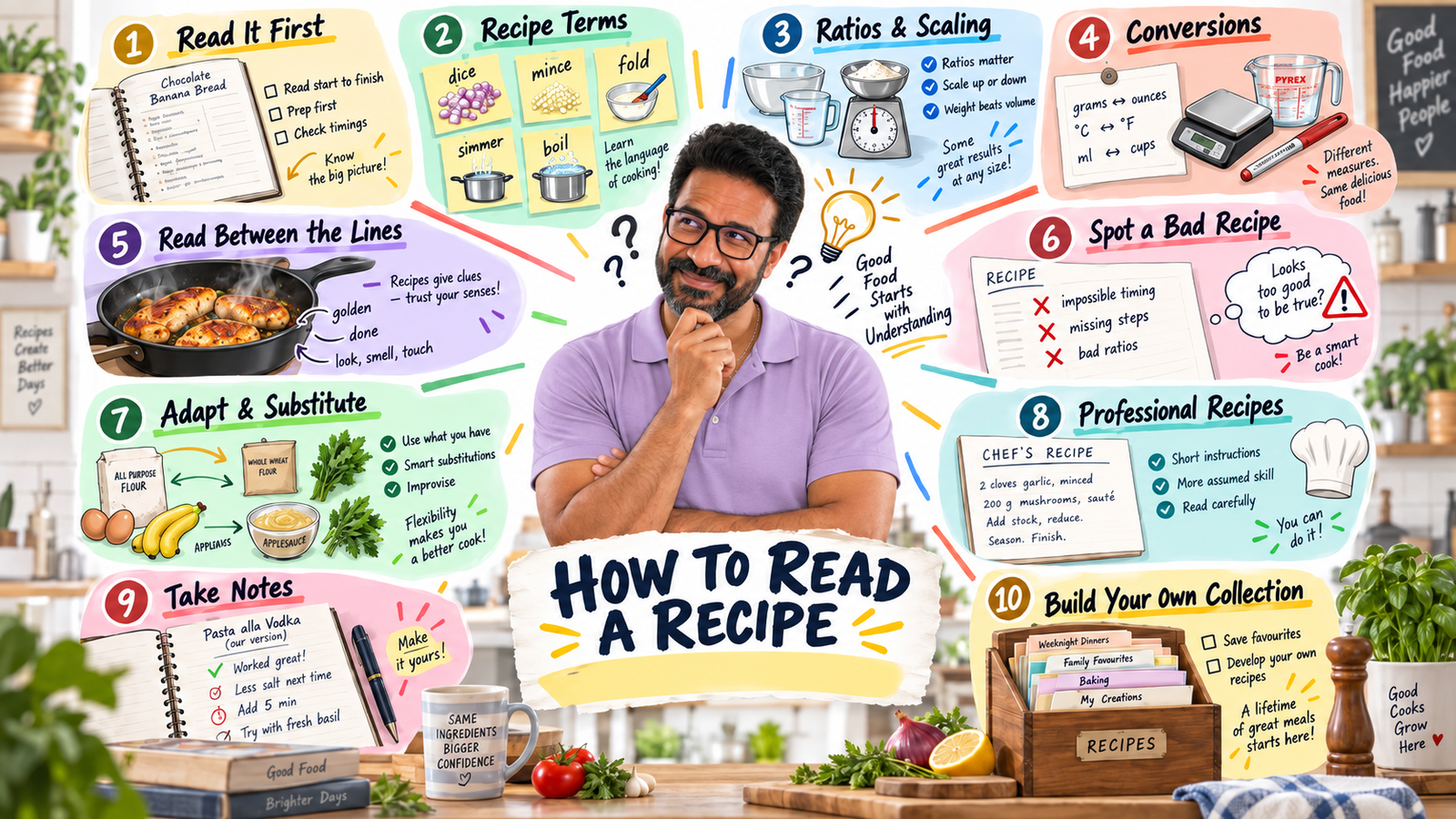
My first and most expensive mistake was treating recipes as something you read while cooking, one line at a time, like following a satnav. Disaster. By the time I read ‘meanwhile, preheat the oven,’ the oven should have been hot twenty minutes ago. The fix is embarrassingly simple: How to Read a Recipe Before Cooking — the whole thing, start to finish, before you touch a single ingredient. And because so much of a recipe lives in its vocabulary, I had to properly learn Common Recipe Terms Decoded — the difference between dice and mince, fold and stir, simmer and boil. Half of what looked like difficulty was just untranslated jargon.
The Numbers Under the Words (This Part I Loved)
Here’s where my old life turned into an unfair advantage. Recipes are, underneath, just ratios — and ratios are the one thing a finance person is never afraid of. Once I understood Understanding Recipe Ratios, whole categories of cooking cracked open: a vinaigrette, a bread dough, a custard are all just proportions you can hold in your head. From there it was a short step to How to Scale a Recipe up or down without it falling apart, and to the surprisingly deep world of How to Follow Baker’s Percentages, which is basically a spreadsheet wearing an apron. The great divide underneath all of it is Weight vs Volume Measurement — the day I switched to a scale and stopped measuring flour in cups was the day my baking stopped being a lottery.
Translating Between Kitchens and Countries
Recipes come from everywhere, and they don’t all speak your dialect. I wasted good ingredients before I learned How to Convert Units and Measures — grams to ounces, millilitres to cups — and Understanding Oven Temperature Conversions, because a European recipe at 180°C and an American one at 350°F are the same instruction wearing different clothes. Cookbooks from abroad hide other assumptions too, which is why Translating International Recipes matters: an ingredient named one thing in London is something else entirely in New York or Delhi. And if you cook anywhere high up, Adjusting Recipes for Altitude explains why your cakes kept collapsing when the recipe swore they wouldn’t.
Reading What the Recipe Doesn’t Say
The best cooks I met at Le Cordon Bleu read recipes the way I used to read financial statements — for what’s missing. A recipe that says ‘cook until golden’ is trusting you to know what golden looks like, so you need Reading Between the Lines of a Recipe and a real grasp of Understanding Doneness Cues, the sensory signals that no recipe can fully write down. Crucially, you also have to develop a nose for How to Spot a Bad Recipe — the ones with impossible timings, missing steps, or ratios that simply won’t work. Not every recipe deserves your trust, and learning to audit one before you commit is a skill in itself. It felt, comfortingly, a lot like due diligence.
Cooking Without a Net
True literacy is when you stop needing the exact ingredients on the page. Some nights you’re missing an item, and How to Adapt a Recipe to What You Have plus a solid understanding of Understanding Ingredient Substitutions is the difference between a shrug and a second trip to the shop. Push a little further and you reach How to Improvise from a Recipe — using it as a springboard rather than a rule — and eventually the professional register itself, How to Read a Professional Recipe, where instructions are terse, assume real skill, and leave enormous amounts unsaid. That fluency is the goal: reading between very few lines.
Keep Records — Your Own P&L of the Kitchen
The finance controller in me never fully left, and thank goodness. The cooks who improve fastest are the ones who keep records, so I became religious about How to Take Notes on Recipes — scribbling in margins what I changed, what worked, what to fix next time. Those notes are data, and data compounds. Over time they became How to Build a Recipe Collection that actually reflects how I cook, not how a stranger does. And at the far end of the road — the destination this whole guide is quietly pointing at — is Developing Your Own Recipes, where you stop reading other people’s compressed files and start writing your own.
From Reader to Author
I think about it like this. When I started, a recipe was a set of orders I obeyed and hoped. Now it’s a conversation between equals — I read it, I question it, I take what’s useful and leave what isn’t, and sometimes I close the book entirely. That shift, from obeying recipes to being in dialogue with them, is what ‘kitchen literacy’ really means, and it’s available to anyone willing to pay attention. You don’t need my finance background to get there; you just need to stop treating recipes as sacred and start treating them as what they are — one cook’s best attempt to hand you what they know. Learn to read that well, and you’ll never be lost in a kitchen again.