When I decided to get serious about cooking, I did what every anxious beginner with disposable income does: I bought things. A finance salary and a guilty conscience about leaving my desk job are a dangerous combination in a kitchen shop. Within a month I owned a spiraliser, an egg separator, an avocado slicer, three novelty gadgets I never opened, and a knife block of matching blades I couldn’t use properly. What I did not own was a single pan good enough to sear a steak. I had confused buying equipment with acquiring skill — the way you might confuse buying a gym membership with getting fit. It took culinary school, and a lot of wasted money, to teach me the truth: a great cook with three good tools will always beat a bad cook with fifty.
So this is the guide I wish someone had forced on me before I opened my wallet. It’s not a shopping list of the most expensive gear — it’s how to think about equipping a kitchen so that every item earns its place. The professional kitchens I later worked in were almost shocking in their sparseness: a few brilliant, battered tools used constantly, and nothing else. That restraint is the goal. Buy less, buy better, and learn to use it all properly.
The Things That Actually Cook Your Food
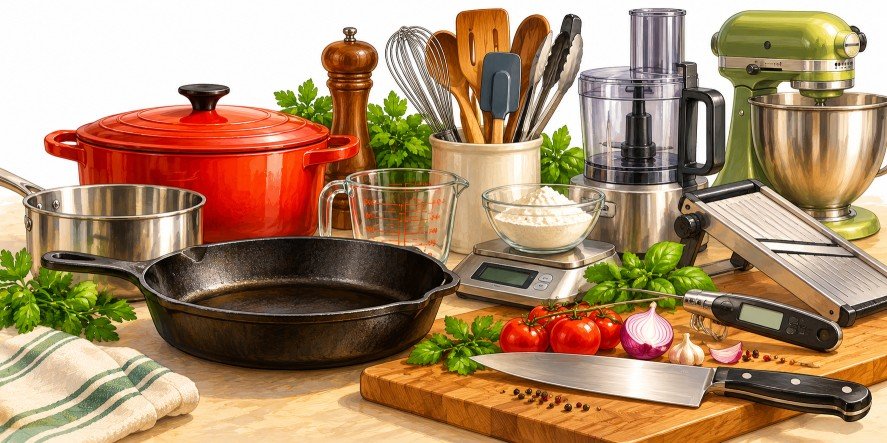
If you spend real money anywhere, spend it on the pans, because they’re where cooking actually happens. Learning Choosing Pots and Pans saved me from my early mistake of buying flimsy sets that warped and scorched. The genuinely useful knowledge is understanding Carbon Steel vs Stainless vs Nonstick — what each surface is for, and why no single pan does everything. The two I’d never give up now are a heavy Choosing a Dutch Oven, which does the work of five pots, and a cast-iron skillet — but cast iron comes with homework, so you’ll want How to Season Cast Iron and, more broadly, How to Maintain Your Cookware, because good pans reward care and punish neglect.
The Knife, and the Handful of Tools You Actually Reach For
A chef’s knife is the one place a beginner should absolutely not economise on skill — the blade matters less than what you do with it, but a cared-for edge changes everything, which is why How to Care for Knives is non-negotiable. Beyond the knife, the revelation for me was how few other tools I truly needed: Essential Small Tools covers the unglamorous heroes — tongs, a fish slice, a good peeler, a whisk — that I reach for every single service. Two supporting cast members deserve a mention: a Choosing Cutting Boards that’s big and stable (small boards are a false economy and a safety hazard), and the How to Use a Mandoline Safely — brilliant, fast, and the tool that has sent more cooks to the emergency room than any other, so it earns its own careful lesson.
Measuring: The Habit My Old Job Gave Me
Here’s where the finance controller in me refused to leave. In baking especially, precision isn’t fussiness — it’s the difference between success and a dense brick, and I trust instruments over guesswork every time. A How to Use a Kitchen Scale is, I’d argue, the highest-value purchase in the entire kitchen: cheap, tiny, and it single-handedly fixed my baking. Its close partner is a How to Use a Thermometer, which took the terror out of cooking meat and tempering chocolate. When you can measure weight and temperature, you stop hoping and start knowing — and for a recovering spreadsheet addict, that felt like coming home.
The Machines: Which Ones Earn Their Counter Space
Appliances are where the money and the clutter really pile up, so I got ruthless about which ones stay. If you bake, Choosing a Stand Mixer is transformative, and Choosing Bakeware is worth getting right once rather than replacing yearly. For everyday cooking, know When to Use a Food Processor versus reaching for a knife, and understand Blenders: High-Speed vs Immersion, because the right blender for soup is not the right blender for smoothies. Two that genuinely changed how I cook at home: How to Use a Pressure Cooker, which turns all-day braises into weeknight dinners, and Sous Vide Equipment Explained, the one piece of restaurant precision that’s now genuinely worth owning. Beyond those, Small Appliances Worth Owning helps you separate the useful from the landfill.
Setting It All Up So It Works
Owning good tools is only half of it; the other half is arranging them so the kitchen works with you. When I learned How to Set Up an Efficient Kitchen — the most-used things within arm’s reach, a clear zone for cutting, everything with a home — my cooking got faster and calmer overnight. It’s the same instinct that made me good at my old job: reduce friction, and good work follows. And if you’re just starting and can’t face spending a fortune, Budget Kitchen Essentials is the honest short list — the handful of things worth buying first, so you can start cooking today rather than saving up for a fantasy kitchen you’ll never quite complete.
Tools Don’t Make the Cook
I still smile at the spiraliser gathering dust in my parents’ garage. It’s a monument to the thing I most want you to avoid: the belief that the next purchase will make you a better cook. It won’t. What makes you better is using a few good tools so often that they become extensions of your hands — the knife you know the weight of, the pan you understand the temper of, the scale you trust without thinking. Buy the essentials, care for them, and spend the money you save on ingredients and mistakes instead. That’s the trade that took me from a drawer full of gadgets to a professional kitchen, and it’s the best financial advice I ever gave myself.