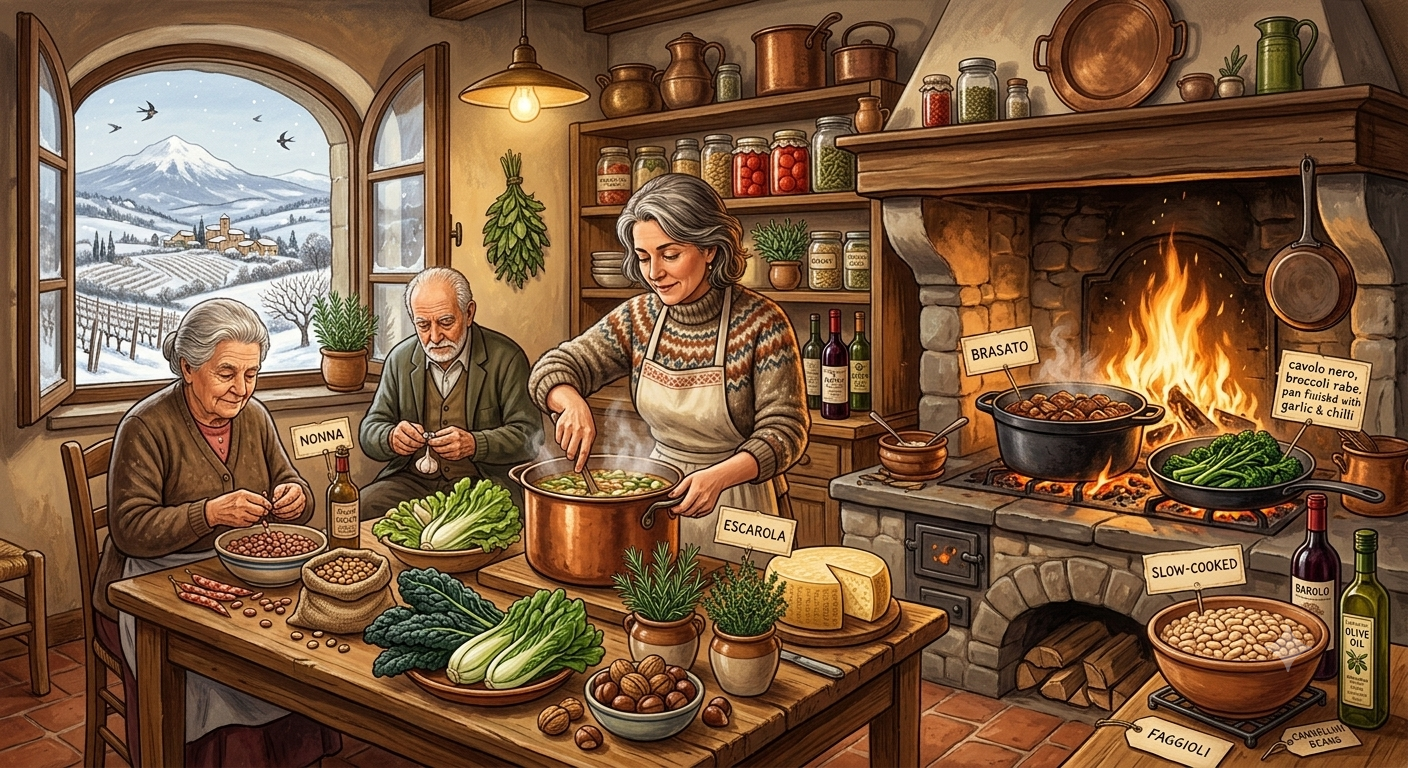
When the weather turns in Italy, the kitchen shifts with it. Summer’s bright tomatoes and delicate herbs give way to something heartier — pots that simmer for hours, greens that hold their own after long cooking, and beans that turn a simple meal into something substantial. Italian winter cooking is not built around a single dish but around three pillars that show up again and again across every region: beans, greens, and braises. Understand how each one works, and you understand the backbone of Italian cold-weather cooking.
Beans: The Quiet Backbone
Long before beans became a trendy pantry staple elsewhere, they were essential to Italian winter cooking, prized for being cheap, filling, and endlessly adaptable. Cannellini, borlotti, and chickpeas appear across the country in soups, stews, and simple side dishes, often forming the true centre of a meal rather than playing a supporting role.
The technique that separates good bean cookery from mediocre is patience. Dried beans, soaked overnight and simmered slowly with aromatics like garlic, sage, and a bay leaf, develop a creaminess that tinned beans rarely match, though tinned beans remain a perfectly respectable shortcut on a busy night. Salt should be added only once the beans have softened, since adding it too early toughens their skins. A generous glug of olive oil stirred in at the end, rather than during cooking, rounds out the flavour and gives the beans a silky finish. Mashing a portion of cooked beans and returning them to the pot is a common trick for thickening soups and stews naturally, without flour or cream.
Greens: Bitterness as a Feature, Not a Flaw
Where summer vegetables lean sweet, Italian winter greens lean bitter, and that bitterness is embraced rather than avoided. Cavolo nero, chicory, escarole, and broccoli rabe all show up regularly in colder months, valued precisely for the assertive, slightly bitter edge they bring to rich, heavy dishes.
The key technique with these greens is understanding that they need real cooking time to soften properly — unlike delicate spinach, which wilts in seconds, hardier winter greens benefit from a longer simmer or braise, which mellows their bitterness and tenderises their tougher fibres. Blanching first in salted water, then finishing in a pan with garlic and chilli, is a common method that tames harshness while preserving texture. These greens are rarely the star of a dish on their own; instead, they are folded into soups, stirred through beans, or layered into braises, where their bitterness balances out richer, fattier elements like sausage, pork, or Parmesan.
Braises: Where Time Becomes Flavour
If beans and greens are the ingredients of Italian winter cooking, braising is the technique that ties them together. A braise relies on low, slow, moist heat to transform tough cuts of meat and firm vegetables into something tender, developing deep flavour along the way that quick cooking simply cannot replicate.
The method typically begins with a hard sear — meat browned aggressively in a hot pan before any liquid is added, building a foundation of flavour through the Maillard reaction. Aromatics follow: onion, carrot, celery, and garlic, cooked briefly before liquid — wine, stock, or tomato — is added to only partially cover the main ingredients. The pot is then covered and left to cook low and slow, whether on the stovetop or in the oven, for anywhere from ninety minutes to several hours, until everything is tender enough to fall apart at the touch of a fork. Braises reward patience above all else; rushing the process with higher heat toughens meat rather than tenderising it, since collagen needs sustained gentle heat to properly break down into gelatin.
Why These Three Belong Together
Beans, greens, and braises are not separate categories so much as complementary elements that Italian winter cooking constantly combines. A braise provides richness and protein; beans add body and heft; greens cut through the richness with bitterness and freshness. Put together in a single pot, they create the kind of meal built for cold evenings — deeply savoury, substantial, and better the next day once the flavours have had time to settle.
White Bean and Sausage Braise with Cavolo Nero
Serves 4
Ingredients
- 2 tbsp olive oil
- 6 Italian sausages
- 1 onion, diced
- 2 carrots, diced
- 3 garlic cloves, minced
- 1 tsp fennel seeds
- ½ tsp chilli flakes
- 200ml white wine
- 500ml chicken stock
- 2 x 400g tins cannellini beans, drained
- 1 bunch cavolo nero, stems removed, roughly chopped
- 1 Parmesan rind (optional)
- Salt and freshly ground black pepper
- Crusty bread, to serve
Method
- Heat the olive oil in a large, heavy-based pot over medium-high heat. Brown the sausages on all sides, then remove and set aside.
- Lower the heat, add the onion and carrots, and cook for 8–10 minutes until softened. Add the garlic, fennel seeds, and chilli flakes, and cook for 1 minute more.
- Pour in the wine, scraping up any browned bits from the base of the pot, and let it reduce for 2–3 minutes.
- Add the stock, beans, and Parmesan rind. Return the sausages to the pot, cover, and simmer gently for 30 minutes.
- Stir in the cavolo nero and cook, uncovered, for a further 10–15 minutes, until the greens are tender and the sauce has thickened slightly.
- Remove the Parmesan rind, season to taste, and serve in bowls with crusty bread.