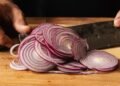
An onion can make you cry, but learning to chop one shouldn’t be another reason.
I used to think dicing an onion was simply a matter of chopping it into smaller and smaller pieces until everything looked roughly the same size. The result was usually a cutting board covered in uneven chunks, with a few pieces flying onto the counter and my eyes watering before I’d even started cooking.
Then I discovered that there’s a much easier way. Instead of chopping randomly, you can use the onion’s natural layers to your advantage. With a few carefully placed cuts, you can turn an entire onion into neat, even pieces without spending ages at the cutting board.
It’s one of those small kitchen skills that makes everyday cooking noticeably easier.
Why Does the Way You Dice an Onion Matter?
You might wonder whether evenly diced onions really make much difference once they’re thrown into a hot pan. After all, won’t everything soften eventually?
Not quite. The size of your onion pieces affects how quickly they cook. Small pieces soften faster and can almost disappear into a sauce, while larger chunks take longer and retain more texture.
For a smooth tomato sauce or curry base, finely diced onions are often ideal. For soups, stews, or dishes where you want a little bite, a medium dice works beautifully.
Even pieces also cook more consistently. When half your onions are tiny and the rest are enormous, the smaller pieces may brown or burn before the larger ones have softened.
Start by Preparing the Onion
Place your onion on a stable cutting board and use a sharp chef’s knife. Trim off the stem end, but leave the root end intact for now. The root helps hold the onion’s layers together while you’re cutting.
Stand the onion on its trimmed end and carefully slice it in half vertically, passing through the root. Remove the dry, papery skin and any tough outer layer.
Place one half cut-side down on the board. This gives you a flat, stable surface and prevents the onion from rolling around.
If you’ve been practising the claw grip, this is a good time to use it. Keep your fingertips curled inward and away from the cutting edge.
How to Dice an Onion Step by Step
With the onion half resting flat on the board, begin making a series of vertical cuts from the stem end toward the root. Keep the cuts parallel to one another, and stop just before the root so the layers remain connected.
The distance between these cuts determines the size of your dice. For finely diced onions, make them closer together. For larger pieces, leave more space.
Now turn the onion so you can slice across those cuts. Use your guiding hand to hold the onion securely, keeping your fingertips tucked behind your knuckles.
As you cut across the onion, the layers naturally separate into small pieces. Continue until you reach the root end, then set the remaining piece aside.
Some chefs also make horizontal cuts through the onion before slicing across it. These can help create a more uniform dice, particularly with large onions, but they’re often unnecessary because the onion already has natural horizontal layers. For beginners, skipping the horizontal cuts is usually easier and safer.
Fine Dice, Medium Dice, or Large Dice?
Not every recipe needs onions cut into tiny cubes. Choosing the right size can make a noticeable difference to the finished dish.
A fine dice, roughly 3–5 mm, works well for sauces, fillings, and dishes where you want the onion to blend into the background. A medium dice, around 6–10 mm, is useful for everyday curries, soups, and sautés. Larger pieces, approximately 1–2 cm, are better suited to chunky stews and slow-cooked dishes.
These measurements are practical guidelines rather than strict rules. What matters most is keeping the pieces reasonably consistent.
If a recipe simply says “one onion, diced,” a medium dice is usually a sensible starting point.
How to Dice an Onion Without Crying
The moment you cut into an onion, its damaged cells release substances that react to form a volatile compound called syn-propanethial-S-oxide. When it reaches your eyes, it causes irritation and tears.
A sharp knife can help because it cuts more cleanly and generally crushes fewer cells than a dull blade. Chilling the onion briefly before cutting may also reduce the release of irritating compounds.
Good ventilation makes a difference too. Working near an extractor fan can help carry the vapours away from your face.
And despite what you may have heard, holding bread in your mouth or balancing a spoon between your teeth isn’t a reliable solution.
Personally, I’d rather use a sharp knife, keep the onion cool, and finish the job without unnecessary fuss.
Common Mistakes When Dicing Onions
One of the most common mistakes is removing the root before cutting. Without it, the onion layers can separate too early, making everything harder to control.
Another is using a dull knife. Instead of slicing cleanly, it crushes the onion and requires more pressure, increasing the risk of slipping.
Trying to chop too quickly is another problem. Professional chefs make dicing look effortless because they’ve repeated the movement thousands of times. There’s no reason to rush while you’re learning.
Finally, avoid chasing tiny pieces of onion around the cutting board with your knife. Gather them with a bench scraper or the flat side of the blade, keeping the sharp edge away from your fingers.
A Small Skill You’ll Use Almost Every Day
Once you learn how to dice an onion properly, you’ll start noticing how often the technique comes in handy. Pasta sauces, curries, soups, stir-fries, omelettes, and countless other dishes begin with a chopped onion.
The first few attempts might be slow, and your pieces probably won’t look perfectly identical. That’s fine. What matters is learning to make controlled cuts while keeping your fingers safe.
After a little practice, the process becomes almost automatic. You’ll trim the onion, halve it, make a few neat cuts, and have everything ready for the pan in less time than you used to spend figuring out where to begin.
And that’s what makes a simple skill like dicing an onion so satisfying. It doesn’t make dinner more complicated. It makes the everyday work of cooking a little easier.