One pan, a handful of ingredients, and dinner on the table without leaving your kitchen looking like a disaster. If you’ve ever wondered how to cook a simple one-pan dinner, this easy beginner’s guide will help—it sounds almost too convenient, but there’s a little technique behind getting it right.
There’s something particularly appealing about a meal that doesn’t require every pot and pan in the cupboard. You chop a few vegetables, add some protein, season everything, and let the heat do most of the work. By the time dinner is ready, you’ve made something satisfying without creating a mountain of dishes.
The first time you try cooking everything in one pan, though, you might discover that it’s not quite as effortless as it looks. The potatoes are still hard, the vegetables have turned soft, and the chicken is browning much faster than everything else. Suddenly, the idea of throwing all your ingredients together doesn’t seem quite so clever.
The secret to a good one-pan dinner is understanding that different ingredients cook at different speeds. Potatoes need more time than courgettes, mushrooms release moisture, and delicate vegetables can become overcooked while you’re waiting for the rest of the meal.
Once you understand how to manage these differences, one-pan cooking becomes one of the easiest ways to prepare everyday meals. It’s affordable, flexible, and particularly useful when you’re learning to cook.
What Exactly Is a One-Pan Dinner?
A one-pan dinner is a complete or nearly complete meal prepared using a single main cooking vessel. That might be a frying pan, a deep skillet, a roasting tray, or a large saucepan. Some recipes cook everything together from the beginning, while others add ingredients gradually.
The appeal is obvious. Fewer utensils, less washing, and a relatively straightforward cooking process. But the real advantage is that ingredients can share flavours as they cook.
When you brown chicken in a skillet, for example, it leaves behind flavourful browned residue. Adding onions, garlic, or vegetables to the same pan allows them to pick up some of those flavours. Similarly, roasting vegetables alongside a seasoned protein can create a delicious combination of aromas and cooking juices.
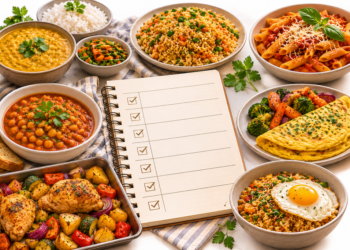
A one-pan meal doesn’t have to be complicated. Rice with vegetables and eggs, chickpeas cooked in tomato sauce, or roasted potatoes with seasonal vegetables can all make satisfying dinners.
The important thing is choosing ingredients that work well together and planning when each one should enter the pan.
Choose the Right Pan Before You Start
The pan you choose can make a surprising difference to the finished meal. A small frying pan might be perfectly suitable for cooking two eggs, but it won’t work nearly as well when filled with potatoes, vegetables, and several pieces of chicken.
Overcrowding prevents moisture from escaping efficiently, which can make food steam rather than brown. This is particularly noticeable with mushrooms and roasted vegetables.
For stovetop cooking, a large skillet or deep frying pan is a practical choice. A heavy-bottomed pan helps distribute heat more evenly, while a lid is useful when ingredients need to simmer or steam. If you’re cooking in the oven, a sturdy roasting tray or sheet pan gives ingredients enough room to spread out.
You don’t need expensive cookware. A dependable pan that’s large enough for your ingredients will make a much greater difference than owning several specialised pieces of equipment.
Understand Which Ingredients Cook First
One of the biggest mistakes beginners make with one-pan dinners is adding everything at the same time. It sounds convenient, but ingredients rarely share identical cooking times.
Potatoes, carrots, and other dense vegetables generally need longer to soften than mushrooms, spinach, or courgettes. Onions often benefit from cooking before garlic, while delicate greens usually need only a short time near the end.
The simplest solution is to cook in stages.
Begin with ingredients that take the longest, then add quicker-cooking foods as the meal progresses. If you’re preparing a vegetable skillet, you might start with potatoes or carrots, followed by onions and peppers, and finish with spinach or other leafy greens.
The size of your ingredients matters too. Small pieces cook more quickly than large ones, so cutting vegetables into reasonably even sizes helps them cook consistently.
You don’t need to memorise exact cooking times for every ingredient. Just remember that dense ingredients usually need a head start, while delicate ingredients are better added later.
Learn to Build Flavour in One Pan
One-pan cooking becomes much more interesting when you understand how flavours develop during cooking.
Imagine making a simple chickpea and vegetable skillet. You could place everything in the pan, add water, and simmer until tender. It would probably be edible, but the flavour might be disappointing.
Now imagine beginning with a little oil and chopped onion. You cook the onion until softened, add garlic and spices briefly, then stir in tomatoes and chickpeas. The ingredients are similar, but the cooking sequence allows different flavours to develop.
Browning is particularly useful. When ingredients are cooked over suitable heat, their surfaces can develop complex flavours through reactions such as the Maillard reaction. These browned flavours contribute depth to many savoury dishes.
Fat also helps distribute aromatic compounds from spices and herbs. That’s why gently heating cumin, paprika, or garlic in oil can make them smell much more pronounced.
The trick is to build flavour gradually rather than expecting every ingredient to develop its best characteristics when added simultaneously.
A Simple One-Pan Dinner Recipe: Chicken and Vegetables
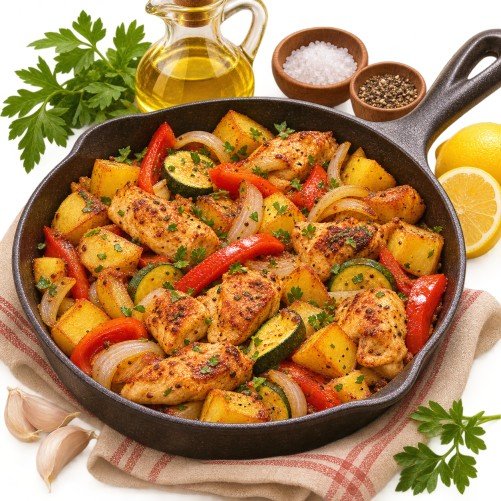
If you’re learning one-pan cooking, a chicken and vegetable skillet is a useful place to start. It teaches you how to prepare ingredients, control heat, cook in stages, and bring everything together in one pan.
This version uses familiar ingredients and can be adapted to suit what you already have.
Ingredients
Serves: 2
Preparation time: 15 minutes
Cooking time: Approximately 25–35 minutes
- 250–300 g boneless, skinless chicken breast, cut into bite-sized pieces
- 1 medium potato, cut into small cubes
- 1 small onion, sliced
- 1 small bell pepper, cut into pieces
- 1 small courgette, sliced
- 2 garlic cloves, finely chopped
- 2 tablespoons olive oil or another suitable cooking oil
- ½ teaspoon paprika
- ½ teaspoon dried oregano
- Salt and black pepper, to taste
- 100–150 ml water or unsalted stock, as needed
- A little lemon juice, to finish
- Fresh parsley or coriander, optional
Step 1: Prepare Everything Before Heating the Pan
Start by washing the vegetables and cutting them into manageable pieces. Keep the potato cubes relatively small so they cook without taking too long. Slice the onion and pepper, chop the garlic, and prepare the courgette.
Cut the chicken on a separate board or clean and sanitise your equipment before using it for other ingredients. Wash your hands thoroughly after handling raw poultry, and avoid washing the chicken itself, since splashing water can spread bacteria around the sink.
Having everything ready before cooking is especially helpful with one-pan meals because several ingredients need to be added at different stages.
Step 2: Give the Potatoes a Head Start
Heat one tablespoon of oil in a large skillet over medium heat. Add the potato cubes with a small pinch of salt and cook for about five minutes, stirring occasionally.
Add approximately 100 ml of water or stock, cover the pan, and allow the potatoes to steam gently for another five to eight minutes, or until they’re beginning to soften. Add a little more liquid if necessary to prevent the pan from drying out.
Once the potatoes are nearly tender, remove the lid and allow the remaining moisture to evaporate. Transfer the potatoes to a clean plate temporarily.
This extra step helps prevent the common problem of having perfectly cooked vegetables alongside potatoes that are still hard in the middle.
Step 3: Cook the Chicken
Add the remaining tablespoon of oil to the same pan and increase the heat slightly if necessary. Season the chicken with paprika, oregano, salt, and black pepper, then add it to the skillet.
Spread the pieces out so they have contact with the hot surface. Let them cook briefly before turning, allowing some browning to develop.
Continue cooking for several minutes, turning as needed. The chicken doesn’t have to be fully cooked before you add the remaining vegetables, because it will continue cooking in the pan. However, it must reach a safe internal temperature of 74°C (165°F) before serving. Use a food thermometer to check the thickest pieces.
Step 4: Add the Vegetables
Add the sliced onion and bell pepper to the pan. Cook for several minutes, stirring occasionally, until they begin to soften.
Stir in the courgette and cook for another few minutes. Add the garlic closer to the end of this stage so it becomes fragrant without burning.
If browned bits have collected on the bottom of the pan, add a small splash of water or stock and gently scrape them loose with a suitable utensil. This process, called deglazing, helps incorporate those flavours into the dish.
Step 5: Bring Everything Together
Return the potatoes to the skillet and stir gently to combine them with the chicken and vegetables.
Cook until the potatoes are completely tender, the vegetables are cooked to your liking, and the chicken has reached 74°C (165°F) throughout. If the pan becomes too dry before everything is ready, add a little water or stock and cover briefly.
Taste the vegetables and sauce, then adjust the seasoning as needed. Finish with a small squeeze of lemon juice and some fresh herbs if you have them.
Serve directly from the pan or divide between two plates. You now have a complete meal with protein, vegetables, and potatoes, all cooked using one main pan.
How to Make a Vegetarian One-Pan Dinner
One-pan cooking works just as well without meat. In fact, some of the easiest versions use beans, chickpeas, lentils, eggs, or tofu.
A chickpea and tomato skillet is a good example. Begin by softening chopped onions in olive oil, then add garlic, cumin, and paprika. Stir in canned tomatoes and drained chickpeas, and allow everything to simmer until the sauce thickens.
Add spinach near the end and cook just until it wilts. Finish with lemon juice and fresh herbs.
If you want something more substantial, serve the skillet with bread or use cooked rice as part of the dish.
Tofu is another useful option, particularly when you want a meal with more protein. Firm tofu can be patted dry, cut into cubes, and browned before adding vegetables and sauce.
The same principles apply: build flavour first, consider cooking times, and avoid overcrowding the pan.
Five Common One-Pan Cooking Mistakes
The most common problem is overcrowding. When too many ingredients are packed into a small pan, moisture accumulates and browning becomes difficult. Use a larger pan or cook some ingredients in batches if necessary.
Another mistake is adding everything at once. Potatoes and leafy greens simply don’t need the same cooking time. Start with dense ingredients and finish with delicate ones.
Using too much liquid can also turn a skillet dinner into an accidental stew. Water and stock are useful for steaming, simmering, and loosening browned residue, but add them gradually unless you’re deliberately making a saucy dish.
Cooking on excessive heat can burn garlic and spices before the other ingredients are ready. Adjust the temperature as the cooking process changes. Browning may need relatively high heat, while simmering requires a gentler temperature.
Finally, forgetting to taste can leave an otherwise well-cooked meal disappointing. Check the seasoning near the end and consider whether the dish needs salt, acidity, or another small adjustment.
How to Make One-Pan Meals More Interesting
Once you’re comfortable with the basic technique, you can change the character of a one-pan meal simply by adjusting the ingredients and seasonings.
For an Italian-inspired version, try tomatoes, garlic, oregano, courgettes, and white beans. A little olive oil and fresh basil can bring everything together.
For an Indian-inspired skillet, begin with onions, cumin, turmeric, and coriander, then add potatoes, cauliflower, peas, or chickpeas. Finish with fresh coriander and a little lemon juice.
A Spanish-inspired version might use smoked paprika, peppers, tomatoes, and chickpeas, while a Mediterranean-style combination could include aubergine, courgettes, olives, and herbs.
These aren’t strict traditional recipes. They’re simple ways to experiment with familiar flavour combinations while practising the same cooking method.
The more often you cook this way, the easier it becomes to look at a few ingredients in the fridge and imagine how they might work together.
Can You Prepare One-Pan Dinners in Advance?
One-pan meals can be useful for meal preparation because many components reheat well. Cooked vegetables, beans, and certain saucy dishes can be portioned into containers for later meals.
However, texture matters. Crispy potatoes may soften after refrigeration, and delicate vegetables can become mushy when reheated repeatedly. If you’re preparing food ahead, choose ingredients that tolerate storage and reheating.
Refrigerate perishable leftovers promptly in shallow containers. As a general rule, don’t leave them at room temperature for more than two hours, or one hour in temperatures above 32°C (90°F). Keep the refrigerator at 4°C (40°F) or below, and use most cooked leftovers within three to four days.
When reheating leftovers containing cooked chicken, heat them thoroughly to 74°C (165°F).
You can also save time by preparing ingredients rather than cooking the entire meal. Chopped vegetables, measured spices, and ready-to-use beans make it much easier to assemble dinner when you’re tired.
The Best One-Pan Dinner Is the One You’ll Actually Make Again
There’s no need for a one-pan dinner to look like something from a restaurant. Sometimes it’s simply a few potatoes, vegetables, and an egg cooked in a skillet. Other evenings, it might be a rich tomato sauce with chickpeas or a pan of chicken and roasted vegetables.
What matters is understanding the small decisions that make everything cook properly.
Choose a pan with enough room, prepare your ingredients before starting, cook dense foods before delicate ones, and adjust the heat as you go. Build flavour gradually and taste before serving.
Once you’ve made a few meals this way, you’ll start recognising combinations that work. You’ll know when the potatoes need a head start, when to add the garlic, and when the pan needs a splash of liquid.
And perhaps the best part comes after dinner, when you look at the kitchen and realise that there’s only one main pan waiting to be washed.