DOWNLOAD IOS
DOWNLOAD ANDROID
  • About
    Us
  • Home
    Cooks
  • Pro-Chefs &
    Enthusiasts
  • Food
    Historians
  • Sustainability
    Advocates
  • Curious
    Learners
  • Science
    Nerds
No Result
View All Result
  • About
    Us
  • Home
    Cooks
  • Pro-Chefs &
    Enthusiasts
  • Food
    Historians
  • Sustainability
    Advocates
  • Curious
    Learners
  • Science
    Nerds
No Result
View All Result
cookdom.blog
No Result
View All Result
Home Italian Cuisine

How Italian Meals Are Structured

by Som Dasgupta
February 2, 2026
in Italian Cuisine
Reading Time: 2 mins read
3
0
How Italian Meals Are Structured
4
SHARES
20
VIEWS
Share on FacebookShare on TwitterShare on Reddit

An Italian meal is less a sequence of courses than a slow choreography of appetite. It is designed not to impress the diner, but to move them — from curiosity to comfort, from hunger to satisfaction, and finally back to lightness again.

This meal structure did not emerge from restaurant menus but from domestic life. In households across Italy, meals evolved around the rhythm of the day, the season, and the ingredients available. Lunch was historically the main meal, heavy enough to sustain labour; dinner was lighter, gentler, more reflective. Over time, this practical rhythm hardened into a cultural grammar.

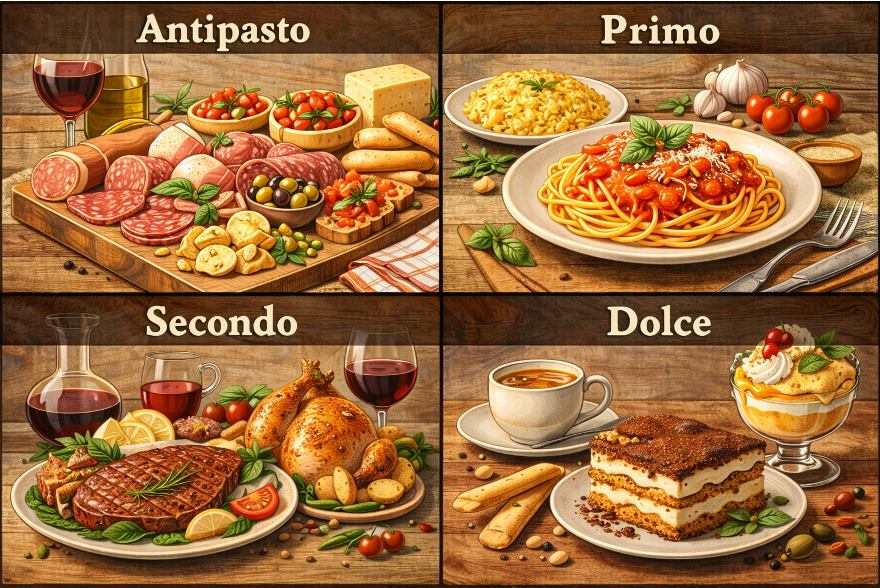
Antipasti do not “start” the meal so much as open a conversation. They are meant to sharpen perception: the briny snap of olives, the bright acidity of marinated vegetables, the silky fat of prosciutto. Nothing here is meant to fill you up. It is a reminder that eating is sensory before it is satiating.

The primi is where Italian cooking reveals its emotional core. Pasta, risotto, or soup are not simply carbohydrates — they are vehicles for memory. A bowl of minestrone carries the garden with it; a plate of ragù speaks of long Sundays and patient simmering. This is why so many iconic dishes belong to this course, and why so many Italian chefs still see pasta as the soul of their cooking. (You might later link this to posts on Ragù alla Bolognese, Risotto technique, or Minestrone across regions.)

Secondi shifts the register. The focus narrows to a single protein — a fish grilled simply, a chicken roasted with lemon, a steak cooked over wood. Italian cooks rarely drown these dishes in sauce; the confidence lies in quality and restraint. What accompanies them is just as important: the contorni. Vegetables here are not garnish but counterpoint, cutting richness, adding bitterness, or bringing freshness back into the meal.

Dessert completes the circle. It is often soft, creamy, or cold — tiramisu, panna cotta, gelato — designed to soothe rather than overwhelm. Coffee follows not as an afterthought but as closure, a final punctuation mark that signals the meal is over.

What this meal structure ultimately teaches is that eating, in Italy, is temporal. Each course has a job, a mood, and a pace. When you understand this, you stop thinking about dishes in isolation and start thinking about meals as stories with a beginning, middle, and end.

This is why structure matters: it shapes not only what Italians eat, how they distribute their meals, but how they feel while eating.

Previous Post

Tartiflette

Next Post

Why Italian Flavours Work

Som Dasgupta

Som Dasgupta

Related Topics

What is Idli Rice and Why It’s Used in South Indian Recipes

What is Idli Rice and Why It’s Used in South Indian Recipes

July 10, 2025
257
Dosa Recipe: Learn to Make Crispy South Indian Dosai

Dosa Recipe: Learn to Make Crispy South Indian Dosai

February 3, 2026
256
Kebabs: Techniques, Types, and Tradition

Kebabs: Techniques, Types, and Tradition

July 22, 2026
250
Why Preheat the Oven?

Why Preheat the Oven?

April 9, 2025
213
Making a Green Oil: Mastering the Technique

Making a Green Oil: Mastering the Technique

March 24, 2025
205
Napoleonic Wars and Canned Food Invention.

Napoleonic Wars and Canned Food Invention.

February 2, 2026
175
Floating Island (Île Flottante): A Classic French Dessert

Floating Island (Île Flottante): A Classic French Dessert

February 3, 2026
163
An Introduction to French Cooking

An Introduction to French Cooking

June 7, 2026
155
Next Post
Why Italian Flavours Work

Why Italian Flavours Work

Leave a Reply Cancel reply

Your email address will not be published. Required fields are marked *

Newsletter

Cookdom App

Popular

  • How to Break Down a Whole Chicken: A Step-by-Step Guide

    1 shares
    Share 0 Tweet 0
  • Honing With a Steel: How to Keep Your Kitchen Knife Sharp

    1 shares
    Share 0 Tweet 0
  • How to Sharpen a Knife: A Beginner’s Guide to a Razor-Sharp Edge

    1 shares
    Share 0 Tweet 0
  • Slicing vs. Chopping vs. Mincing: What’s the Difference?

    1 shares
    Share 0 Tweet 0
  • How to Chiffonade Herbs: The Secret to Perfectly Thin Ribbons

    1 shares
    Share 0 Tweet 0
  • An Introduction to Indian Cooking

    22 shares
    Share 9 Tweet 6

About Us

  • Mission
  • Platform
  • Methodology
  • FAQs
  • Contact Us

Cooking

  • Courses
  • French
  • Indian
  • Italian
  • Spanish

Privacy

  • Policy
  • Terms and Conditions
  • Community Guidenlines

Community

  • Facebook
  • X
  • Instagram
  • TikTok
  • Reddit
  • Linkedin
  • Pinterest
  • © Cookdom, Inc.
  • Terms of Service
  • Privacy Policy

Welcome Back!

Login to your account below

Forgotten Password?

Retrieve your password

Please enter your username or email address to reset your password.

Log In
No Result
View All Result
  • About Us
  • Home Cooks
  • Pro-Chefs &
    Enthusiasts
  • Sustainability
    Advocates
  • Science Nerds
  • Food
    Historians
  • Curious
    Learners
  • DOWNLOAD IOS
  • DOWNLOAD ANDROID
  • Login