
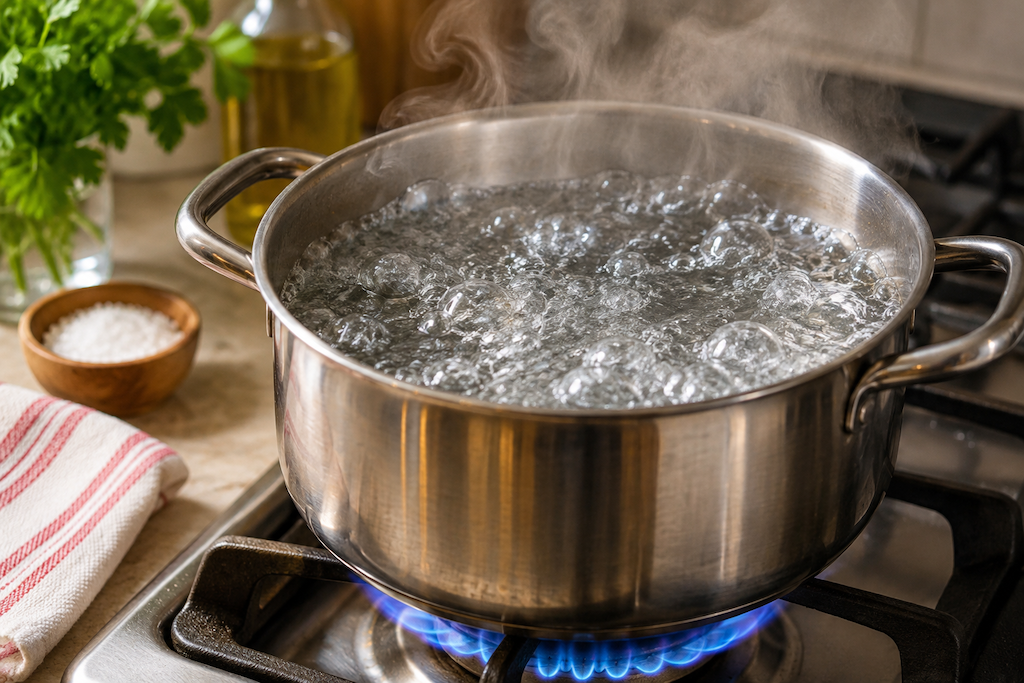
How to boil water properly sounds like the kind of question nobody should need to ask. Put water in a pot, turn on the stove, wait for bubbles. Done. Except the moment you start cooking pasta, blanching vegetables, making stock, or boiling eggs, you realize that “boiling water” is not always as simple as it sounds.
There is a difference between a few bubbles appearing at the bottom of a pan and a full rolling boil. The amount of water matters. The size of the pot matters. A lid can save time, and adding salt at the wrong moment can be inconvenient. None of this makes boiling water difficult, but understanding what is happening gives you much better control in the kitchen.
Start With the Right Pot
Before thinking about temperature, choose a pot that comfortably holds both the water and whatever you plan to cook in it. Filling a small saucepan almost to the top might save space, but the moment you add pasta or potatoes, you risk water spilling over the sides.
For pasta, use enough room for the water to move around the food. For a few eggs, a smaller saucepan makes more sense. There is no prize for using the biggest pot in the cupboard.
Also, remember that more water takes more energy and usually more time to heat. If you only need 500 ml, boiling three litres simply wastes time.
What Does Boiling Water Actually Look Like?
One of the easiest mistakes when learning how to boil water is assuming that the first bubbles mean the water is boiling.
They do not.
As water heats, you may notice tiny bubbles forming along the bottom and sides of the pot. Continue heating and those bubbles become more active. Eventually, large bubbles rise continuously to the surface and disturb it vigorously. That is what cooks generally call a rolling boil.
At standard atmospheric pressure, water boils at about 100°C or 212°F. At higher elevations, lower atmospheric pressure means water boils at a lower temperature.
You rarely need a thermometer, though. Your eyes are usually enough.
Should You Put a Lid on the Pot?
Yes, especially when your goal is simply to get the water boiling.
A lid reduces heat loss and helps the water reach boiling temperature faster. Once the water boils, you can remove or partially open the lid depending on what you are cooking.
This is particularly useful when preparing a large pot of water for pasta.
However, watch the pot after adding starchy ingredients. Pasta water can foam and rise quickly, so keeping a tightly covered pot over high heat can lead to a messy boil-over.
How to Boil Water Properly for Cooking
Start with the amount of water your food actually requires. Place the pot over suitable heat and cover it if you want to speed things up. Once the water reaches the stage required by your recipe, add the food and adjust the heat.
That last part is often forgotten.
You do not always need to keep the burner at maximum once the water is boiling. Water cannot simply become endlessly hotter while boiling under the same pressure. Extra heat mainly makes it boil more aggressively and evaporate faster.
For pasta or blanching vegetables, a steady boil is useful. For potatoes, soups, stocks, and many other foods, a gentler simmer may be more appropriate after the initial boil.
When Should You Add Salt?
This depends on what you are making.
For pasta, salting the cooking water is important because it seasons the pasta as it cooks. You can add the salt once the water is hot or boiling, then stir before adding the pasta.
You may have heard that salt makes water boil dramatically faster. In normal cooking quantities, the effect on boiling temperature is far too small to provide a meaningful shortcut.
So salt the water for flavor, not speed.
For vegetables, potatoes, and other foods, follow the needs of the particular recipe rather than treating salted water as a universal rule.
A Boil and a Simmer Are Not the Same Thing
Knowing this difference will improve your cooking far more than simply memorizing a temperature.
A rolling boil is energetic. Large bubbles continuously break across the surface. A simmer is calmer, with smaller bubbles appearing more gently.
Pasta can handle active boiling. A delicate soup, stock, sauce, or piece of fish often benefits from gentler heat.
If a recipe tells you to “bring to a boil, then reduce to a simmer,” it is asking you to do two different things. First, get the liquid hot enough to boil. Then lower the heat so it cooks steadily without violently bubbling.
Why Boiling Water Properly Matters
Learning how to boil water properly is really about learning heat control.
Once you recognize the stages between cold water, gentle heating, simmering, and a rolling boil, recipes become easier to understand. You stop treating the stove like an on-and-off switch and start controlling how aggressively food cooks.
That skill carries into pasta, rice, vegetables, eggs, soups, stocks, sauces, and countless other dishes.
Boiling water may be the simplest technique in the kitchen, but it teaches one of cooking’s most useful lessons: simple does not mean careless.


