
The secret to chopping vegetables safely isn’t how you hold the knife. It’s what you do with your other hand.
Have you ever watched a professional chef chop an onion at an almost ridiculous speed and wondered how they manage to keep all their fingers intact? Their knife moves up and down, the vegetables fall into perfectly even pieces, and somehow their fingertips never seem to get in the way.
The secret is a simple technique called the claw grip. It might feel a little awkward when you first try it, especially if you’re used to holding vegetables flat against the cutting board. But once you get comfortable with it, chopping becomes safer, more controlled, and surprisingly easier.
And the best part? You don’t need an expensive knife or professional training to learn it.
What Is the Claw Grip?
The claw grip is a knife safety technique used to hold food securely while keeping your fingertips away from the cutting edge.
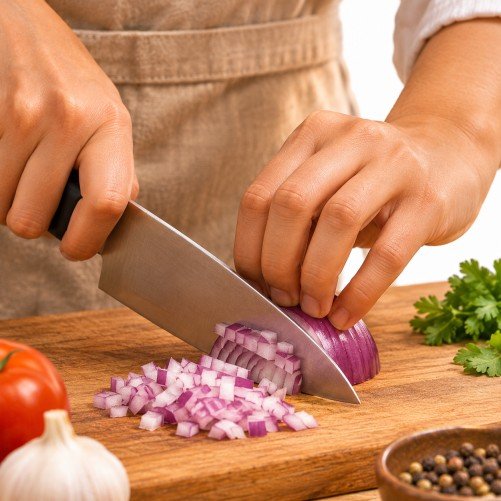
Instead of spreading your fingers across an onion or carrot, you gently curl them inward, almost as though you’re holding a small ball. Your fingertips tuck behind your knuckles, while your thumb stays safely behind your fingers.
The knuckles of your middle fingers form a guide for the side of the knife blade. As you chop, the blade moves up and down beside them, helping you maintain consistent slices without exposing your fingertips.
It might sound uncomfortable, but the grip should feel relaxed rather than tense. You’re simply creating a protective barrier between the knife and your fingers.
How to Hold Your Fingers Correctly
Start with something easy to control, such as a cucumber or a carrot with a flat side.
Place the vegetable on a stable cutting board and rest your non-knife hand on top. Curl your fingertips inward so that your nails point toward the food rather than toward the blade. Keep your thumb tucked behind your fingers.
Your knuckles should extend slightly farther forward than your fingertips. This allows the flat side of the knife blade to move beside your knuckles while the sharp edge stays away from your fingers.
Hold the knife comfortably with your other hand and begin making slow, controlled cuts.
Don’t worry about speed. At first, the movement might feel unnatural, particularly when you need to move your guiding hand backward as the vegetable becomes smaller.
With practice, you’ll learn to move your hand gradually while keeping your fingertips curled.
Why the Claw Grip Makes Chopping Safer
Imagine slicing an onion while holding it with your fingertips spread out. Every time the knife comes down, there’s a chance that one finger could move into its path.
The claw grip reduces that risk by keeping your fingertips tucked away from the cutting edge.
It also gives you better control over the ingredient. Your curled fingers help hold the food steady, while your knuckles provide a reference point for making even cuts.
However, the claw grip isn’t a guarantee against injury. If your knife slips, your cutting board moves, or you try to chop faster than you can control, accidents can still happen.
That’s why a sharp knife, a stable cutting surface, and deliberate movements are just as important as the grip itself.
Practise With an Onion
An onion is a useful ingredient for practising the claw grip because it requires several controlled cuts.
Begin by cutting the onion in half from top to root, then place the flat side against your cutting board. This prevents it from rolling while you work.
With your fingertips curled into the claw position, hold the onion securely and make a series of careful slices. Keep your guiding hand behind the cutting edge and move it gradually as you work.
If you’re dicing the onion, you can make additional cuts according to your preferred method, but always reposition your hand safely before changing the direction of the knife.
The goal isn’t to produce restaurant-perfect cubes immediately. It’s to become comfortable keeping your fingers protected while the knife moves.
Once the onion becomes too small to hold safely, stop using the claw grip and reposition it, use a suitable tool, or set the remaining piece aside. Trying to chop the last tiny bit is rarely worth the risk.
Don’t Forget Your Knife Hand
While the claw grip protects the hand holding the food, the hand controlling the knife matters just as much.
Many cooks prefer the pinch grip, where the thumb and index finger gently hold opposite sides of the blade just in front of the handle, while the remaining fingers wrap around the handle.
This can provide better control than gripping only the end of the handle, particularly when using a chef’s knife.
Keep your wrist comfortable and let the knife move naturally. Avoid forcing the blade through ingredients or making exaggerated chopping movements.
A sharp, properly maintained knife usually requires less pressure than a dull one, which can help reduce slipping.
Common Claw Grip Mistakes
The most common mistake is curling your fingers only halfway. If your fingertips extend beyond your knuckles, they may still be exposed to the blade.
Another mistake is pressing your knuckles too firmly against the knife. The blade should move smoothly beside your guiding hand without excessive pressure or scraping.
Some beginners also try to copy the speed of professional chefs before they’ve developed control. This usually makes the technique harder to learn.
Start slowly and concentrate on accuracy. Speed can develop naturally as your movements become more familiar.
And remember to stabilise your cutting board. A damp cloth or non-slip mat underneath can prevent it from sliding across the counter.
Does the Claw Grip Work for Every Ingredient?
The claw grip is particularly useful when slicing onions, carrots, cucumbers, potatoes, and other ingredients that can be held securely on a cutting board.
But not every ingredient is suited to exactly the same hand position.
Large vegetables may need to be cut into manageable pieces first. Round ingredients such as tomatoes can be easier to control once they have a flat surface. Very small ingredients, such as garlic cloves, may require a different approach or a suitable kitchen tool.
The important principle remains the same: keep your fingers away from the cutting edge and make sure the ingredient is stable before cutting.
Good Knife Skills Begin With Good Habits
The first few times you try the claw grip, you’ll probably find yourself stopping to reposition your fingers. You might even feel slower than before. That’s completely normal when you’re learning a new movement.
But after preparing a few onions, carrots, and cucumbers, the position begins to feel more familiar. You’ll start holding vegetables correctly without having to think about every finger.
What makes the claw grip worth learning is that it changes the way you approach chopping. Instead of concentrating entirely on where the knife is going, you begin paying attention to how both hands work together.
And that’s one of the most useful kitchen habits you can develop. A good cook doesn’t need to chop at extraordinary speed. They need to chop with confidence, control, and enough care to keep their fingers safely out of the way.







Comments 1