
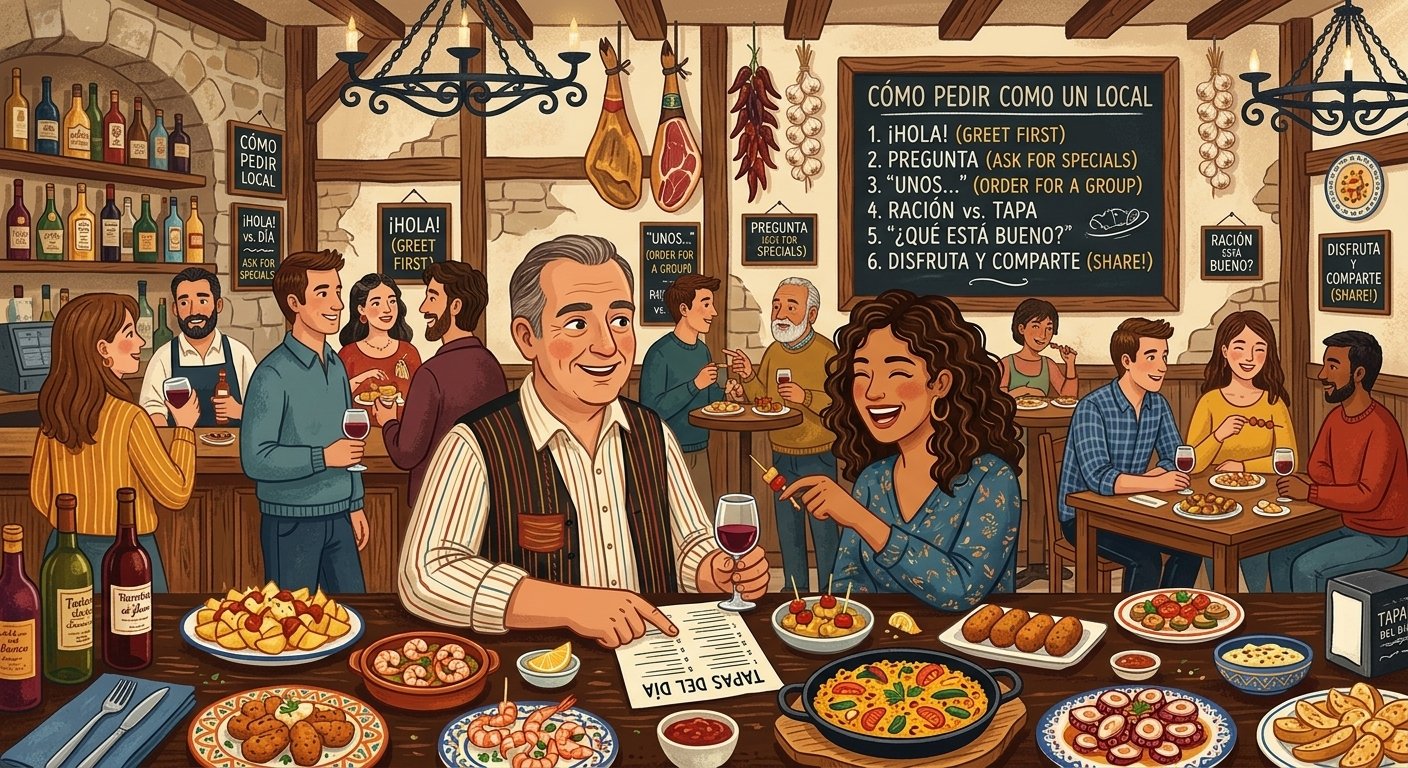
Spanish tapas are much more than small plates of food. They represent a social way of eating built around conversation, drinks, sharing, and discovering different flavors. Walk into a lively bar in Spain and you may see people standing at the counter, ordering one or two dishes, finishing their drinks, and moving somewhere else. Understanding this relaxed rhythm is the real secret to ordering like a local.
However, customs change considerably across Spain. What feels completely normal in Granada may work differently in Madrid, Seville, or San Sebastián. Therefore, learning to observe the room matters more than memorizing strict rules.
What Are Spanish Tapas?
Spanish tapas are generally small portions of food served alongside drinks or ordered as part of an informal meal. However, their size, price, and presentation vary throughout the country.
Some bars provide a complimentary bite with a drink, while others charge separately for each dish. Meanwhile, modern restaurants may serve sophisticated small plates that resemble miniature restaurant courses.
Popular choices include olives, jamón, anchovies, tortilla española, croquetas, meatballs, fried seafood, and patatas bravas.
Therefore, the tradition represents more than portion size. It describes a relaxed and social approach to eating.
Understanding Spanish Tapas Bar Etiquette
One of the easiest ways to understand tapas culture is to watch what local customers are doing.
Are people ordering directly at the counter? Does a waiter visit each table? Are customers standing while eating? Does a small dish automatically arrive with their drinks?
A quick look around can answer several questions.
Traditional establishments may expect customers to order at the counter. In contrast, sit-down restaurants usually provide table service.
Instead of assuming every place follows the same system, adapt to the rhythm of the room.
Start With a Drink
Drinks have long played an important role in Spanish tapas culture.
Beer remains a popular choice. You may hear customers request a caña, generally meaning a small draft beer. Depending on the region, wine, vermouth, sherry, or cider may also accompany the food.
Once your drink arrives, consider what you would like to eat.
In Granada, some establishments still provide a complimentary tapa with a drink. However, this custom does not apply everywhere.
Consequently, never assume every drink in Spain automatically includes free food.
Useful Phrases for Ordering Tapas in Spain
You do not need fluent Spanish to order confidently. A few practical expressions can make the experience much easier.
“Una caña, por favor.”
A small draft beer, please.
“Una tapa de croquetas, por favor.”
A small portion of croquetas, please.
“¿Qué nos recomienda?”
What do you recommend for us?
“¿Cuál es la especialidad de la casa?”
What is the house specialty?
“La cuenta, por favor.”
The bill, please.
Most importantly, keep things simple and polite. Perfect pronunciation matters much less than patience and courtesy.
Spanish Tapas Portion Sizes Explained
Before ordering Spanish tapas, it helps to understand three common terms: tapa, media ración, and ración.
A tapa generally means a small portion designed for tasting.
A media ración means a half portion and works well when two or three people want to share several dishes.
A ración is a larger serving, usually intended for sharing.
However, exact sizes vary between establishments. For example, five full raciones could be far too much food for two people.
Therefore, ask about portion sizes whenever you are uncertain.
Don’t Order Everything at Once
Visitors sometimes treat Spanish small-plate dining like a conventional restaurant meal and immediately order six or seven dishes.
Instead, begin with one or two plates.
Eat them, enjoy your drink, and then decide whether you want more. Alternatively, you may pay and continue to another bar.
This slower approach keeps the experience flexible. Moreover, ordering gradually often means hot dishes arrive fresher.
The meal should unfold naturally rather than landing on the table all at once.
Choosing the Best Spanish Small Plates
Many establishments become locally famous for one particular dish.
Therefore, asking “¿Cuál es la especialidad de la casa?” can lead to something more memorable than automatically choosing familiar favorites.
One bar might specialize in tortilla española. Another may serve exceptional croquetas, fried anchovies, mushrooms, seafood, or jamón.
Look around too.
If nearly every local customer has ordered the same plate, there is probably a good reason.
Following house specialties also helps you discover regional cooking rather than eating identical dishes everywhere you travel.
Sharing Is Part of Spanish Tapas Culture
Sharing plays an important role in Spanish tapas dining.
Instead of everyone ordering an individual main course, groups often place several dishes in the center of the table.
Consequently, four people might taste tortilla, croquetas, jamón, anchovies, and patatas bravas during the same meal.
However, sharing remains informal.
Nobody needs to divide every plate perfectly. Someone takes a croqueta, another reaches for some jamón, and the conversation continues.
In this way, food supports the social experience rather than controlling it.
How Tapas in Spain Change by Region
Spain does not follow one universal small-plate dining system.
In Granada, many establishments maintain the tradition of providing complimentary food with drinks.
Meanwhile, bars in Madrid may offer a simple snack while charging separately for substantial dishes.
In Seville, ordering small portions of several dishes remains deeply connected with local eating culture.
Travel north to the Basque Country, however, and you will frequently encounter pintxos.
Therefore, eating like a local means adapting to regional traditions rather than expecting the same experience everywhere.
Tapas and Pintxos: What’s the Difference?
Spanish tapas and pintxos overlap, but they do not always describe the same type of food.
Pintxos are particularly associated with the Basque Country and cities such as San Sebastián and Bilbao.
Traditionally, some consisted of ingredients arranged on bread and held together with a small stick. Today, however, pintxos range from simple skewers to sophisticated miniature dishes.
An Andalusian bar and a San Sebastián pintxos counter can therefore provide noticeably different experiences.
Nevertheless, both traditions encourage variety, conversation, and sampling several foods rather than committing to one large plate.
Why Standing at the Bar Is Normal
Visitors often enter a crowded Spanish bar and immediately search for an empty table.
However, standing at the counter is completely normal in many establishments.
The bar puts you close to the food and makes ordering another drink or dish easier. Furthermore, popular places may have limited seating.
Standing also encourages shorter visits, which works particularly well when people plan to move between several bars.
So, when locals happily gather around the counter, there is no need to wait anxiously for a table.
Tapeo and Spanish Tapas Culture
One of the most enjoyable ways to experience Spanish tapas is through tapeo—moving between bars for drinks and small dishes.
Start with one drink and a house specialty at the first establishment.
Then move somewhere else.
Perhaps the first stop serves excellent tortilla, the second specializes in seafood, and the third has unforgettable croquetas.
As a result, an ordinary evening becomes a miniature food tour.
This tradition also explains why smaller portions work so well. Instead of filling yourself at the first stop, you leave room to discover something different at the next.
Paying at a Spanish Bar
Payment systems vary between establishments.
Some bars keep track of everything until customers ask for the bill. Others expect payment directly at the counter.
When you are ready to leave, simply say:
“La cuenta, por favor.”
Although traditional systems can sometimes appear surprisingly informal, experienced staff usually keep track of orders efficiently.
Tipping also tends to be more modest in Spain than in countries where large percentage-based tips are standard. Leaving a small amount for good service can be appreciated, but large tips are generally unnecessary.
Common Mistakes When Ordering Spanish Tapas
Several simple mistakes can make your Spanish tapas experience more confusing than necessary.
First, do not assume every drink includes a free tapa.
Next, avoid ordering several full raciones before understanding their size.
Timing also matters. Spaniards often eat later than visitors from many other countries, so arriving extremely early may mean finding a much quieter atmosphere.
Moreover, do not restrict yourself to famous dishes you already recognize.
Try local cheeses, preserved fish, regional vegetables, seafood, or whatever the establishment recommends.
Curiosity often leads to the most memorable meals.
How Locals Enjoy Spanish Tapas
Ultimately, enjoying Spanish tapas like a local has less to do with complicated etiquette and more to do with understanding the pace of the experience.
Observe the bar first. Start with a drink and a small amount of food. Ask what the establishment does best, share dishes with your group, and order another round only when you want it.
Sometimes you will stay for several plates. Other times, you will finish one dish, pay, and walk to another bar.
Above all, avoid rushing.
Spanish small-plate dining turns food into a social activity built around variety, conversation, curiosity, and movement.
The goal is not simply to consume as many dishes as possible. Instead, eat a little, talk a little, try something unfamiliar, and allow each bar to show you what it does best.
That relaxed rhythm is the real pleasure of Spanish tapas.


