
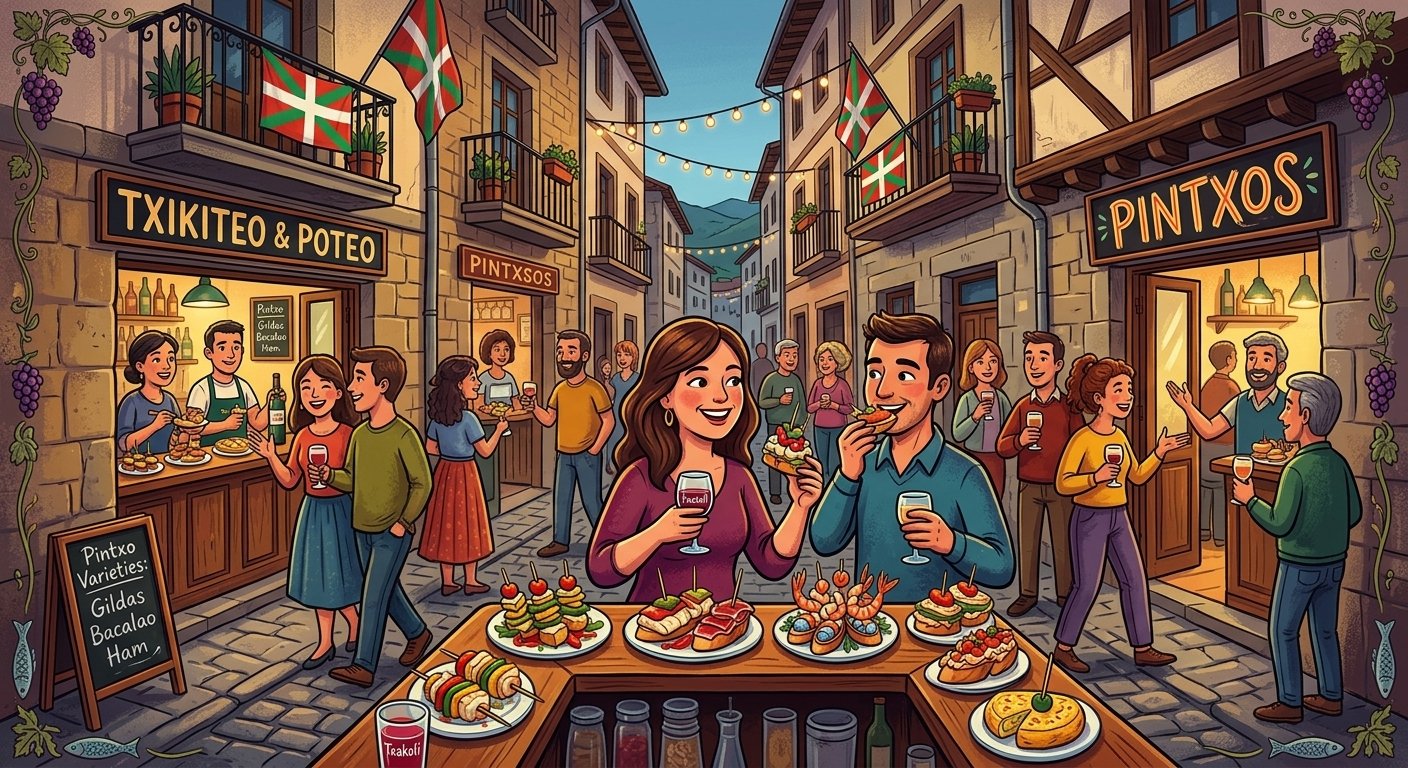
A Pintxo Crawl is one of the most enjoyable ways to understand Basque food culture. Rather than spending the whole evening at one restaurant, people move from bar to bar, enjoying a small drink and perhaps a pintxo at each stop. In the Basque Country, this social ritual connects with traditions known as txikiteo and poteo. Yet these words describe more than simply going out for drinks. They reflect friendship, routine, neighborhood life, and a distinctly social approach to eating.
For visitors, hopping between pintxo bars can feel like a culinary adventure. For locals, however, it can simply be part of everyday social life.
What Is a Pintxo Crawl?
A Pintxo Crawl involves visiting several bars rather than settling into one establishment for an entire meal.
At each stop, you might order one drink and one pintxo. After enjoying them, you move to the next bar and try something different.
Therefore, the evening develops gradually.
One bar may specialize in anchovies, while another serves excellent tortilla. The next might be famous for mushrooms, seafood, croquetas, or an elaborate modern pintxo.
This movement creates variety without requiring a huge meal at any single location.
More importantly, the experience keeps the evening social and energetic.
Understanding Txikiteo in Basque Culture
The word txikiteo comes from txikito, traditionally referring to a small glass of wine.
Historically, groups of friends would move between bars while drinking small servings, particularly wine. Instead of staying for hours in one place, they followed a familiar route through neighborhood establishments.
Conversation mattered just as much as the drinks.
Consequently, txikiteo developed into a social ritual. Regular groups could meet, visit familiar bars, talk with friends and bartenders, and continue along their usual circuit.
Food may accompany the drinks, especially in today’s pintxo culture. However, the tradition is not simply a food tour.
Its deeper purpose is social connection.
What Does Poteo Mean?
Poteo describes another closely related Basque social tradition.
The word comes from pote, an informal term for a drink. Ir de poteo essentially means going from bar to bar for drinks.
Although txikiteo historically carries a strong association with small glasses of wine, poteo can include beer, wine, cider, or other drinks.
In modern conversation, the boundaries between these terms can overlap.
However, both describe something important: drinking as a social activity connected with movement between bars rather than remaining in one place.
When pintxos join the experience, the result resembles what visitors often call a Basque bar crawl or pintxo crawl.
Pintxo Crawl vs. a Typical Bar Crawl
Calling the tradition a “bar crawl” can create the wrong impression.
In some countries, a bar crawl focuses heavily on drinking large amounts of alcohol. A Pintxo Crawl, by contrast, often emphasizes moderation, food, conversation, and variety.
You might have a small beer or wine alongside one pintxo before moving to another establishment.
Therefore, the goal is not necessarily to drink as much as possible.
Instead, each stop provides a new flavor, atmosphere, and conversation.
The portions themselves support this rhythm. Small drinks and small bites make it possible to visit several establishments without becoming full too quickly.
Why Pintxos Work Perfectly for Bar-Hopping
Pintxos naturally suit the tradition of moving between bars.
They are small enough to eat quickly but varied enough to make each stop interesting. Furthermore, individual establishments often develop reputations for particular specialties.
A traditional pintxo might feature anchovies, peppers, tortilla, seafood, or cured meat. Meanwhile, modern bars may serve carefully constructed miniature dishes using contemporary culinary techniques.
As a result, pintxo hopping becomes an opportunity to compare different cooking styles.
Rather than ordering five specialties from one kitchen, you can try five bars and discover what each does best.
That variety lies at the heart of the experience.
How to Start a Pintxo Crawl
A successful Pintxo Crawl does not require a complicated plan.
Choose an area with several bars within walking distance. In San Sebastián, for example, neighborhoods with concentrated pintxo bars make moving between establishments particularly easy.
At the first stop, look around before ordering.
Notice what other customers are eating. Check the counter, but also look for menu boards because many excellent hot pintxos need to be ordered from the kitchen.
Then choose one or two specialties and a drink.
Afterward, pay according to the establishment’s system and continue to the next stop.
The key is restraint. Ordering too much at the first bar defeats the purpose of the crawl.
What Should You Drink During Txikiteo?
Wine has a historical connection with txikiteo, particularly through the txikito, the small serving that helped give the tradition its name.
However, modern drink choices are broader.
Beer is common, while txakoli, the distinctive Basque wine, can pair beautifully with seafood and salty pintxos. Cider also has an important place in Basque drinking culture.
Non-alcoholic drinks are equally possible if you want to participate in the social ritual without alcohol.
The important point is pace.
Because the evening may involve several stops, smaller servings make much more sense than large drinks at every bar.
How to Choose Pintxos Like a Local
When entering a busy pintxo bar, avoid immediately ordering everything that catches your eye.
First, look for the house specialty.
If several customers are ordering the same hot dish, consider trying it. Likewise, ask the bartender what the establishment does particularly well.
“¿Cuál es la especialidad?” means “What is the specialty?”
You can also ask:
“¿Qué pintxo recomienda?”
“Which pintxo do you recommend?”
These simple questions can lead you toward dishes you might otherwise overlook.
Furthermore, remember that not every great pintxo sits on the counter. Many of the best-known specialties in modern bars come hot from the kitchen.
The Social Rhythm of Poteo
The real pleasure of poteo comes from movement and conversation.
You enter a bar, greet people, order something small, talk, and then continue elsewhere.
This rhythm prevents the evening from becoming too formal.
Moreover, each establishment changes the atmosphere slightly. One bar may feel traditional and crowded, while the next has contemporary food and a younger crowd.
The streets between bars become part of the experience too.
Instead of separating dinner from socializing, poteo blends food, drinks, walking, and conversation into one continuous evening.
Don’t Rush Through the Experience
A Pintxo Crawl involves movement, but that does not mean speed.
There is no prize for visiting the greatest number of bars.
Instead, allow enough time to appreciate what each establishment offers. Taste the food, enjoy the drink, and pay attention to how locals interact with the space.
At the same time, avoid becoming too settled.
If you order several large dishes and spend two hours at the first stop, you have turned the experience into a conventional dinner.
The ideal pace sits somewhere between rushing and lingering.
Pintxo Etiquette Worth Knowing
Busy Basque bars can initially appear chaotic. However, they usually have their own rhythm.
Be patient when ordering and make your request clearly when the bartender reaches you.
Additionally, do not assume that every establishment uses exactly the same ordering or payment system. Some may expect payment immediately, while others keep track until you finish.
If you are uncertain, observe other customers or simply ask.
Most importantly, respect the limited space. Crowded bars depend on people making room for others rather than occupying unnecessary counter space.
These small habits make pintxo hopping much easier.
Why Txikiteo Is About More Than Food
Visitors may remember the anchovies, tortilla, seafood, and glasses of wine. Yet txikiteo has survived because it offers something beyond eating.
Repeated routes create familiarity.
People return to the same neighborhood bars, encounter familiar faces, and strengthen social relationships. Bartenders become part of that network, while streets and establishments become connected with shared memories.
Therefore, the tradition shows how bars can function as social spaces rather than simply businesses selling food and drinks.
A pintxo may provide the reason to enter, but conversation often provides the reason to stay.
The Pintxo Crawl as a Taste of Basque Life
A Pintxo Crawl offers an unusually direct way to experience Basque food culture because it combines eating with the places and people surrounding the food.
Txikiteo contributes the tradition of moving through familiar bars with small drinks. Poteo broadens that idea into the social practice of going out for drinks from place to place. Pintxos, meanwhile, transform each stop into a chance to taste something different.
Together, these traditions create an evening that feels less like a formal meal and more like a journey through a neighborhood.
The secret is simple: order small, move gradually, try the house specialty, and leave room for the next stop.
Ultimately, the Pintxo Crawl is not about how many bars you can visit. It is about turning food, drinks, walking, and conversation into one shared experience—and understanding why, in Basque culture, the journey between bars can matter just as much as what is waiting on the counter.


