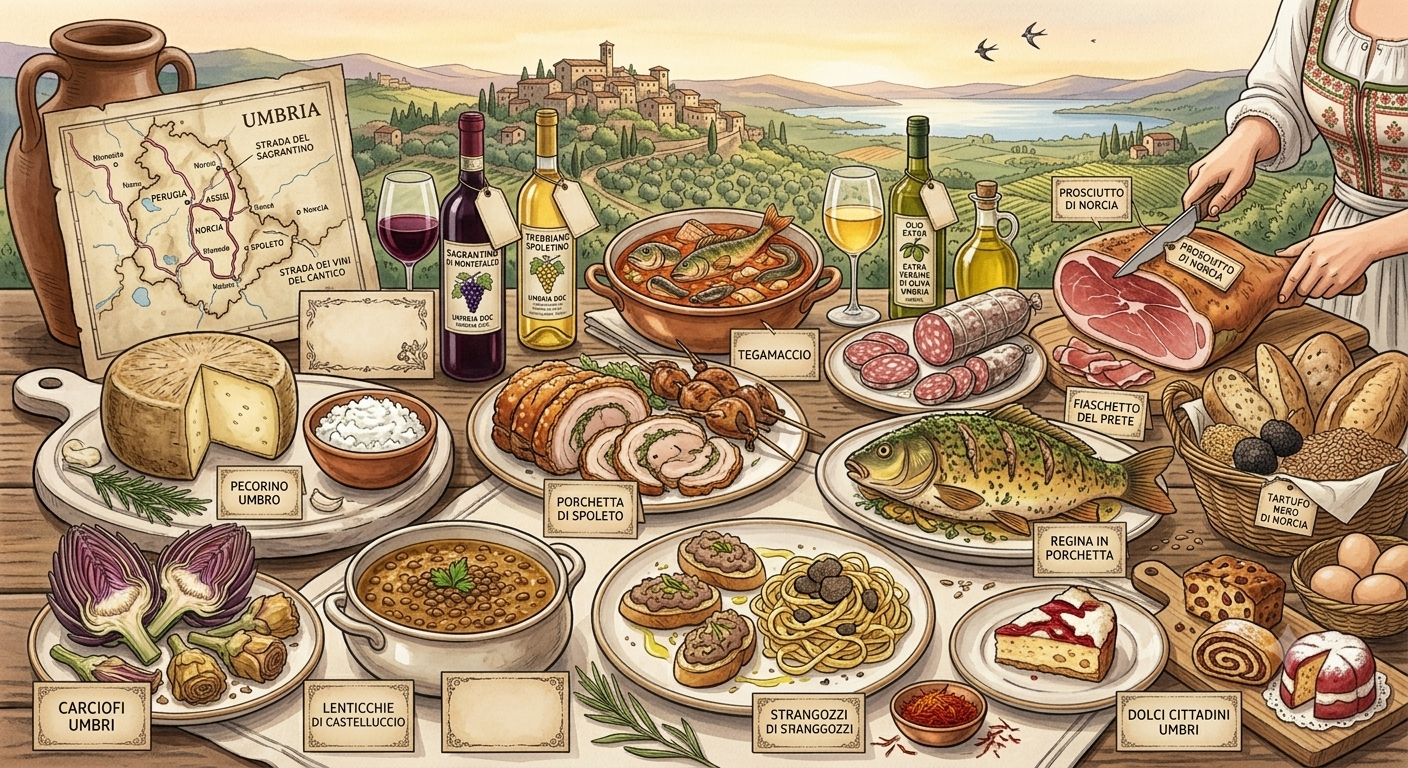
Umbria is the only Italian region with neither a coastline nor a border with another country, and that landlocked isolation has shaped its food as much as anything else. Nicknamed il cuore verde d’Italia — the green heart of Italy — for its rolling hills, dense forests, and lack of sea access, Umbria developed a cuisine turned entirely inward: built on pork, truffles, lentils, and the kind of rustic, unfussy cooking that defines a region historically removed from outside influence. Where coastal regions built their identity around the day’s catch, Umbria built its around what the land and the forest floor could reliably provide.
Truffles: A Region Defined by What Grows Underground
Umbria rivals Piedmont as one of Italy’s most significant truffle-producing regions, and the town of Norcia is particularly renowned for its prized black truffles, available for a longer season than the fleeting white truffles found further north. Unlike white truffles, which are almost always used raw, black truffles hold up slightly better to gentle heat, though Umbrian cooks still treat them with considerable restraint.
The technique here favours simplicity above all else. Truffles are shaved thin over dishes at the last possible moment — a plate of fresh pasta, a simple fried egg, a round of soft cheese — allowing their intense aroma to perfume the dish without being cooked away. Because truffles are prized for scent as much as flavour, Umbrian cooks generally avoid pairing them with anything too assertive; garlic, cream, and strong cheeses are used sparingly, if at all, so as not to compete with the truffle itself.
Norcineria: The Art of Pork Butchery
Few regions in Italy hold pork in as much esteem as Umbria, and nowhere is this clearer than in the town of Norcia itself, whose name has become genuinely synonymous with pork butchery across the country — a skilled pork butcher anywhere in Italy is still often called a norcino. This tradition developed out of necessity in a landlocked region with limited refrigeration access historically, where curing and preserving pork was essential to making it last through the year.
The techniques passed down through generations of norcini are exacting: prosciutto and other cured meats are salted and air-dried for months in the cool mountain air, while sausages and salami are seasoned with local ingredients like wild fennel and black pepper before curing. Wild boar, abundant in Umbria’s forests, receives similar treatment, transformed into cured salami or slow-braised into rich ragùs. This deep, patient relationship with pork — curing, aging, and slow-cooking rather than quick preparation — runs through nearly every corner of Umbrian cuisine.
Lentils and the Legacy of Simple, Humble Ingredients
If truffles represent Umbria’s luxury and pork represents its craft, lentils represent its humility. The lentils of Castelluccio, grown on a high plateau beneath the Sibillini mountains, are considered among the finest in Italy — small, thin-skinned, and prized for cooking evenly without needing to be soaked beforehand, unlike many other dried legumes.
The technique with Castelluccio lentils is refreshingly simple: because their skins are so delicate, they hold their shape well through gentle simmering, making them ideal for hearty stews and soups without turning to mush. They are traditionally paired with pork sausage, another nod to the region’s butchery tradition, and appear at New Year’s tables across Italy as a symbol of prosperity, their coin-like shape considered a good omen for the year ahead. Farro, another regional staple, follows a similar spirit — a humble, ancient grain turned into soups and simple salads with minimal intervention.
A Cuisine of Restraint and Patience
What ties truffles, pork, and lentils together is a shared Umbrian sensibility: let good, local ingredients do the work, and resist the urge to overcomplicate them. Whether it is a truffle shaved sparingly over pasta, a sausage cured slowly over months, or a pot of lentils simmered until just tender, Umbrian cooking consistently favours a light hand and genuine patience over elaborate technique. It is a cuisine shaped by isolation, but one that turned that isolation into a deep, enduring culinary identity all its own.
Lenticchie di Castelluccio con Salsiccia (Umbrian Lentils and Sausage)
Serves 4
Ingredients
- 250g Castelluccio lentils (or other small green lentils)
- 3 tbsp olive oil, plus extra to serve
- 1 onion, finely diced
- 1 carrot, finely diced
- 1 celery stalk, finely diced
- 2 garlic cloves, minced
- 6 Italian pork sausages
- 1 bay leaf
- A sprig of rosemary
- 700ml vegetable or chicken stock
- Salt and freshly ground black pepper
Method
- Rinse the lentils and set aside; they do not require soaking.
- Heat 2 tablespoons of olive oil in a large pot and sauté the onion, carrot, and celery over medium-low heat for 8–10 minutes until softened. Add the garlic and cook for 1 minute more.
- In a separate pan, heat the remaining olive oil and brown the sausages on all sides.
- Add the lentils, bay leaf, and rosemary to the pot with the vegetables, then pour in the stock.
- Bring to a simmer and cook, uncovered, for 25–30 minutes, until the lentils are tender but still hold their shape, adding more stock if needed.
- Nestle the browned sausages into the pot for the final 10–15 minutes of cooking, allowing them to finish cooking through and flavour the lentils.
- Season to taste, remove the bay leaf and rosemary sprig, and serve with a drizzle of good olive oil.