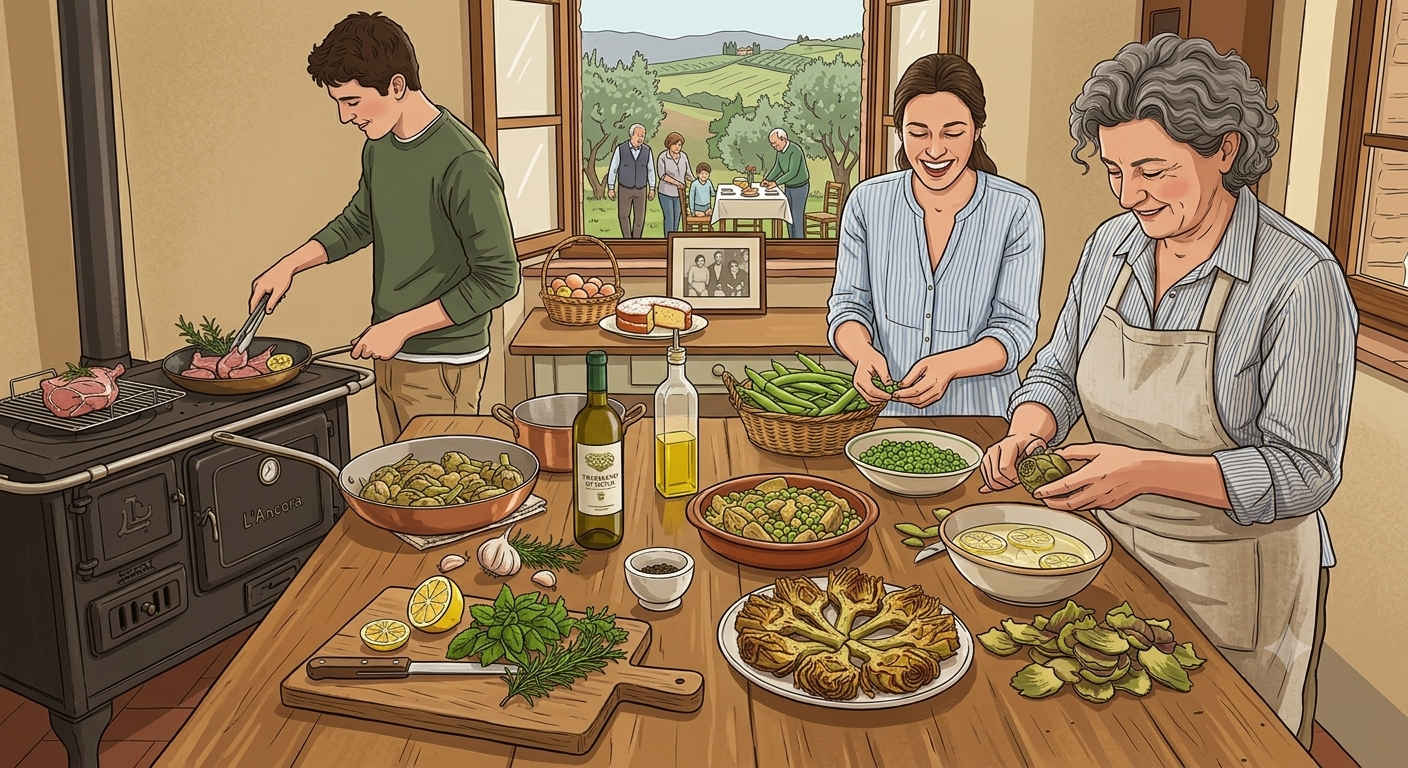
After winter’s long braises and autumn’s earthy richness, spring arrives in the Italian kitchen like a held breath finally released. Markets fill almost overnight with baby artichokes, fresh fava beans, tender peas, and the first lamb of the season. Everything on offer is young, delicate, and fleeting — spring vegetables in particular have a narrow window before they toughen, which shapes the entire way Italian cooks approach this time of year. Three ingredients capture the season best: artichokes, fava beans and peas, and spring lamb.
Artichokes: A Vegetable Worth the Effort
Few vegetables demand as much preparation for as much reward as the artichoke. Their tough outer leaves and fibrous choke hide a tender heart that, once properly cleaned, becomes remarkably versatile — braised whole, sliced thin and eaten raw, or fried until crisp, as in the Roman-Jewish classic carciofi alla giudia.
The essential technique with artichokes is speed and acid. Once cut, artichoke flesh oxidises and browns within minutes, so prepared pieces are dropped immediately into water acidulated with lemon juice to keep them pale. Removing the tough outer leaves down to the pale, tender inner ones, then trimming the stem and scooping out the fibrous choke, takes practice but is far from difficult once the motion is familiar. Baby artichokes, harvested before the choke fully develops, are often the easiest entry point, since much of this trimming becomes unnecessary. Cooked gently in olive oil with garlic and white wine, artichokes soften into something silky, their slightly bitter, mineral flavour mellowing considerably with heat.
Fava Beans and Peas: Sweetness at Its Freshest
Nothing signals spring in an Italian kitchen quite like the arrival of fresh fava beans and peas, sold still in their pods and prized for a sweetness that fades quickly once picked. Unlike their dried, winter counterparts, these vegetables need barely any cooking at all — their whole appeal lies in preserving that brief, fleeting freshness rather than developing deep flavour through long simmering.
Fava beans require a bit of technique to enjoy at their best: after shelling, the beans are often blanched briefly and then peeled a second time, removing the slightly bitter outer skin to reveal the tender, bright green bean underneath. It is an extra step many home cooks skip, but one that transforms the texture from slightly waxy to genuinely delicate. Peas need almost nothing beyond a very brief cook, whether blanched, sautéed with a little butter and mint, or, in the case of very young peas, simply eaten raw straight from the pod. Both vegetables are often paired together, their sweetness and texture complementing one another in classic spring dishes.
Spring Lamb: A Seasonal and Symbolic Centrepiece
Lamb takes on particular significance in Italian spring cooking, tied closely to Easter celebrations across the country. Young, milk-fed lamb, slaughtered before it has grazed on grass, offers a milder, more delicate flavour than the lamb available later in the year, and it is traditionally the centrepiece of the Easter table in many Italian households.
The technique suited to spring lamb differs from the long, slow braises of winter game. Because the meat is naturally tender, quicker cooking methods work well — roasting whole racks or legs at high heat, or pan-searing chops just until pink in the centre. Rosemary, garlic, and lemon are classic companions, their brightness echoing the freshness of the season rather than the deep, warming spices favoured in winter cooking. When lamb is braised in spring, it is usually a shorter, gentler braise than a winter stew, often incorporating the season’s fresh vegetables directly into the pot towards the end of cooking.
A Season of Restraint and Timing
What unites artichokes, fava beans and peas, and spring lamb is the same lesson repeated across all of Italian spring cooking: timing matters more than technique. These ingredients are at their best for only a few short weeks, and much of the cook’s job is simply not overcooking them, not masking their delicate flavours, and getting them to the table while they are still genuinely fresh. It is a briefer, gentler counterpart to the patience-driven cooking of colder months.
La Vignarola (Roman Spring Vegetable Stew)
Serves 4
Ingredients
- 4 baby artichokes
- Juice of 1 lemon
- 3 tbsp olive oil
- 1 small onion or 4 spring onions, sliced
- 100g pancetta or guanciale, diced (optional)
- 300g fresh peas, shelled
- 300g fresh fava beans, shelled and peeled
- 100ml vegetable stock or water
- A handful of fresh mint, torn
- Salt and freshly ground black pepper
Method
- Trim the artichokes down to their pale, tender leaves, halve or quarter them, and place immediately in water with the lemon juice.
- Heat the olive oil in a wide pan over medium heat. Add the onion and pancetta, if using, and cook for 5 minutes until softened.
- Drain the artichokes and add them to the pan. Cook for 5 minutes, stirring occasionally.
- Add the peas, fava beans, and stock. Cover and simmer gently for 10–15 minutes, until all the vegetables are tender.
- Uncover and let any excess liquid reduce for a few minutes.
- Stir through the fresh mint, season with salt and pepper, and serve warm as a side dish or light main with crusty bread.