Salt can make tomatoes taste sweeter, help meat retain moisture, and transform a bland soup into something delicious. But what exactly happens when you add it to food?
Imagine preparing two identical bowls of vegetable soup. Both contain the same carrots, onions, tomatoes, and spices. The only difference is that one has been seasoned with salt, while the other hasn’t.
When you taste them, the difference is immediately noticeable. The salted soup seems richer, the vegetables taste more distinct, and the broth feels more complete. Yet nothing about the main ingredients has changed.
This is what makes salt such an important ingredient in cooking. Its influence extends far beyond adding a salty taste.
Salt changes how we perceive flavours, interacts with proteins, influences moisture movement, and affects the texture of everything from bread dough to cooked vegetables.
Understanding how salt works in cooking helps explain why professional chefs season at different stages, why meat is sometimes salted hours before cooking, and why even sweet desserts often contain a pinch of salt.
What Is Salt, and Why Is It Important in Cooking?
The salt most commonly used in cooking is sodium chloride, a crystalline compound made of sodium and chloride ions.
When salt dissolves in water or the moisture present in food, it separates into these ions. They can then interact with taste receptors and components of the food.
Sodium ions are particularly important in producing the familiar salty taste.
But salt’s role extends beyond taste perception. It also influences protein behaviour, moisture distribution, fermentation, and preservation.
These effects depend on the amount of salt used, the food’s composition, and how long the salt remains in contact with the ingredients.
A small pinch added just before serving may change flavour immediately, while salt applied to meat several hours before cooking can influence its internal seasoning and texture.
How Salt Makes Food Taste Better
Salt improves flavour partly because it changes how different tastes are perceived.
At suitable concentrations, salt can suppress the perception of certain bitter compounds. It may also make sweetness and other flavours seem more noticeable.
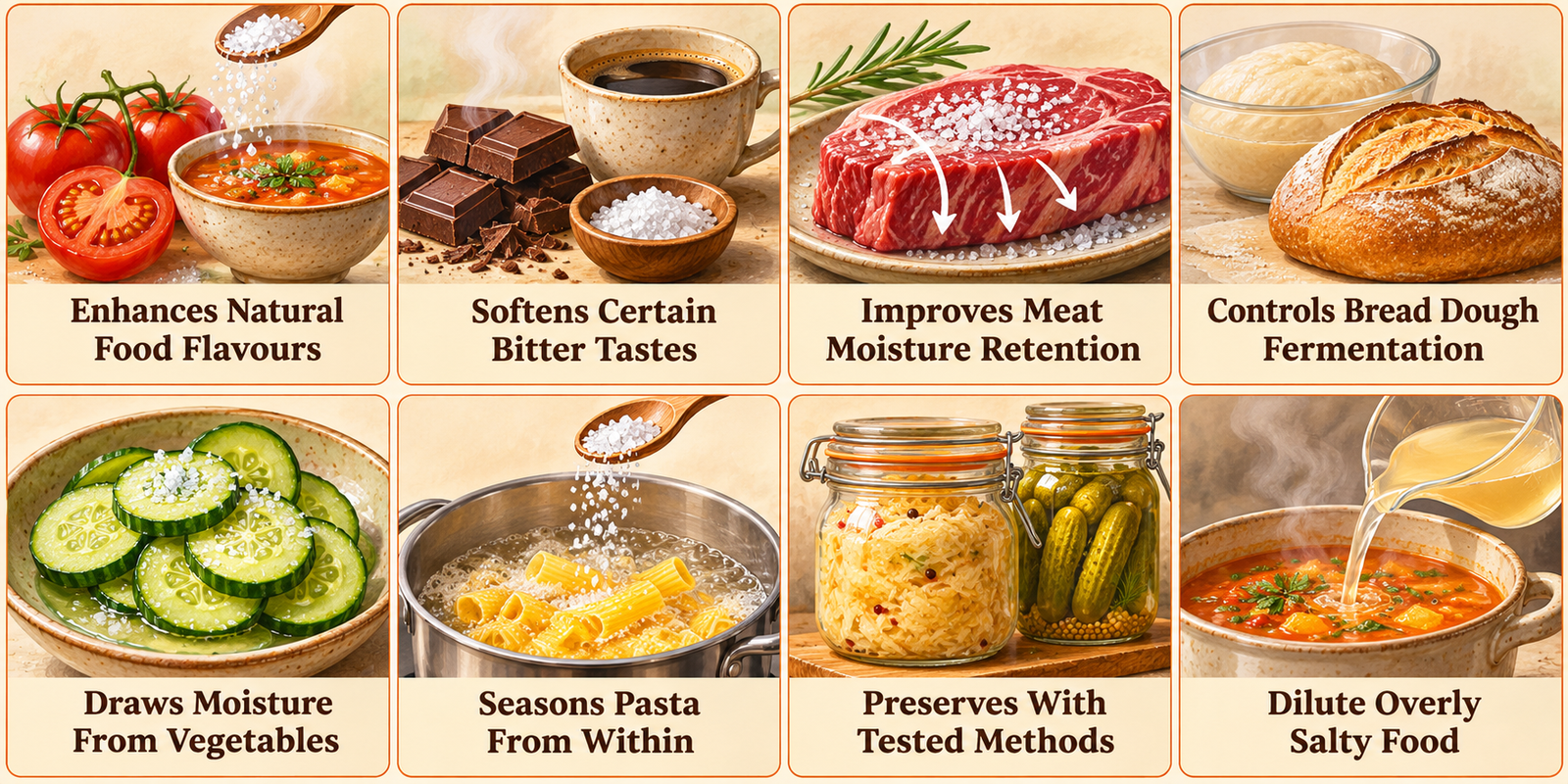
Consider a ripe tomato. Its flavour comes from a combination of sugars, organic acids, and aromatic compounds. Adding a little salt changes the overall taste experience, often making the tomato seem sweeter and more flavourful.
The same principle applies to soups, sauces, vegetables, and even some desserts.
However, salt doesn’t create new sugars or increase the concentration of flavour compounds simply by being added. Instead, it influences how our sensory system responds to the food.
This is why a properly seasoned dish can taste more complete without requiring additional spices.
Why Salt Reduces Bitterness
One of salt’s most interesting effects is its ability to reduce the perceived intensity of certain bitter tastes.
Bitterness comes from many different compounds found in foods such as coffee, cocoa, leafy vegetables, and some spices.
Research on taste interactions has shown that sodium salts can suppress bitterness under certain conditions, although the effect varies depending on the bitter compound and its concentration.
This helps explain why a small amount of salt can improve some bitter foods.
For example, a tiny pinch of salt may soften the harshness of strongly brewed coffee. Salt can also make certain bitter vegetables more pleasant when used as part of balanced seasoning.
However, salt cannot reliably disguise severe burnt flavours. If garlic or spices have scorched, adding more salt may simply produce food that is both bitter and excessively salty.
How Salt Affects Sweetness
Salt and sugar may seem like opposites, but they often work together in cooking.
A small amount of salt can make sweetness more noticeable by reducing competing bitter tastes and changing the overall flavour balance.
This is one reason chocolate desserts, caramel sauces, and baked goods frequently contain salt.
In salted caramel, the contrast between sweetness and saltiness creates a more complex eating experience. In chocolate cake, salt helps balance the sweetness and bitterness of cocoa.
However, the amount matters. Too little salt may have little noticeable effect, while too much can make a dessert unpleasantly salty.
The purpose is to support the existing flavours rather than overwhelm them.
How Salt Moves Into Food
When salt comes into contact with moisture, it dissolves and forms a concentrated solution.
Over time, dissolved sodium and chloride ions can move from areas of higher concentration to areas of lower concentration through diffusion.
This process helps explain why salting meat in advance can season more than just its surface.
The movement is gradual. Salt doesn’t instantly penetrate a thick steak or a whole chicken, and the rate depends on factors such as thickness, temperature, and the structure of the food.
Moisture movement also plays a role. Salt can initially draw water from food surfaces, but what happens afterward depends on the ingredient and the cooking conditions.
Understanding these processes helps you choose when to salt different foods.
What Happens When You Salt Meat?
Salt affects meat in several ways.
When salt is applied to the surface of meat, it dissolves in available moisture. Given enough time, dissolved salt diffuses inward.
Salt also interacts with muscle proteins, influencing their structure and ability to retain water during cooking.
This is one reason properly salted meat can sometimes remain juicier after cooking than comparable unsalted meat.
The effect depends on salt concentration, resting time, cut thickness, and cooking method.
For example, salting a steak shortly before cooking primarily seasons the surface. Salting it well in advance allows more time for salt to move inward.
Neither approach is universally correct. The best timing depends on the result you want and the recipe you’re following.
What Is Dry Brining?
Dry brining is a technique in which salt is applied directly to meat and allowed to rest before cooking, usually under refrigeration.
Unlike a traditional wet brine, dry brining doesn’t require immersing the meat in salted water.
Initially, salt draws some moisture to the surface. The salt dissolves in this moisture, and over time, the resulting solution can move into the meat.
Salt also changes the behaviour of certain muscle proteins, which can improve moisture retention during cooking.
For a steak or chicken, dry brining may produce more even seasoning and a better cooking result.
A practical starting point for many plain cuts is approximately 0.8–1% salt by the meat’s weight, although the ideal quantity varies by recipe and personal preference.
For example, 500 g of meat seasoned at 1% would require 5 g of salt.
Keep the meat refrigerated throughout the resting period, and follow appropriate food safety practices.
Why Salt Matters in Bread Making
Salt is a small ingredient in bread dough, but it performs several important functions.
First, it contributes flavour. Bread made without salt often tastes noticeably bland, even when the flour and fermentation are otherwise well managed.
Salt also influences gluten behaviour. It changes interactions between proteins in the dough, helping produce a more cohesive and manageable structure.
In addition, salt affects yeast fermentation. Higher salt concentrations generally slow yeast activity, which can help control the rate at which dough rises.
This is why bread recipes often specify salt carefully rather than treating it as an optional finishing ingredient.
Many conventional yeast bread formulas use salt at approximately 1.8–2.2% of flour weight, although the amount varies by bread style.
If a recipe uses 500 g of flour and 2% salt, it requires 10 g of salt.
Why Salt Is Important in Baking
Salt influences flavour in cakes, biscuits, pastries, and other baked goods.
Even when a recipe is predominantly sweet, a small amount of salt can improve its overall balance.
In bread and certain doughs, salt also affects gluten and fermentation. In cakes and cookies, its most noticeable role is often flavour enhancement.
Salted and unsalted butter can create different results because their salt contents vary between products.
For recipes requiring precise measurements, unsalted butter gives you greater control over the quantity of salt added.
If you’re substituting salted butter, consider the salt already present before adding the amount specified in the recipe.
How Salt Changes Vegetables During Cooking
Salt affects vegetables differently depending on their structure and cooking method.
When sprinkled over sliced cucumbers, cabbage, or aubergines, salt can encourage water to move out of the plant tissues.
This happens partly because the dissolved salt creates a concentration difference across cell membranes.
The released moisture can be useful in certain preparations. For example, salting shredded cabbage helps soften it and release liquid when preparing coleslaw or fermented vegetables.
Salting aubergines can also remove some moisture before cooking, although it isn’t always necessary for modern varieties.
In boiling water, salt primarily contributes seasoning. It may also influence texture, but the effect varies considerably between vegetables.
Does Adding Salt Make Water Boil Faster?
A common kitchen belief is that adding salt makes water boil faster.
In reality, dissolved salt raises water’s boiling point, a phenomenon known as boiling-point elevation.
However, the amount of salt normally used for cooking produces only a very small change.
For example, adding around 10 g of salt to 1 litre of water raises its boiling point by roughly 0.17°C under idealised conditions.
This difference is too small to provide a meaningful advantage when boiling pasta or vegetables.
The main reason to salt cooking water is to season the food, not to make the water heat more quickly.
Why Pasta Water Should Be Salted
Pasta absorbs water as it cooks, and some of the dissolved salt in that water can enter the pasta.
This helps season the pasta itself rather than relying entirely on the sauce.
The amount of salt required depends on the volume of water, the pasta, and how salty the accompanying sauce will be.
For example, a strongly seasoned sauce containing cheese, olives, or cured ingredients may require less salt in the pasta water than a mild vegetable sauce.
Avoid treating the popular advice that pasta water should taste like the sea as a precise measurement. Seawater is far saltier than most people would want for everyday pasta cooking.
Instead, use a measured quantity that suits the recipe and adjust according to the finished dish.
Why Salt Is Used in Food Preservation
Salt has been used to preserve food for thousands of years.
At sufficiently high concentrations, salt reduces the availability of water that microorganisms need for growth.
This property is associated with water activity, which describes how much water is available for microbial and chemical processes.
Salt can also create conditions that inhibit certain microorganisms while allowing others to grow, as seen in some controlled fermentation processes.
Traditional salted fish, cured meats, and fermented vegetables demonstrate different applications of these principles.
However, a small amount of salt used for everyday seasoning doesn’t make food safe to store without refrigeration.
Safe preservation requires tested salt concentrations, appropriate acidity or other controls, correct handling, and suitable storage conditions. Homemade curing and fermentation should follow reliable, tested procedures.
Different Types of Salt: Do They Cook Differently?
Several types of salt are commonly used in kitchens, including table salt, kosher salt, sea salt, and flaky finishing salt.
Although they differ in crystal size, shape, and sometimes mineral content, most consist predominantly of sodium chloride.
Their main practical differences involve measurement, handling, and texture.
| Type of salt | Characteristics | Common uses |
|---|---|---|
| Fine table salt | Small, uniform crystals | General seasoning, baking |
| Kosher salt | Usually larger crystals; size varies by brand | Seasoning meat, everyday cooking |
| Fine sea salt | Fine crystals, mainly sodium chloride | Cooking, baking |
| Coarse sea salt | Larger crystals | Seasoning, grinding |
| Flaky salt | Thin, delicate crystals | Finishing cooked dishes |
| Iodised salt | Salt with added iodine | Everyday cooking and seasoning |
Iodised salt provides iodine, an essential nutrient that supports normal thyroid function.
Specialty salts may contain trace minerals, but these generally don’t provide meaningful nutritional advantages at normal seasoning quantities.
Why Measuring Salt by Weight Is Better
Salt crystals vary in size and packing density, which means equal spoonfuls of different salts may contain different amounts of sodium chloride.
A teaspoon of fine table salt can weigh substantially more than a teaspoon of some coarse or flaky salts.
This matters when following recipes that specify salt by volume.
For accurate results, particularly in bread making, brining, and other preparations where salt concentration matters, weighing salt in grams is preferable.
For everyday cooking, you can still season by taste, but using the same salt consistently helps you develop reliable habits.
When Should You Salt Food?
The best time to add salt depends on what you’re cooking.
| Food or preparation | Useful timing | Why it helps |
|---|---|---|
| Steak | Shortly before cooking or well in advance | Seasons the surface or allows diffusion |
| Whole chicken | In advance, under refrigeration | Improves seasoning throughout |
| Soups and stews | Gradually, with final adjustment | Accounts for evaporation and concentration |
| Pasta | In the cooking water | Seasons the pasta as it cooks |
| Bread dough | During mixing, as directed | Controls flavour and dough behaviour |
| Roasted vegetables | Before roasting | Distributes seasoning |
| Fresh salads | Near serving, depending on ingredients | Helps control moisture release |
| Fried foods | Often immediately after cooking | Helps salt adhere to the surface |
These are practical guidelines rather than strict rules. Recipes may require different timing to achieve particular textures.
How to Fix Food That Is Too Salty
Too much salt can overwhelm other flavours, and correcting it isn’t always easy.
The most reliable approach is to reduce the concentration of salt by adding more unsalted ingredients.
For soups and stews, this may mean adding water, unsalted stock, vegetables, or another suitable base.
For sauces, preparing an additional unsalted portion and combining it with the original can sometimes restore balance.
Sugar or acidity may change how saltiness is perceived, but neither removes sodium from the food.
The popular potato trick is also unreliable. A potato absorbs seasoned liquid as it cooks, but it doesn’t selectively remove enough salt to correct most oversalted dishes.
The best prevention is to season gradually and taste before making large adjustments.
Is More Salt Always Better?
Salt is essential to human physiology, but excessive sodium intake is associated with increased blood pressure and greater cardiovascular risk in many populations.
The World Health Organization recommends that adults consume less than 2,000 mg of sodium per day, equivalent to less than 5 g of salt from all dietary sources.
This includes sodium already present in packaged foods, sauces, bread, snacks, and other ingredients.
Using salt thoughtfully doesn’t mean eliminating it from cooking. It means recognising when a dish needs seasoning and avoiding unnecessary additions.
Herbs, spices, citrus, vinegar, and umami-rich ingredients can help create satisfying flavour without relying exclusively on salt.
People with specific medical conditions may require individualised sodium recommendations.
A Simple Experiment to Understand Salt
You can experience salt’s effect on flavour with a basic kitchen experiment.
Prepare a small quantity of unsalted vegetable soup and divide it into three equal portions.
Leave the first portion unchanged. Add a small pinch of salt to the second and a slightly larger, measured amount to the third.
Stir thoroughly and taste each portion.
The unsalted soup may taste muted. The lightly salted version may reveal more of the vegetables’ natural flavours, while the third may taste better or become excessively salty, depending on the amount used.
Try the same experiment with sliced tomatoes or a simple chocolate drink.
The purpose is to recognise how salt changes flavour perception and to understand that the most enjoyable level of seasoning isn’t necessarily the saltiest one.
Common Mistakes When Cooking With Salt
One frequent mistake is adding too much salt before a sauce or soup has reduced. As water evaporates, the salt becomes more concentrated.
Another is forgetting that ingredients such as soy sauce, cheese, pickles, stock cubes, and salted butter already contain sodium.
Using volume measurements without considering crystal size can also lead to inconsistent results.
Some cooks rely on salt to fix every flavour problem. However, a dish may need acidity, sweetness, umami, or better browning rather than more salt.
Finally, failing to taste during cooking makes it harder to recognise when the seasoning is balanced.
The Secret to Using Salt Well
Salt is one of the simplest ingredients in the kitchen, but its effects are surprisingly complex.
It changes how we perceive taste, influences protein behaviour, affects moisture movement, helps control bread fermentation, and plays an important role in certain food preservation methods.
Understanding these functions makes it easier to decide when to season, how much salt to use, and why different foods respond differently.
The next time you cook, pay attention to what happens when you add a small amount of salt. Notice how the flavours change, whether the food becomes more enjoyable, and when additional salt stops helping.
Good seasoning is about finding the point where salt supports the ingredients without taking over.
And once you learn to recognise that point, even the simplest meal can taste noticeably better.