Part of Second Career in the Kitchen.
Fish frightened me more than anything else in the kitchen, and I suspect it frightens you too. It’s expensive, it’s delicate, it overcooks in the time it takes to answer a text, and ruining it feels like a small moral failure. For a long time I simply didn’t cook it at home — which is absurd, because some of the greatest meals of my eating life were fish: grilled sardines on a Basque harbour, a whole turbot in San Sebastián, a plate of raw, glistening something in a Tokyo basement. The irony is that fish is, in truth, the fastest and often the simplest protein to cook well. Its delicacy, the thing that scared me, is actually a gift: it asks for a light touch and very little time. Once Le Cordon Bleu taught me to stop treating fish like meat and start respecting how little it needs, my fear turned into something like reverence.
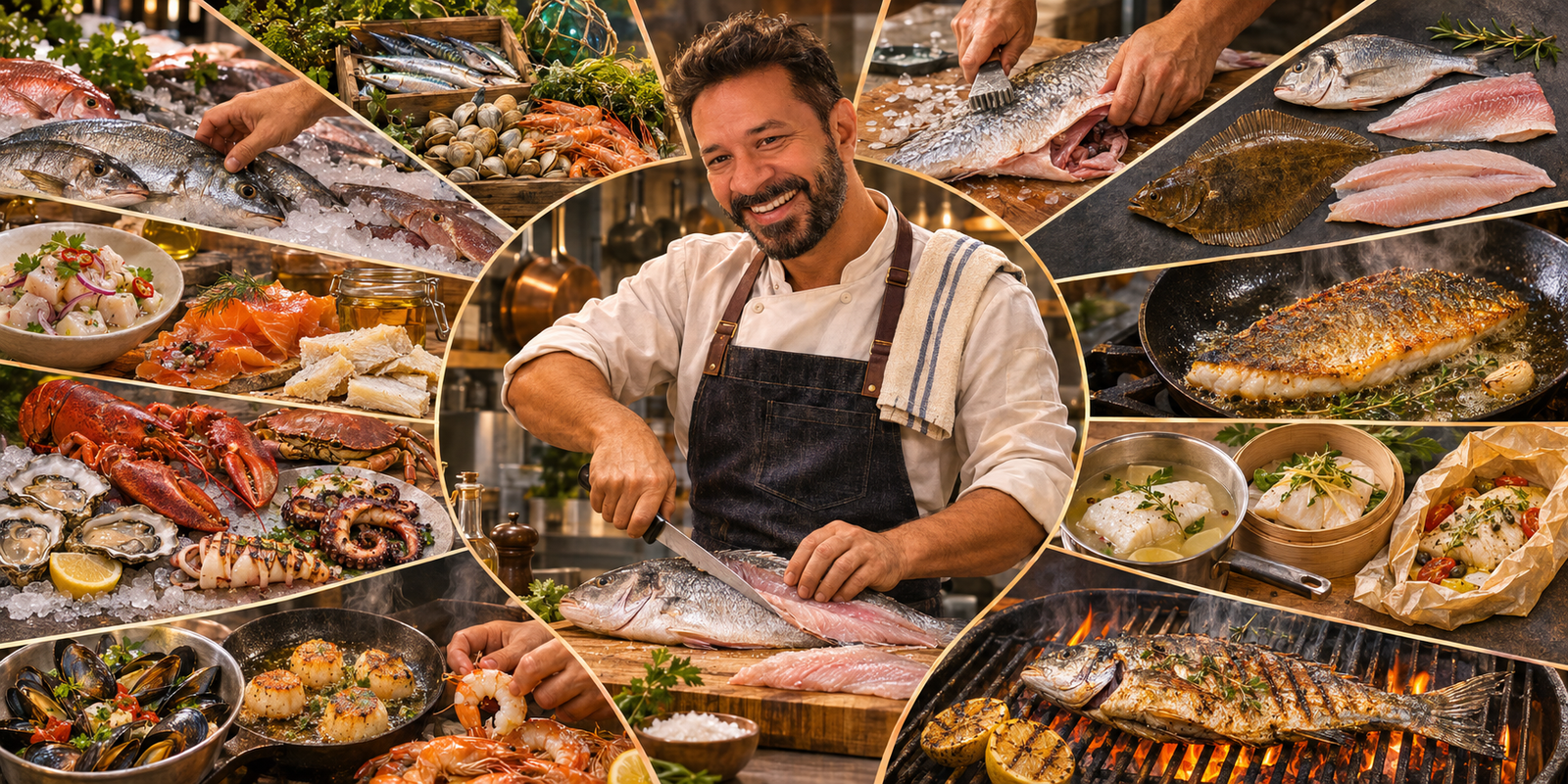
Seafood is the protein most home cooks avoid and most would love to master. The secret is that it rewards restraint over force: buy well, cook briefly, and get out of its way. This guide covers everything from choosing a fish that’s actually fresh, through the knife work, to the gentle cooking methods and the shellfish that feel like a treat and are far easier than they look.
It Starts at the Fishmonger
More than any other ingredient, seafood is made or lost before it reaches the pan, so How to Buy Fresh Fish is the most important lesson here — clear eyes, a clean smell, firm flesh, and the confidence to ask questions. Tangled up with buying well is buying responsibly, which is why Understanding Sustainable Seafood matters: knowing what’s overfished and what’s abundant makes you a better cook and a better citizen of the sea. Get these two right and you’re most of the way to a good dinner before you’ve turned on the hob.
The Knife Work
Learning to handle whole fish saves real money and demystifies the whole category. Scaling and Gutting a Fish is the unglamorous first step, and from there the two core skills are How to Fillet a Round Fish — salmon, bass, mackerel — and How to Fillet a Flat Fish like sole or plaice, which follows a different logic. It looks like surgery the first time and becomes oddly meditative by the fifth. Buying a whole fish and breaking it down yourself is cheaper, fresher, and gives you the frames for stock as a bonus.
The Essential Cooking Methods
Here’s where fish proves how forgiving it really is, if you respect its speed. Pan-Searing Fish with Crispy Skin is the technique I use most — crisp skin, just-set flesh — and it hinges entirely on Fish Doneness: How to Tell, because the gap between perfect and overdone is seconds, not minutes. The gentle methods are almost foolproof: How to Poach Fish Gently, the clean Steaming Fish the Asian Way, and How to Bake Fish en Papillote — sealed in a parcel with aromatics, which practically cooks itself. For bigger occasions, How to Grill Whole Fish is spectacular and simpler than it looks.
Shellfish Without Fear
Shellfish feels like special-occasion, restaurant-only food, and it absolutely isn’t. How to Cook Mussels and Clams is genuinely one of the fastest, cheapest impressive meals there is — a pan, some wine, ten minutes. How to Cook the Perfect Scallop is all about a hot pan and nerve, Peeling and Deveining Prawns is basic prep worth doing properly, and the showpieces — Shucking Oysters Safely and How to Cook Lobster and Crab — are far more approachable than their reputation. The one that teaches patience is Cooking Squid and Octopus Tender, which is either very quick or very slow, and disastrously rubbery in between.
Raw, Cured, and Preserved
Some of the most thrilling seafood never meets a pan at all, and these techniques open a whole new register. How to Make Ceviche ‘cooks’ fish in nothing but citrus acidity — a revelation the first time you make it — while Curing and Smoking Fish at Home turns fresh fish into silky cured salmon or home-smoked mackerel with surprisingly little equipment. And the deep tradition of Salt Cod and Preserved Fish connects you to centuries of coastal cooking, from Spanish bacalao to Italian baccalà. These are the techniques that make people assume you trained somewhere serious.
Respect, Not Fear
The shift I most want to pass on is from fear to respect. Fish doesn’t need you to be brave or heavy-handed; it needs you to be attentive and quick, and then to leave it alone. Buy the freshest thing on the ice, cook it for less time than feels right, trust the cues of doneness over the clock, and you’ll produce the kind of clean, delicate, confident seafood that I used to think only restaurants could manage. The protein I avoided for years is now the one I cook when I want to eat really well with the least effort. Stop treating fish like meat, start respecting how little it asks, and the whole intimidating world of the sea opens up.