Croissant lamination is the technique that gives a croissant its delicate, flaky layers. Without this careful process of folding butter into dough, a croissant would simply be bread shaped into a crescent. The magic lies in the layers.
Although it looks complicated, croissant lamination follows a logical pattern. It involves enclosing butter inside dough and folding it repeatedly to create thin sheets. When baked, the butter melts and releases steam, which separates the layers and creates the familiar airy texture.
Understanding this process helps explain why croissants feel light yet rich at the same time.
Croissant lamination and the Science of Layered Pastry
Croissant lamination works by building alternating layers of dough and butter. Each fold multiplies those layers. For example, a single “turn” can triple the layers, and several turns create dozens of delicate sheets.
The temperature must remain cool throughout. If the butter melts too early, it blends into the dough instead of forming layers. As a result, the final pastry becomes dense rather than flaky.
Layered pastry depends on precision. Timing, pressure, and consistency all influence the final texture.
Understanding the French Butter Folding Method
The French butter folding method begins with a simple yeasted dough known as détrempe. Once rested, a flat block of cold butter is placed inside the dough. The dough is then rolled and folded carefully.
After each fold, the dough rests in the refrigerator. This resting period prevents shrinking and keeps the butter firm. Repeating this process several times creates the thin layers essential for croissant lamination.
Patience is crucial. Rushing the process weakens structure.
Why Croissant lamination Requires Temperature Control
Croissant lamination succeeds only when temperature remains controlled. Ideally, both dough and butter should feel cool but pliable.
If the butter becomes too hard, it cracks through the dough. If it becomes too soft, it seeps out. For this reason, many bakers chill the dough between folds.
This balance ensures clean layers and even rise during baking.
Croissant Laminated Dough
Making croissant lamination at home takes time but is achievable with care.
Ingredients:
- 500 g strong white flour
- 60 g sugar
- 10 g salt
- 10 g dried yeast
- 300 ml lukewarm milk
- 250 g cold unsalted butter
Method:
- Mix flour, sugar, salt, yeast, and milk to form a soft dough.
- Knead briefly, then refrigerate for at least 1 hour.
- Flatten the butter into a thin square between baking paper.
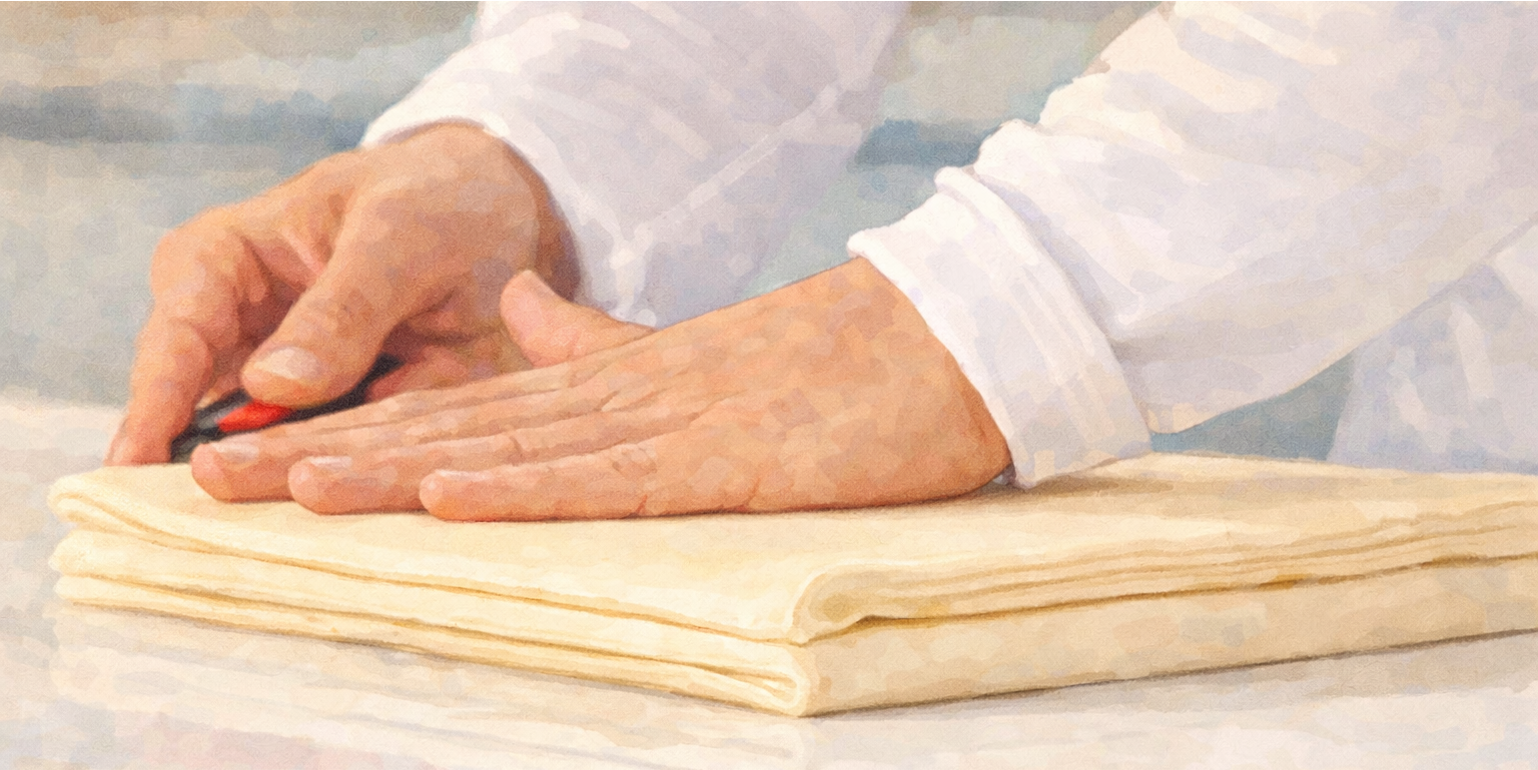
- Roll the dough into a larger square and place the butter in the centre.
- Fold the dough over the butter to seal it completely.
- Roll out gently and fold into thirds (first turn).
- Chill for 30 minutes.
- Repeat rolling and folding twice more, chilling between each turn.
- Roll out, cut into triangles, and shape into crescents.
- Allow to proof until doubled, then bake at 200°C until golden.
The result should display clear layers and a crisp exterior.
How Layered Pastry Creates Texture
Layered pastry expands in the oven because water in the butter turns to steam. This steam pushes against the dough layers, creating lift.
As the pastry bakes, the outer layers become crisp while the inside remains tender. The contrast between crunch and softness defines a good croissant.
Even slight differences in folding technique can change the outcome dramatically.
Why Croissant lamination Still Matters
Croissant lamination remains essential in French baking because it combines skill and simplicity. The ingredients are basic, yet the method demands attention.
In modern bakeries, machines assist with rolling, but the principles stay the same. Control, patience, and precision create the desired texture.
Through careful lamination, ordinary dough transforms into one of the world’s most recognisable pastries.