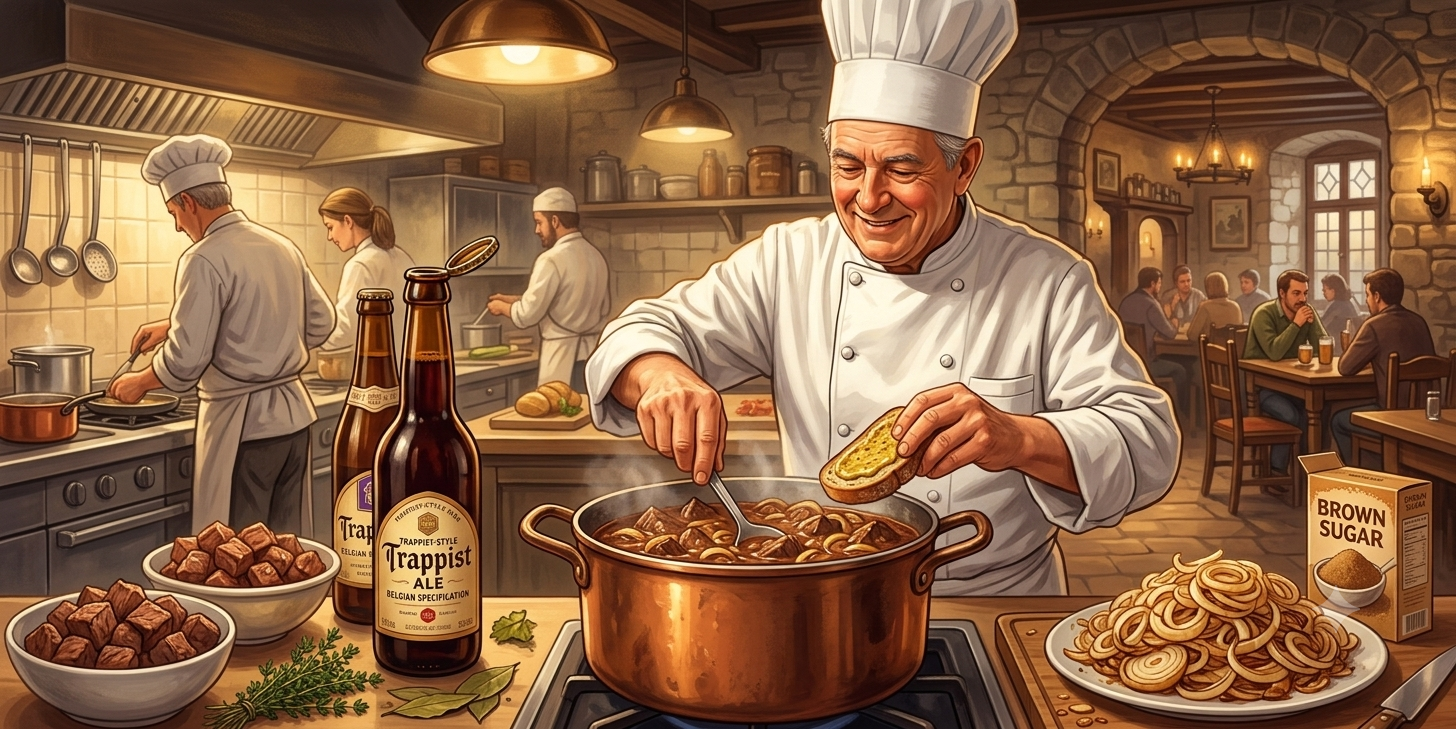
Ask most people to name a great beef stew braised in wine and Beef Bourguignon comes to mind almost automatically. Ask a Belgian, and they will point you instead towards carbonnade flamande — a dish built not on wine, but on beer, and arguably just as deserving of its reputation. Rich, dark, and deeply savoury, it is the kind of dish that turns a handful of humble ingredients into something far greater through nothing more than time, patience, and the right beer.
A Dish Rooted in Flanders
Carbonnade flamande hails from Flanders, the Dutch-speaking north of Belgium, a region famous as much for its beer as its cuisine. The name itself derives from carbo, the Latin word for coal, a nod to the dish’s origins as meat cooked slowly over coals or an open flame. Traditionally a working-class dish, it made use of tougher, cheaper cuts of beef, transforming them through hours of gentle braising into something tender enough to fall apart at the touch of a fork.
What distinguishes it most clearly from its French cousin is the choice of braising liquid. Where Bourguignon relies on red wine, carbonnade flamande uses Belgian beer — typically a dark, malty ale rather than anything hoppy or bitter. This single substitution changes everything about the dish’s character, giving it a sweeter, maltier depth entirely its own, along with a slight bitterness at the back of the palate that wine could never quite replicate.
Understanding the Flavour
The magic of carbonnade flamande lies in the way several simple elements are stacked to create real complexity. Beef, browned hard before braising, contributes a deep savoury base. Onions, cooked low and slow until they turn a deep golden-brown, add sweetness and body — in many traditional versions, the onions are cooked in almost equal proportion to the meat, becoming as central to the dish as the beef itself. The beer brings malt sweetness, a gentle bitterness, and a faint yeasty richness that ties everything together. A slice of bread spread with mustard, pressed into the stew partway through cooking, dissolves slowly, thickening the sauce and adding a subtle tang. A touch of brown sugar or a spoonful of redcurrant jelly rounds out the bitterness from the beer, while a bay leaf and thyme lend quiet herbal background notes. The result is a stew that tastes sweet, savoury, and slightly bitter all at once — comforting rather than sharp, deep rather than heavy.
The Technique That Matters
Browning in batches. Cut the beef into large chunks and brown it in batches over high heat, never overcrowding the pan. Crowding the pan causes the meat to steam rather than sear, losing the caramelised crust that forms the base of the dish’s flavour. Each batch should develop a deep brown colour before being set aside.
Caramelising the onions properly. This step deserves real patience — twenty to thirty minutes over medium-low heat, stirring occasionally, until the onions turn a deep golden-brown rather than simply translucent. Rushing this stage with high heat produces a harsher, less rounded sweetness in the final dish.
Choosing the right beer. A Belgian dark ale, dubbel, or brown ale works best — something malty and slightly sweet rather than hoppy or bitter, since hop bitterness intensifies unpleasantly over a long braise. Avoid pale lagers, which lack the depth the dish depends on.
The mustard-bread trick. Spreading a slice of dense bread with mustard and pressing it, mustard-side down, into the stew is a technique passed down through generations of Flemish cooks. As it cooks, the bread breaks down entirely, thickening the sauce naturally without any flour or cornflour, while the mustard adds a subtle tang that cuts through the richness.
Low, slow, and covered. Whether on the stovetop or in the oven, carbonnade flamande needs low heat and a long cooking time — typically two to three hours — with the lid on for most of that time to retain moisture, then removed towards the end to let the sauce reduce and concentrate.
A Dish Best Made a Day Ahead
Like most braises, carbonnade flamande improves overnight, as the flavours settle and deepen further. Many Belgian households consider it a dish to make a day in advance almost as a rule, serving it the following evening alongside a simple pile of frites or boiled potatoes to soak up the sauce.
Classic Carbonnade Flamande
Serves 4–6
Ingredients
- 1kg beef chuck or shin, cut into large chunks
- 2 tbsp vegetable oil
- 3 large onions, thinly sliced
- 2 garlic cloves, minced
- 500ml Belgian dark ale or brown ale
- 250ml beef stock
- 1 tbsp brown sugar
- 1 tbsp red wine vinegar
- 2 bay leaves
- A few sprigs of thyme
- 1 thick slice of dense bread
- 2 tbsp Dijon mustard
- Salt and freshly ground black pepper
Method
- Season the beef generously. Heat the oil in a large, heavy-based pot and brown the beef in batches over high heat. Set aside.
- Lower the heat, add the onions, and cook slowly for 25–30 minutes until deeply golden, adding the garlic in the last few minutes.
- Return the beef to the pot. Pour in the beer and stock, scraping up any browned bits from the base of the pan.
- Stir in the sugar, vinegar, bay leaves, and thyme.
- Spread the bread with mustard and press it, mustard-side down, into the liquid.
- Bring to a gentle simmer, cover, and cook on low heat (or in a 150°C oven) for 2–2½ hours, until the beef is fork-tender.
- Remove the lid for the final 20–30 minutes to let the sauce thicken slightly.
- Season to taste and serve with frites or boiled potatoes.