My teacher in culinary school used to say, “Italians take ingredients and put them on the plate.” That line captures what Italians really mean by Simplicity. Italian cooking is often described as “simple,” yet this simplicity rests on centuries of cultural memory, precise ingredient knowledge, and a finely tuned sense of proportion. It is minimal not because cooks lack technique, but because they know exactly what can be removed without losing meaning.
At its core, Italian cooking is about clarity and relationships. Dishes are built around a small number of elements that must be recognised, tasted, and understood — especially the invisible triangle of Fat, Acid, and Starch. These relationships are not tricks; they are habits shaped by landscape, climate, and daily life.
Flavour in Italy is less about intensity than balance. In Spaghetti al Pomodoro, the tomato should taste of sun and soil, while Olive Oil — tasting, grades, bitterness carries fragrance and depth. Even seasoning is cultural: Salt as Culture in Italian Cooking means salting throughout the cook, not as a late correction.
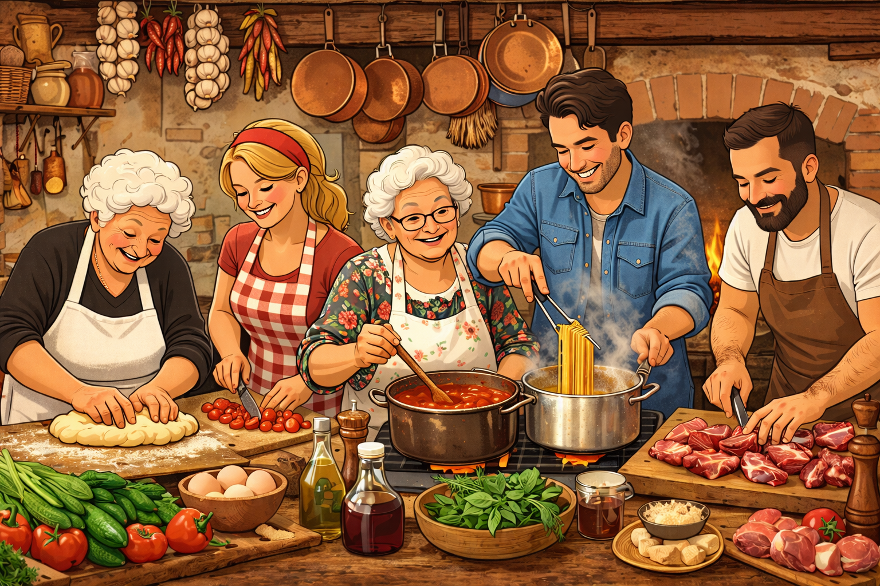
This way of thinking mirrors how food functions socially. Markets as Culinary Classrooms are as important as kitchens, and recipes travel through families rather than manuals. To cook Italian food well is therefore to understand daily life as much as technique.
Flavour as culture, not technique
Italian cooking thrives on tension. Sweet tomato sharpened with acid; Bitterness in Mediterranean Cooking balanced by anchovy or Pecorino Romano; richness tempered by brightness.
You begin to see patterns: why Garlic: raw, softened, browned creates three different flavours; why pasta water binds sauces; and why building flavour without browning matters in a gentle soffritto. You learn Why fresh herbs are added late to protect aroma and Why dried herbs are added early to release it.
This reveals Italian cooking as a coherent system. You start to understand The role of starch in sauces, Why bitterness balances fat, and When to use lemon vs vinegar. You also grasp Why simplicity reveals mistakes: with so few ingredients, every error is visible.
In this way, Italian food trains judgement, timing, and taste — not rule-following — and leads naturally into questions of Emulsification in Italian cooking and How Italians season during cooking.
The rhythm of an Italian meal
An Italian meal moves with intention, from light to substantial and back again.
Antipasti awaken appetite — especially Bruschetta, where bread, garlic, and oil teach you texture, heat, and timing.
Primi form the emotional centre. Risotto alla Milanese embodies Why risotto needs constant movement, while Cacio e Pepe — emulsion, not cream demonstrates Mantecatura: Finishing Pasta in the Pan and Why pasta must finish in the sauce. Here you learn Why al dente matters and How Italian cooks think about texture.
Secondi narrow the focus to a single protein, balanced by contorni that showcase Grilled vegetables with olive oil and lemon and remind you Why finishing oil matters.
Dessert closes the circle — soft, creamy, and calm — restoring balance rather than excess.
If you want to understand why this choreography matters, see How Italian Meals Are Structured.
Italy as many cuisines, not one
Italy is not one cuisine but many.
In the south, Naples and the Birth of Tomato Cookery explains why tomatoes became cultural identity and why How long to simmer tomato sauce changes flavour. Sicily gives us Sicilian caponata, a lesson in sweet-sour balance.
Central Italy is defined by Tuscany and Unsalted Bread, which clarifies Why Italian bread is often unsalted, and by Roman classics like Carbonara (Roman tradition) and Amatriciana, both rooted in pork fat, pecorino, and restraint.
In the north, Emilia-Romagna: butter, pork, egg pasta produces Ragù alla Bolognese and Tagliatelle al burro e salvia, where richness becomes cultural memory. Lombardy gives us rice-centric cooking, while Liguria offers Pesto alla Genovese, an essay in herb, oil, and nut harmony.
Across the peninsula, you see how climate shapes crops and cooking — captured in Minestrone across regions and explored more deeply in Regions of Italy in Food.
Pasta: a system, not a recipe
Pasta is not just food; it is logic.
That Pasta Shape Matters becomes obvious once you see how strands, tubes, and sheets interact with sauce. Fresh pasta speaks of tenderness; dried pasta of structure.
Technique matters: cooking does not end in boiling. You learn Why pasta must finish in the sauce, how Pasta Water as a Cooking Tool builds gloss, and how Cheese as Structure in Sauces creates silk rather than grit.
Every great plate — from Puttanesca to Caprese salad to Neapolitan Margherita pizza — is built on the same principles of balance, starch, fat, and acid.
This is why Pasta as a System, Not a Dish sits at the centre of Italian culinary thinking.
Why Italian cooking matters today
In an age of ultra-processed food, Italian cooking insists on care, seasonality, and shared meals. It shows How Heat Shapes Flavour through gentle simmering, slow soffritto, and controlled finishing.
At its base lies The Anatomy of a Soffritto, alongside insights like Why garlic should not brown in soffritto, Tomatoes: raw vs cooked, and Why Italian soups are vegetable-forward.
It also explains Butter vs olive oil in Italy, Why Roman cooking loves pecorino, Why anchovies melt into sauces, and Why Italian food feels “light but satisfying.” All of this feeds into How to build a balanced plate.
For Cookdom, Italian cuisine is not just a module — it is a model for learning. It teaches heat control, flavour balance, texture, and attention to ingredients.
From here, readers can branch into structure, flavour logic, regions, and pasta technique — each a doorway into deeper knowledge.
Ultimately, Italian cooking asks: how do we make everyday food meaningful? The answer is not extravagance but attention — to ingredients, to place, and to one another at the table.
And in that sense, Italian Cooking as a Way of Thinking is not just a cuisine — it is a philosophy.