Why does butter burn in a hot pan while refined oils can handle intense heat? And is olive oil really unsuitable for frying? The answers are more interesting than a simple smoke point chart.
You’ve probably experienced it while cooking. You pour oil into a hot frying pan, turn away to prepare your ingredients, and suddenly notice thin wisps of smoke rising from the surface. The oil smells sharp, and you’re no longer sure whether it’s safe to continue.
Or perhaps you’ve heard conflicting advice about cooking fats. One recipe recommends extra virgin olive oil for roasting vegetables, while another insists that olive oil should never be heated. Some cooks swear by ghee for frying, while others prefer sunflower or groundnut oil.
The confusion usually comes down to one concept: the smoke point of cooking fats.
Understanding fats and their smoke points can help you choose suitable oils, avoid overheating, and improve the flavour and texture of your food. But smoke point is only part of the story. Fat composition, refining, storage, and cooking time also determine how an oil behaves under heat.
What Is the Smoke Point of an Oil?
The smoke point is the temperature at which a cooking fat begins producing a continuous, visible stream of smoke under specified conditions.
When oils are heated, their components undergo chemical changes. As temperatures rise, certain compounds can evaporate or break down, contributing to the smoke and sharp aromas associated with overheating.
Smoke point varies between oils because their chemical compositions differ. Refining, free fatty acid content, impurities, and previous heating can also affect the temperature at which smoke becomes visible.
This means a smoke point isn’t a perfectly fixed number. Two bottles of the same type of oil may behave differently depending on how they were processed and stored.
For home cooking, smoke point is best treated as a practical guideline rather than an exact safety boundary.
Why Do Different Fats Have Different Smoke Points?
Cooking fats contain different proportions of saturated, monounsaturated, and polyunsaturated fatty acids. They may also contain free fatty acids, water, proteins, pigments, and other naturally occurring compounds.
These differences influence how fats respond to heat.
Refined oils generally have higher smoke points than their unrefined counterparts because processing removes many substances that can contribute to early smoking.
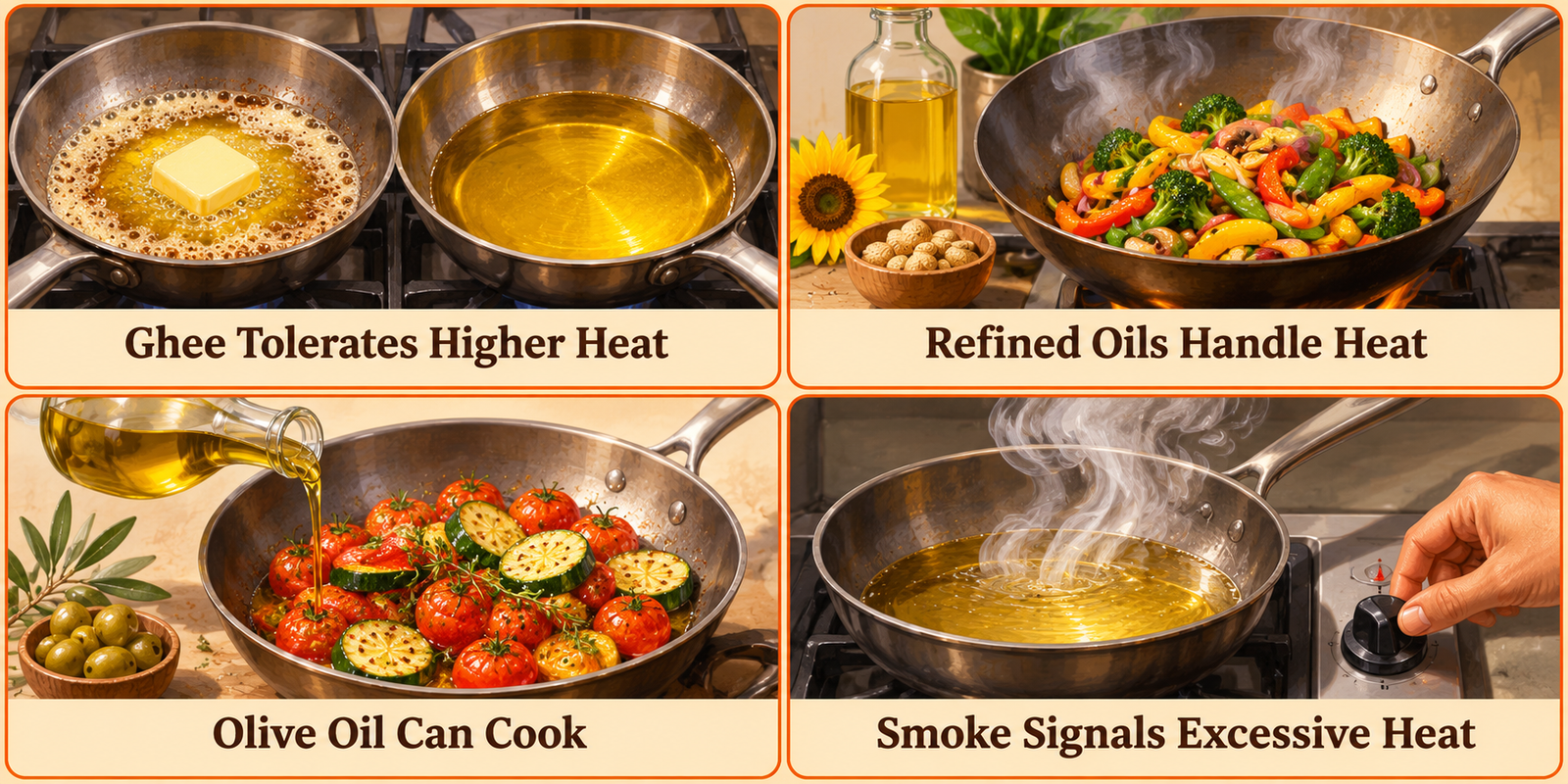
Butter provides a useful example. Ordinary butter contains approximately 80–82% fat, along with water and milk solids. The milk solids can brown and eventually burn during cooking, limiting its usefulness at high temperatures.
Ghee, by contrast, is made by removing most of the water and milk solids from butter. This gives it a higher smoke point and makes it more suitable for many high-temperature cooking methods.
However, a high smoke point doesn’t automatically mean an oil is more resistant to every form of heat-related deterioration.
Cooking Oil Smoke Point Chart
The following table shows approximate smoke point ranges for common cooking fats. Actual values vary by product, refining method, and testing conditions.
| Cooking fat | Approximate smoke point | Common uses |
|---|---|---|
| Refined avocado oil | 250–270°C (482–518°F) | High-heat searing, frying |
| Refined sunflower oil | 225–245°C (437–473°F) | Frying, sautéing |
| Refined groundnut oil | 225–235°C (437–455°F) | Stir-frying, deep-frying |
| Refined canola oil | 200–240°C (392–464°F) | Baking, sautéing, frying |
| Refined olive oil | 220–240°C (428–464°F) | Sautéing, roasting |
| Ghee | 230–250°C (446–482°F) | Frying, roasting, tempering |
| Refined coconut oil | 200–230°C (392–446°F) | Baking, frying |
| Extra virgin olive oil | 175–210°C (347–410°F) | Sautéing, roasting, dressings |
| Unrefined coconut oil | 175–205°C (347–401°F) | Gentle frying, baking |
| Sesame oil, toasted | 175–210°C (347–410°F) | Finishing, dressings, flavouring |
| Whole butter | 150–175°C (302–347°F) | Gentle sautéing, baking |
| Unrefined flaxseed oil | Around 105–110°C (221–230°F) | Cold dressings |
These figures are broad estimates, not guaranteed specifications. For example, sunflower oil varies considerably depending on whether it is conventional or high-oleic, and the same is true of several other vegetable oils.
What Happens When Oil Goes Beyond Its Smoke Point?
When oil is overheated, it can undergo oxidation, hydrolysis, and thermal decomposition. These processes produce a mixture of chemical compounds, some of which contribute unpleasant flavours and odours.
The oil may begin to smell acrid, darken, or become more viscous with prolonged heating.
Repeated high-temperature cooking can accelerate deterioration, particularly when food particles remain in the oil.
However, oil doesn’t suddenly become toxic the instant it reaches its smoke point. Chemical changes begin at different temperatures and continue over time, depending on the fat and cooking conditions.
The practical concern is that visible smoking indicates the oil is becoming excessively hot and may be deteriorating.
If oil begins smoking heavily, turn off the heat and allow it to cool safely. If it smells burnt or has deteriorated noticeably, discard it rather than using it for cooking.
Never add water to smoking or burning oil. If an oil fire starts, turn off the heat if safe, cover the pan with a suitable metal lid or fire blanket, and never attempt to extinguish it with water.
Is a Higher Smoke Point Always Better?
Not necessarily. Smoke point tells you when visible smoking begins, but it doesn’t fully describe an oil’s oxidative stability.
Oxidative stability refers to how well a fat resists chemical deterioration when exposed to oxygen, heat, and time.
Fatty acid composition matters here. Oils rich in polyunsaturated fatty acids are generally more susceptible to oxidation than those containing higher proportions of monounsaturated or saturated fats, although antioxidants and processing also influence stability.
This helps explain why two oils with similar smoke points may behave differently during prolonged heating.
For example, high-oleic sunflower oil contains more monounsaturated fat than conventional sunflower oil and is often formulated for improved frying stability.
Extra virgin olive oil contains natural antioxidants and is relatively rich in monounsaturated fat, which can contribute to good stability under many normal cooking conditions despite its sometimes lower smoke point.
The best oil therefore depends on more than a single temperature value.
Can You Cook With Extra Virgin Olive Oil?
Yes. Extra virgin olive oil can be used for many everyday cooking methods, including sautéing, roasting, and gentle frying.
The common belief that extra virgin olive oil should never be heated is misleading.
Although its smoke point varies, it is suitable for many normal cooking temperatures. Its relatively high monounsaturated fat content and naturally occurring antioxidants contribute to its heat stability.
Extra virgin olive oil is particularly useful when its fruity, grassy, or peppery flavour complements the food.
For extremely high-temperature searing, a refined oil with a higher smoke point may offer more flexibility, especially when cooking in a very hot pan.
For salads, dips, and finishing dishes, extra virgin olive oil is an excellent choice because its distinctive flavour remains prominent.
Butter vs Ghee: Which Is Better for Cooking?
Butter and ghee come from the same starting ingredient, but their cooking properties differ considerably.
Butter contains water and milk solids, which contribute to its creamy flavour and help it brown. When heated, these solids can develop nutty aromas before eventually scorching.
This makes butter particularly useful for gentle sautéing, baking, and preparing sauces.
Ghee is produced by heating butter and separating most of its water and milk solids. The resulting fat has a higher smoke point and a concentrated, nutty flavour.
In Indian cooking, ghee is frequently used for tempering spices, preparing certain sweets, and cooking dishes where its aroma is desirable.
However, ghee is rich in saturated fat. Its suitability for high-temperature cooking doesn’t automatically make it the healthiest everyday choice.
For regular use, dietary guidance generally favours replacing some saturated fats with unsaturated fats, particularly from oils such as olive, canola, and suitable sunflower oils.
Which Oil Is Best for Deep-Frying?
Deep-frying generally takes place at approximately 160–190°C (320–375°F), depending on the food.
A suitable frying oil should tolerate these temperatures, have reasonable oxidative stability, and complement the intended flavour.
Refined groundnut oil, canola oil, high-oleic sunflower oil, and other oils designed for frying are common choices.
Temperature control is essential. If the oil is too cool, food may absorb more oil and become greasy. If it is excessively hot, the exterior may brown or burn before the centre cooks properly.
Using a kitchen thermometer helps maintain a consistent frying temperature.
Avoid repeatedly overheating oil, and remove burnt food particles between batches. Oil that has developed an unpleasant smell, persistent foaming, excessive darkening, or unusual thickness should be discarded.
Which Fat Is Best for Sautéing and Stir-Frying?
Sautéing involves cooking food in a relatively small amount of fat over moderate to high heat. Stir-frying often uses a hot pan and short cooking times.
For these techniques, refined groundnut oil, canola oil, refined sunflower oil, and other suitable neutral oils can work well.
Ghee is also useful when its flavour complements the dish.
Extra virgin olive oil works well for many sautéed vegetables, particularly when the cooking temperature remains controlled.
The choice should reflect both the heat required and the flavour you want.
For example, groundnut oil may suit a quick vegetable stir-fry, while olive oil may be preferable for sautéed Mediterranean vegetables.
Which Oils Are Best for Roasting Vegetables?
Roasting vegetables often involves oven temperatures of approximately 180–220°C (356–428°F).
However, the oven temperature isn’t necessarily the same as the temperature of the oil coating the food. Moisture evaporation and the food’s surface temperature influence how hot the fat becomes.
Extra virgin olive oil, refined olive oil, canola oil, and suitable sunflower oils can all work for roasting.
Use enough oil to coat the vegetables lightly rather than allowing excess oil to collect on the baking tray.
If you’re roasting at particularly high temperatures or for long periods, choose an oil that tolerates the conditions well and monitor for excessive smoking.
What About Coconut Oil and Sesame Oil?
Coconut oil is relatively high in saturated fat, which contributes to its distinctive physical properties. It is solid or semi-solid at cooler room temperatures and melts when warmed.
Refined coconut oil generally has a higher smoke point and a more neutral flavour than unrefined coconut oil.
Unrefined coconut oil retains more of its characteristic coconut aroma, making it useful in recipes where that flavour is desirable.
Sesame oil requires a different distinction. Light, refined sesame oil can be used for cooking, while toasted sesame oil is commonly added for its strong nutty aroma.
Toasted sesame oil is often best used in small quantities near the end of cooking, where its flavour remains noticeable.
The label matters because different forms of the same oil can have substantially different cooking properties.
Does Reusing Frying Oil Make It Unsafe?
Repeated heating gradually changes the chemical composition of cooking oil.
During frying, exposure to heat, oxygen, moisture, and food particles encourages oxidation and other degradation reactions.
Over time, the oil may become darker, thicker, foam excessively, or develop unpleasant odours.
Commercial kitchens often monitor oil quality using specialised measurements, including total polar compounds. Home cooks generally don’t have access to these tests, so careful handling is important.
Avoid mixing heavily deteriorated oil with fresh oil in an attempt to restore its quality.
If oil is reused, filter out food particles after cooling, store it in a clean, closed container, and avoid unnecessary reheating. Discard it when signs of deterioration appear.
For home cooking, limiting repeated frying and avoiding overheating are sensible precautions.
How to Store Cooking Oils Properly
Heat, light, and oxygen can accelerate the deterioration of cooking oils, even when they aren’t being used.
Store oils in tightly closed containers away from direct sunlight and heat sources.
A cool, dark cupboard is suitable for many everyday cooking oils. Avoid keeping bottles immediately beside a hot stove, where repeated exposure to heat may reduce their quality.
Some oils rich in polyunsaturated fats, such as flaxseed oil, are especially sensitive to oxidation and may require refrigeration after opening, according to the manufacturer’s instructions.
Always check the recommended storage conditions and use-by information on the packaging.
If an oil develops a stale, paint-like, or unpleasant rancid smell, discard it.
Common Mistakes When Cooking With Fats
One frequent mistake is assuming that all oils behave the same way under heat. Refined and unrefined versions of an oil can have different smoke points and flavour characteristics.
Another is overheating an empty pan containing oil. Without food to absorb heat, the oil temperature can rise quickly.
Using too much oil is also unnecessary for many cooking methods. A thin coating may be sufficient for sautéing or roasting, depending on the ingredients and cookware.
Reusing visibly deteriorated oil can affect both flavour and quality.
Finally, choosing an oil based only on smoke point overlooks other important factors, including oxidative stability, nutritional composition, and flavour.
How to Choose the Right Cooking Fat
The simplest approach is to match the fat to the cooking method.
| Cooking method | Practical choices | Main consideration |
|---|---|---|
| Salad dressings | Extra virgin olive oil, suitable cold-pressed oils | Flavour |
| Gentle sautéing | Olive oil, butter, canola oil | Moderate heat |
| High-heat stir-frying | Refined groundnut oil, high-oleic sunflower oil | Heat tolerance |
| Deep-frying | Refined groundnut, canola, or frying-grade oils | Stability and temperature control |
| Roasting | Olive oil, canola oil, suitable sunflower oil | Cooking time and heat |
| Baking | Butter, neutral vegetable oils | Texture and flavour |
| Tempering spices | Ghee, suitable vegetable oils | Temperature and aroma |
| Finishing dishes | Extra virgin olive oil, toasted sesame oil | Distinctive flavour |
There is no single perfect oil for every cooking method. Keeping two or three suitable fats in the kitchen is often more practical than trying to use one for everything.
Smoke Point vs Health: What Really Matters?
Smoke point is important for cooking performance, but it shouldn’t be confused with overall nutritional quality.
The health effects of dietary fats depend partly on their fatty acid composition and how they fit into the broader diet.
Unsaturated fats, particularly monounsaturated and polyunsaturated fats, are generally preferred over excessive saturated fat consumption in established dietary guidance.
Oils such as olive and canola can provide useful unsaturated fats, while butter, ghee, and coconut oil contain relatively high proportions of saturated fat.
Cooking method also matters. Frequent deep-frying, excessive oil use, and repeated overheating can affect the nutritional quality of meals regardless of which fat is selected.
Choosing a suitable oil, controlling temperature, and using moderate quantities are more useful habits than focusing exclusively on the highest possible smoke point.
The Best Cooking Oil Depends on What You’re Making
Understanding fats and their smoke points gives you greater control over how food cooks and tastes.
Butter is useful when you want richness and gentle browning. Ghee offers a distinctive flavour and greater heat tolerance. Extra virgin olive oil works well for many everyday preparations, while suitable refined oils provide flexibility for higher-temperature cooking.
The key is remembering that smoke point is only one part of the decision. Fatty acid composition, oxidative stability, flavour, refining, and cooking time all influence how an oil performs.
The next time you reach for a bottle of cooking oil, consider what you’re preparing and how much heat the process requires.
With the right fat and careful temperature control, you can achieve better browning, cleaner flavours, and more consistent results without unnecessarily overheating your ingredients.