
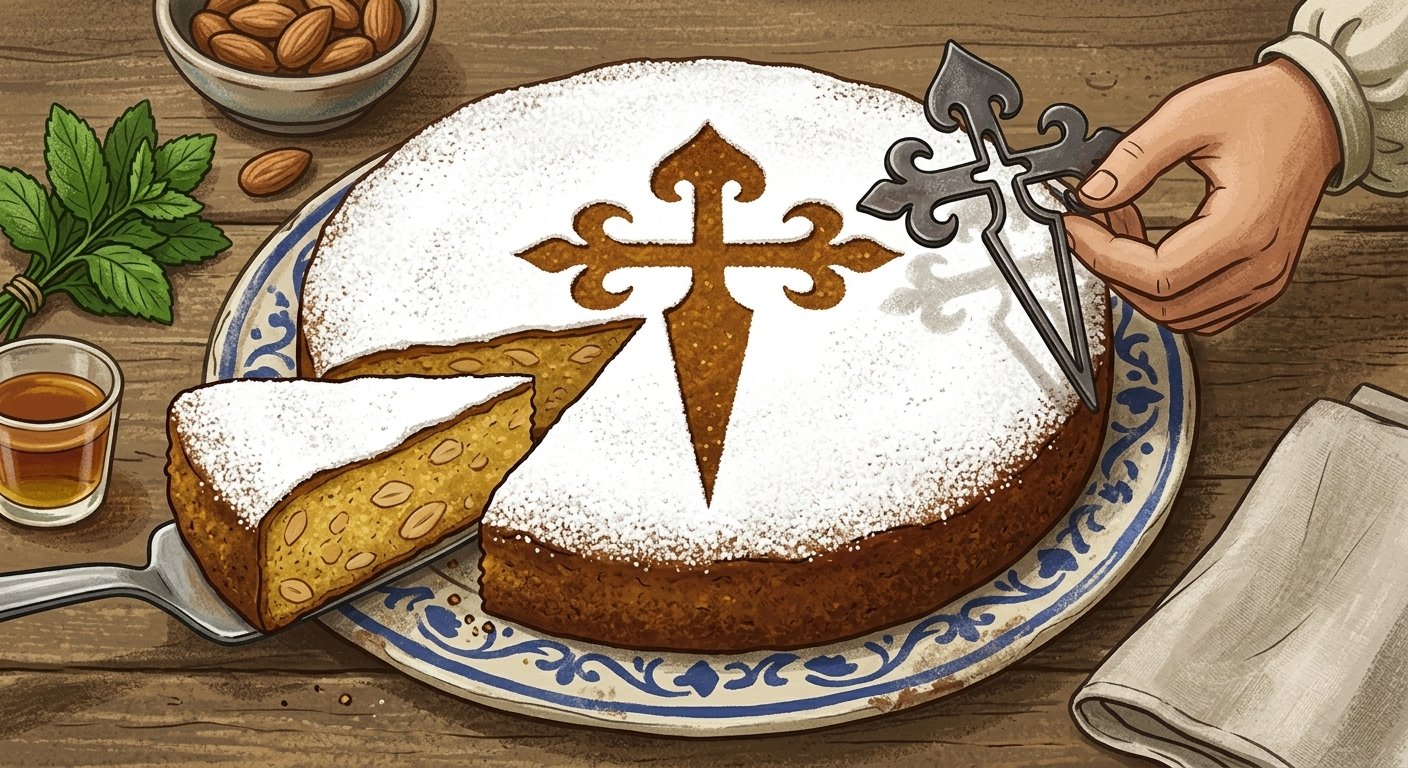
A white dusting of sugar covers the top of Tarta de Santiago, hiding the golden almond cake underneath. Then comes the familiar moment: a stencil lifts away to reveal the sharp outline of the Cross of Saint James. Cut into it and the cake gives way easily, with a soft, slightly grainy texture and the unmistakable richness of almonds.
This is one of Galicia’s most recognisable desserts, closely associated with Santiago de Compostela and the pilgrimage routes that lead there. Its ingredient list is remarkably short, yet that simplicity is part of its charm. Almonds, sugar, eggs, lemon zest, and sometimes a little sweet wine or brandy create a cake with a deep nutty flavour and delicate sweetness.
A Cake With Centuries Behind It
The history of Tarta de Santiago reaches back several centuries. Historical sources connect its origins with the wealthier households of Galicia between the 16th and 18th centuries, when almonds and sugar were expensive ingredients rather than everyday pantry staples. A reliable almond cake recipe appears in a confectionery notebook compiled around 1838.
Almonds were not widely grown in Galicia, so cooks relied on almonds brought in through trade, particularly from Spain’s Levante region. Their cost gave almond-based sweets a sense of luxury. Over time, however, almonds became more accessible and the cake moved beyond wealthy kitchens into the broader tradition of Galician baking.
What Makes Tarta de Santiago Different?
Traditional Tarta de Santiago is wonderfully uncomplicated. The protected Galician version uses almonds, sugar, and eggs as its essential ingredients, with lemon zest and, depending on the recipe, sweet wine, brandy, or orujo adding extra flavour. The cake can appear with or without a pastry base.
The texture is also distinctive. It is neither a light sponge nor a dense fruitcake. Ground almonds give it a pleasantly grainy crumb, while the eggs keep the centre tender. As it bakes, the surface takes on a warm golden colour and the aroma of toasted almonds fills the kitchen.
The Cross That Became Its Signature
The powdered sugar design is perhaps the first thing you notice about Tarta de Santiago, but the famous cross was actually a relatively late addition. The Cross of the Order of Santiago began appearing on the cake in 1924, when the founder of Casa Mora in Santiago de Compostela used the design to give the traditional cake a distinctive finish. Other bakers soon adopted it.
Today, that cross has become inseparable from the cake’s identity. Place a stencil in the centre, cover the surface with icing sugar, and carefully lift the stencil away. The result is simple but striking: a white cake marked by a crisp, dark almond-coloured cross.
Keep the Almonds at the Centre
Because there are so few ingredients in Galician almond cake, each one matters. Use good-quality ground almonds with a fresh, sweet aroma. The official specification for the protected cake requires almonds to make up at least 33% of the mixture, alongside at least 33% sugar and 25% egg.
Mix the eggs and sugar until well combined, then fold in the almonds and lemon zest. Avoid treating the batter like a conventional sponge cake. You do not need to whip it into a huge volume. The almonds should remain the star, giving the finished cake its characteristic texture and rich flavour.
Bake Until Golden
Pour the mixture into a round cake tin and bake until the surface turns golden and the centre sets. Traditional specifications place the baking temperature around 180 to 200°C, with cooking time depending on the thickness of the cake.
Let the cake cool before decorating it. This matters because the crumb becomes easier to handle as it settles. Once completely cool, place the Cross of Saint James stencil over the centre and sift icing sugar generously across the surface. Lift the stencil carefully and let the design appear.
A Cake Connected to the Camino
The connection between Tarta de Santiago and Santiago de Compostela became even stronger as pilgrimage to the city grew. Travellers arriving in Galicia encountered the cake as one of the region’s characteristic sweets, helping spread its reputation beyond the city and eventually beyond Spain.
That connection makes the cake particularly fitting as a symbol of Galicia. Almonds and sugar tell the story of its older culinary roots, while the cross connects it directly with Santiago and the pilgrimage. A slice therefore carries more than its sweet, nutty flavour.
Tarta de Santiago Recipe
Ingredients
- 250 g ground almonds
- 250 g sugar
- 4 large eggs
- Zest of 1 lemon
- ½ tsp ground cinnamon, optional
- 1 tbsp sweet wine, brandy, or orujo, optional
- Icing sugar, for decorating
Method
- Prepare the oven: Heat the oven to 180°C. Grease a round cake tin and line the base with baking paper.
- Mix the eggs and sugar: Whisk the eggs and sugar until thoroughly combined. You do not need to create a heavily aerated mixture.
- Add the flavour: Stir in the lemon zest, cinnamon if using, and sweet wine or brandy.
- Fold in the almonds: Add the ground almonds and mix until you have a smooth, evenly combined batter.
- Bake: Pour the mixture into the prepared tin. Bake for approximately 25 to 30 minutes, until the cake is golden on top and set in the centre.
- Cool completely: Let the cake cool before removing it from the tin.
- Decorate: Place a Cross of Saint James stencil in the centre. Dust the entire surface generously with icing sugar, then carefully lift the stencil away.
- Serve: Slice and serve at room temperature with coffee, tea, or simply on its own.


