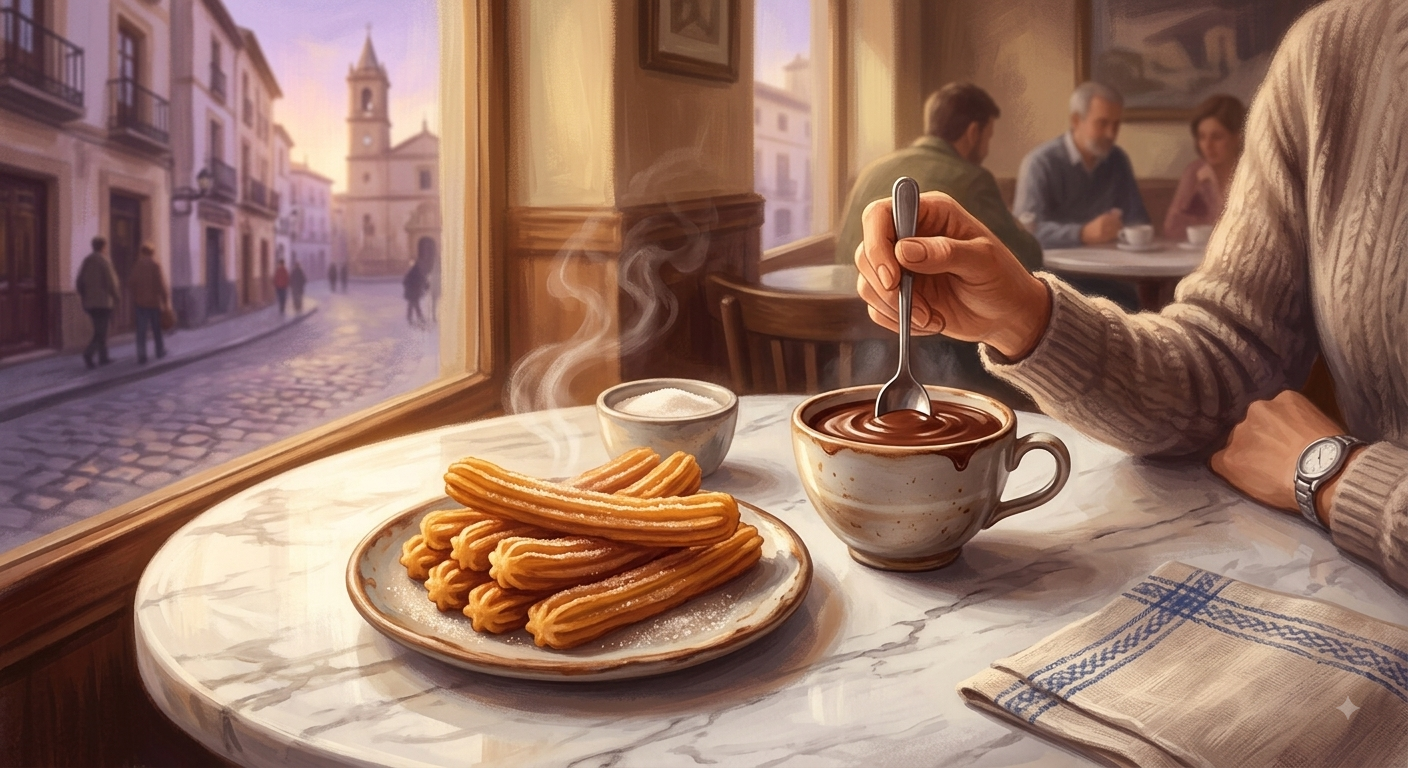
There are few sights in Spain more inviting than a marble café table at seven in the morning, a plate of golden churros still ticking with heat, and beside it a small cup of chocolate so thick a spoon can almost stand up in it. This is not breakfast as most of the world knows it. It is closer to a ritual — a warm, unhurried pause Spaniards reach for at the start of a big day, the end of a long night, or the middle of a winter afternoon.
If you have never met a churro, picture a length of plain dough, piped through a star-shaped nozzle so it fries up ridged and crisp, then dropped into hot oil until deep gold outside and soft inside. Unlike a doughnut, a churro is not sweet in itself. That is the point: the sweetness comes from the chocolate.
Not a drink, but a dip
The “chocolate” here surprises most newcomers. Spanish drinking chocolate is dense, glossy, and pudding-like — real chocolate melted with milk and thickened until it coats a spoon. It is served in a small cup because it is meant for dipping, not sipping. You take a churro, plunge one end in, let it soak for a second, and eat. When the churros are gone, you drink what remains. That contrast — the salty, crisp, almost bland churro against deep bittersweet chocolate — is the whole magic. Neither is as good alone.
A food of celebration
Spaniards eat churros year-round, but the dish carries special weight at certain moments: the classic close to a night out, a fixture of winter fairs, and a treat that turns an ordinary morning — New Year’s Day, a family Sunday — into an occasion. At the century-old chocolaterías of Madrid, the same plates have greeted sleepy revellers and elegant grandmothers alike for generations. Going for churros is as much about the company and the pause as the food.
You will also meet the churro’s relatives: the porra, a thicker, softer, coiled version, and sweeter filled cousins across Latin America. The Spanish original stays defiantly simple — crisp dough, thick chocolate, nothing hidden inside.
The good news for the curious cook is that churros are humble food. The dough is a hot-water paste — no yeast, no proving — and the only real skills are hot oil and quick eating. Here is how to make both parts at home.
Recipe: Churros con Chocolate
Serves 4 · about 45 minutes
For the churros
- 250 g plain flour
- 250 ml water
- 1 tsp salt
- 1 tbsp olive oil, plus 1 litre neutral oil for frying
- Caster sugar, for dusting (optional)
For the chocolate
- 200 g dark chocolate (about 60–70% cocoa), chopped
- 400 ml whole milk
- 1 tbsp cornflour
- 1–2 tbsp sugar, to taste
Method
- Make the dough. Bring the water, salt, and 1 tbsp olive oil to a rolling boil. Tip in all the flour at once and beat hard with a wooden spoon until it forms a smooth, thick paste that pulls away from the pan. Let it cool for 10 minutes — it should be warm, not hot.
- Heat the oil. Pour the frying oil into a deep, heavy pan and heat to 180°C. If you don’t have a thermometer, a scrap of dough should sizzle steadily and turn gold in about a minute. Getting this right is everything: too cool and the churros drink oil; too hot and they burn before the inside cooks.
- Pipe and fry. Spoon the dough into a piping bag fitted with a star nozzle (the ridges help them crisp). Pipe strips 10–12 cm long straight over the oil, snipping each off with scissors. Fry 3–4 at a time for 2–3 minutes, turning once, until deep gold. Lift onto kitchen paper and, if you like, roll in caster sugar.
- Make the chocolate. Whisk the cornflour into a splash of the cold milk to make a smooth paste. Warm the rest of the milk with the sugar, add the chopped chocolate, and stir until melted. Whisk in the cornflour paste and keep stirring over low heat for 2–3 minutes until thick enough to coat a spoon.
- Serve at once. Pour the chocolate into small cups, pile the churros alongside, and dip. Churros wait for no one — they are best within minutes, while they still crackle.
A word of both caution and encouragement: churros don’t keep, don’t travel, and were never meant to. They belong to the moment — the steam off the plate, the first crisp bite dipped into warm chocolate. That is why Spaniards call this the breakfast of celebration. In a country that treats eating together as one of life’s real pleasures, few things say welcome, slow down, enjoy quite like a plate of churros con chocolate.