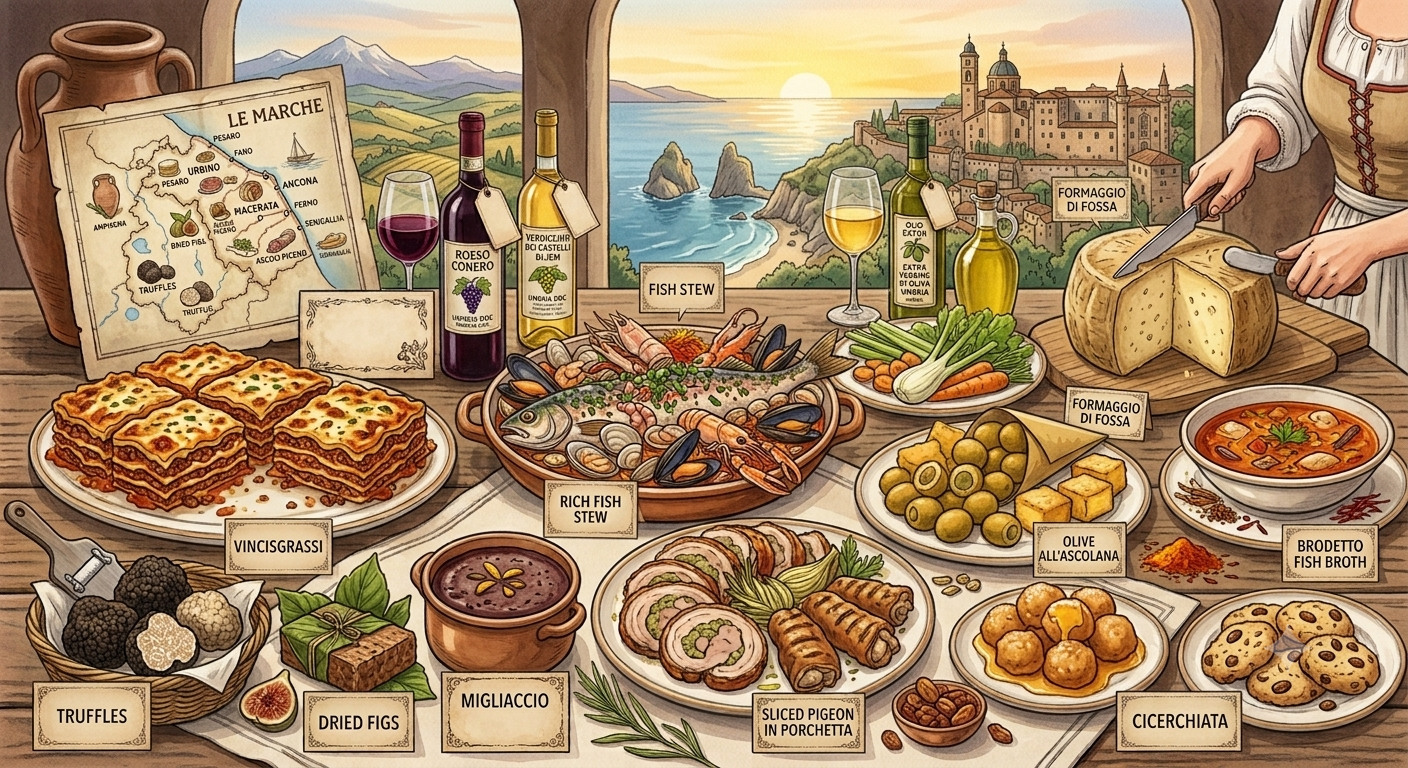
Ask most people to name an Italian region known for its food, and Le Marche rarely comes up first — overshadowed by its more famous neighbours, Tuscany to the west and Emilia-Romagna to the north. Yet few regions in Italy capture such a genuine culinary duality. Squeezed between the Apennine mountains and the Adriatic coast, Le Marche’s cooking pulls in two directions at once: hearty, rustic dishes rooted in pork, truffles, and mountain produce on one side, and light, delicate seafood cookery on the other. The result is a regional cuisine defined not by a single identity, but by the tension and balance between two very different landscapes.
The Mountains: Pork, Truffles, and Patience
Inland Le Marche belongs to the hills and mountains, and its cooking reflects that terrain closely. Pork holds a central place here, most famously in porchetta, a whole deboned pig seasoned generously with garlic, rosemary, and wild fennel, then slow-roasted until the skin turns impossibly crisp and the meat inside stays tender and moist. Le Marche is widely credited as porchetta’s birthplace, and the technique demands real patience: hours of slow roasting at a moderate temperature, allowing the fat to render gradually and baste the meat from within, rather than the higher heat that would char the skin before the interior finished cooking.
The region is equally celebrated for its truffles, particularly the prized white truffles of Acqualagna, one of Italy’s most important truffle-hunting towns. Unlike more assertive flavours elsewhere in Italian cooking, truffles are treated with restraint — shaved raw over simple dishes like pasta or eggs at the very last moment, since heat destroys much of their delicate aroma almost instantly. The inland technique, broadly, favours slow transformation for meat and minimal intervention for delicate, prized ingredients like truffles.
The Coast: Light Hands and Quick Cooking
Along the Adriatic, the cooking shifts entirely. Towns like Ancona and San Benedetto del Tronto built their culinary identity on the daily catch, and the region’s most iconic seafood dish, brodetto, exemplifies the coastal approach. A fish stew made from whatever mix of fish and shellfish the boats bring in that day, brodetto varies from town to town along the coast, but the underlying technique stays consistent: a light tomato-based broth, gently simmered, into which the fish are added in careful sequence — firmer, longer-cooking varieties first, delicate ones added only in the final minutes to avoid overcooking.
This same restraint carries through much of the region’s coastal cooking. Fritto misto, a mixed fry of small fish and vegetables, relies on a light, crisp batter and oil kept at a precise, consistent temperature, so the coating crisps quickly without soaking up excess oil or overcooking the delicate fish inside. Where inland cooking asks for hours of patience, coastal cooking in Le Marche asks for speed, precision, and a light touch.
Where the Two Meet
Nowhere is Le Marche’s dual identity more perfectly expressed than in olive all’Ascolana, the region’s most famous specialty and arguably its culinary emblem. Large, mild green olives from Ascoli Piceno are pitted in a single continuous spiral cut, stuffed with a rich filling of three ground meats — typically beef, pork, and chicken or turkey, cooked down with wine and nutmeg — then breaded and deep-fried until golden. It is, quite literally, a mountain filling wrapped inside a product of the region’s agricultural land, fried using the same confident, high-heat technique found in the coastal kitchens. Few single dishes so neatly summarise an entire region’s culinary character.
A Region Defined by Contrast
What makes Le Marche worth studying is precisely this refusal to settle into one culinary identity. A meal here might open with a delicate seafood antipasto and close with a rich, slow-cooked pork dish, without ever feeling disjointed, because both traditions share a deep respect for local, seasonal ingredients and technique suited precisely to what they’re working with. It is a regional cuisine built on geography as much as culture — proof that a landscape squeezed between mountain and sea can produce a food culture just as varied as the terrain itself.
Olive all’Ascolana (Ascoli-Style Stuffed Fried Olives)
Makes about 30
Ingredients
- 30 large green olives (Ascolana or similar), pitted in a spiral
- 150g minced pork
- 150g minced beef
- 50g minced chicken or turkey
- 1 small onion, finely diced
- 1 tbsp olive oil
- 50ml white wine
- 30g grated Parmesan
- 1 egg yolk
- A pinch of grated nutmeg
- Salt and freshly ground black pepper
- 100g plain flour
- 2 eggs, beaten
- 150g breadcrumbs
- Vegetable oil, for frying
Method
- Heat the olive oil in a pan and sauté the onion until soft. Add the minced meats and cook until browned, breaking up any lumps.
- Pour in the white wine and let it evaporate. Season with nutmeg, salt, and pepper, then remove from heat and let cool.
- Stir the Parmesan and egg yolk into the cooled meat mixture, then blend or finely chop until it forms a smooth, pliable paste.
- Carefully stuff each pitted olive with the meat mixture, pressing it back into its original shape.
- Set up three bowls: flour, beaten eggs, and breadcrumbs. Roll each stuffed olive through the flour, then the egg, then the breadcrumbs, coating evenly.
- Heat vegetable oil to 180°C in a deep pan or fryer. Fry the olives in batches for 2–3 minutes, until golden brown.
- Drain on paper towels and serve hot as an antipasto.