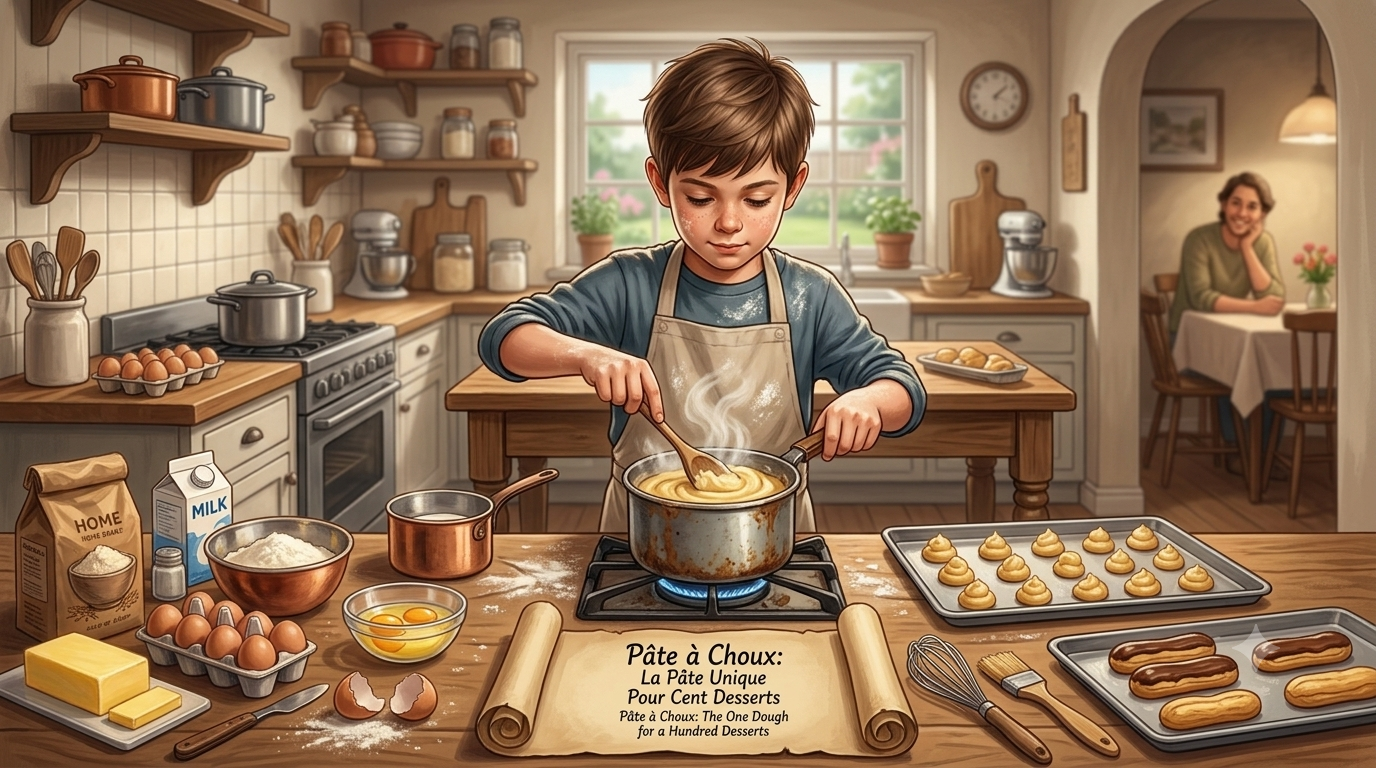
Some pastries earn their reputation through complexity — endless lamination, precise temperatures, years of practice. Pâte à choux earns its reputation the opposite way. It is a simple, almost improbable dough, cooked twice before it ever sees the oven, that somehow becomes the foundation for éclairs, profiteroles, gougères, and the towering croquembouche. Master this one base, and an entire wing of French pastry opens up.
A Dough with an Identity Crisis
Choux pastry does not behave like other doughs. It contains no leavening agent, no baking powder, no yeast — yet it puffs dramatically in the oven, hollowing itself out into a shell ready to be filled. The name choux comes from the French word for cabbage, a nod to the round, ridged shape of the baked buns, which vaguely resemble small cabbages sitting on a tray.
Its history stretches back to the Renaissance, with credit often given to Catherine de’ Medici’s Italian pastry chef Pantanelli, though it was Antonin Carême in the nineteenth century who refined the recipe into something close to what bakers use today. Since then, it has proven remarkably adaptable: the same base dough, piped into different shapes and baked to different sizes, becomes an entirely different pastry depending on what happens next.
The Technique: Two Cooks, One Dough
Cooking the panade. The process begins on the stovetop, not in a mixing bowl. Water, butter, salt, and sometimes sugar are brought to a boil together, then flour is added all at once and stirred vigorously. This mixture, called a panade, needs to cook for a minute or two longer, stirring constantly, until it pulls cleanly away from the sides of the pan and a thin film forms on the base. This step gelatinises the starch in the flour, which is essential — it is what allows the dough to trap steam later and puff properly.
Cooling before eggs. The panade must cool slightly before eggs are beaten in — adding them immediately would scramble them in the residual heat. A few minutes of stirring off the heat, or a rest of five to ten minutes, is usually enough.
Beating in the eggs gradually. This is the stage most beginners rush. Eggs should be added one at a time, fully incorporating each before adding the next. The dough will look broken and slippery at first, then come back together into a smooth, glossy paste. The final consistency matters enormously: it should fall from a spatula in a slow, thick ribbon, holding a distinct point rather than running off like batter or clinging stiffly like dough. Too much egg and the paste is too loose to hold its piped shape; too little and it will not puff properly.
Piping with consistency. Whether piping éclairs, buns, or swan shapes, uniform size matters — mismatched pieces bake unevenly, with smaller ones drying out before larger ones finish cooking. A light egg wash and a gentle smoothing of any peaks with a wet fingertip helps the pastry bake with a clean, even surface.
Baking without interruption. This is where the real magic happens. In the oven’s heat, the water trapped inside the dough turns rapidly to steam, and the gelatinised starch structure expands around it, creating the hollow centre. The single most important rule: do not open the oven door during the first twenty minutes of baking. A rush of cold air collapses the delicate, still-forming structure before it has set, leaving flat, dense pastries with no cavity to fill. Many bakers also pierce each bun with a skewer near the end of baking and return them to the turned-off oven for a few minutes, letting steam escape so the shells stay crisp rather than turning soggy as they cool.
From One Dough, Many Desserts
Once you have a properly made choux pastry, the possibilities multiply quickly. Piped into small rounds and filled with pastry cream, it becomes profiteroles or cream puffs. Piped into long batons and topped with fondant icing, it becomes the classic éclair. Piped into a ring and filled with praline cream, it becomes a Paris-Brest, shaped in homage to a famous cycling race. Piped in tiny mounds, mixed with cheese, and baked until golden, it transforms into gougères, a savoury French classic served alongside wine. Stacked into a towering cone and bound with spun caramel, it becomes croquembouche, the celebratory centrepiece of French weddings and christenings. The dough itself never changes — only its shape, size, and filling do.
Classic Choux Buns
Makes about 16 buns
Ingredients
- 125ml water
- 125ml whole milk
- 100g unsalted butter, cubed
- ¼ tsp salt
- 1 tsp sugar
- 150g plain flour, sifted
- 4 large eggs, lightly beaten
- 1 egg, beaten, for egg wash
Method
- Preheat the oven to 200°C (180°C fan) and line two baking trays with parchment.
- In a saucepan, bring the water, milk, butter, salt, and sugar to a boil.
- Remove from the heat and add the flour all at once, stirring vigorously until it forms a smooth ball.
- Return to low heat and cook for 1–2 minutes, stirring, until a thin film forms on the base of the pan.
- Transfer to a bowl and let cool for 5 minutes.
- Beat in the eggs a little at a time, mixing thoroughly after each addition, until the dough is smooth, glossy, and falls in a thick ribbon from the spatula.
- Pipe into rounds about 4cm wide, spaced well apart. Smooth any peaks with a wet finger and brush lightly with egg wash.
- Bake for 20 minutes without opening the door, then reduce the heat to 180°C (160°C fan) and bake for a further 10–15 minutes until deeply golden and firm.
- Pierce each bun with a skewer and return to the switched-off oven for 5 minutes to dry out.
- Cool completely before filling with whipped cream or pastry cream.