
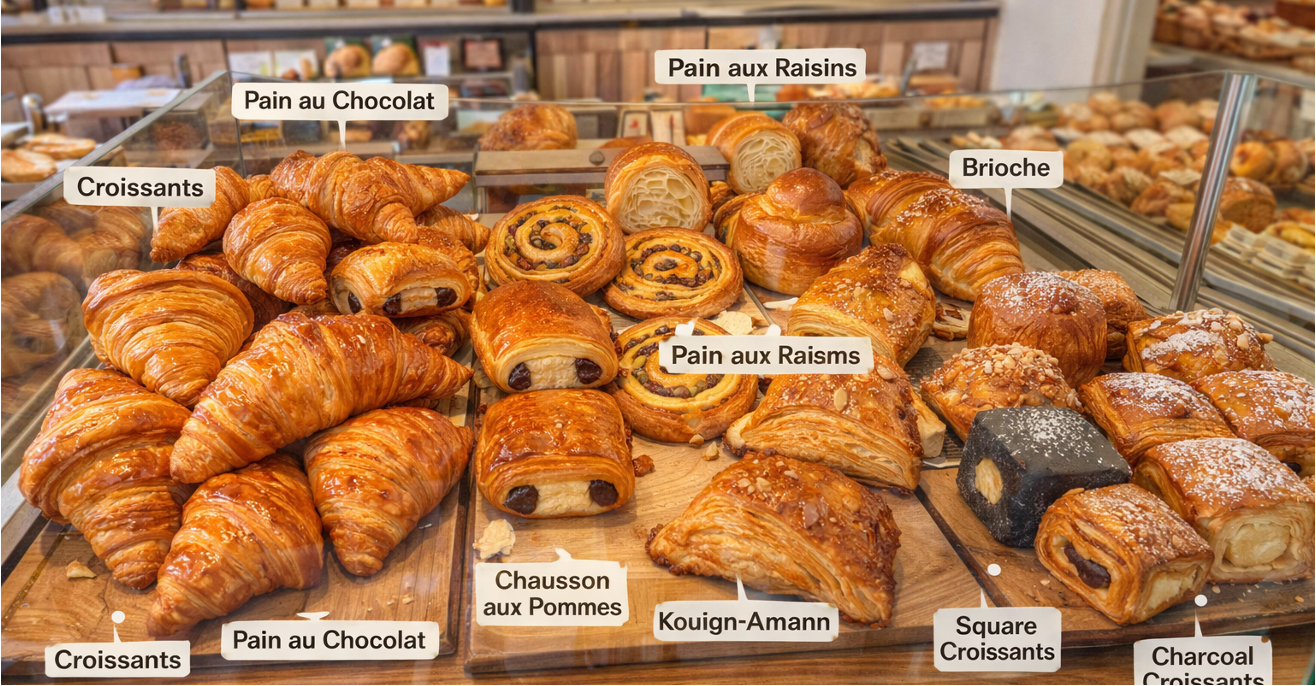
Walk into a French bakery at seven in the morning and you will see a distinct section of the counter glowing gold. This is the domain of viennoiserie — a family of enriched, yeast-raised pastries that sit between bread and pâtisserie. They are lighter than cake, richer than baguette, and inseparable from French breakfast culture.
The term suggests Vienna, and historically that connection matters. In the nineteenth century, Austrian baking techniques — particularly laminated yeast dough — arrived in France. Parisian bakers refined these methods, increased the butter, adjusted fermentation, and shaped what we now recognise as the modern French breakfast pastry tradition. Over time, viennoiserie stopped being foreign influence and became French ritual.
But to understand viennoiserie properly, it helps to classify it.
1. Laminated Yeast Dough: The Layered Classics
The most recognisable members belong to laminated dough, where butter is folded repeatedly into yeast dough to create alternating layers. During baking, steam lifts these layers apart, forming a honeycomb interior.
At the centre stands the Croissant, followed closely by Pain au chocolat and Pain aux raisins. Variations include the almond-filled Croissant aux amandes, fruit-filled Chausson aux pommes, and the Breton Kouign-amann, a butter-and-sugar-rich relative that blurs the line between pastry and confection.
These pastries rely on precision: dough temperature, butter plasticity, and fermentation timing must align. Their visual appeal — crisp exterior, open interior structure — makes technique visible.
Each of these classics warrants its own exploration, from lamination mechanics to regional interpretation.
2. Enriched Non-Laminated Dough: The Brioche Family
Not all viennoiserie is laminated. Some varieties depend instead on high enrichment — eggs, butter, milk, and sugar incorporated directly into the dough.
The most famous example is Brioche, which itself branches into forms such as Brioche à tête, Brioche Nanterre, and regional interpretations like Brioche vendéenne. Related styles include Pain viennois, softer and more elongated, and regional breads such as Gâche or Fouace, which hover between celebratory loaf and breakfast pastry.
These doughs ferment more slowly due to their fat content. The result is tender rather than flaky, plush rather than layered. Toasted slices of brioche reveal how richness and lightness can coexist — a defining quality of viennoiserie as a whole.
3. Shaped, Filled, and Display Variants
Beyond foundational dough types lie shaped and filled forms that animate the bakery display.
The spiral Escargot, custard-filled Suisse, apricot-centred Oranais, and twisted Sacristain demonstrate how shaping influences texture and caramelisation. Even items such as the Palmier — technically made from puff pastry — are culturally grouped with morning pastries.
These variations reflect the creativity of the boulanger. The base dough remains familiar, yet fillings and forms diversify the offering without abandoning technique.
4. Regional and Revival Traditions
Viennoiserie also includes regional members that express local identity. Alsace contributes Kougelhopf, while Normandy and western France offer distinctive enriched loaves. The clever reuse of day-old brioche as Bostock, soaked in syrup and topped with almond cream, reveals the practical wisdom embedded in French baking culture.
Such pastries show that viennoiserie is not a static canon but a living tradition shaped by geography and season.
More Than Breakfast
Viennoiserie persists because it embodies balance. Yeast fermentation provides lightness. Butter provides richness. Skill transforms ordinary ingredients into structured elegance.
Though industrial production exists, artisanal bakeries remain central to its identity. The early-morning bake, the aroma escaping onto the street, and the ritual purchase before work or school sustain its cultural relevance.
Ultimately, viennoiserie is not merely a category of baked goods. It is the architecture of the French morning — layered, enriched, disciplined, and quietly indulgent.
Each pastry within this family opens the door to deeper study: technique, regional context, ingredient science, and evolving modern interpretation.


