An Italian meal is less a sequence of courses than a slow choreography of appetite. It is designed not to impress the diner, but to move them — from curiosity to comfort, from hunger to satisfaction, and finally back to lightness again.
This meal structure did not emerge from restaurant menus but from domestic life. In households across Italy, meals evolved around the rhythm of the day, the season, and the ingredients available. Lunch was historically the main meal, heavy enough to sustain labour; dinner was lighter, gentler, more reflective. Over time, this practical rhythm hardened into a cultural grammar.
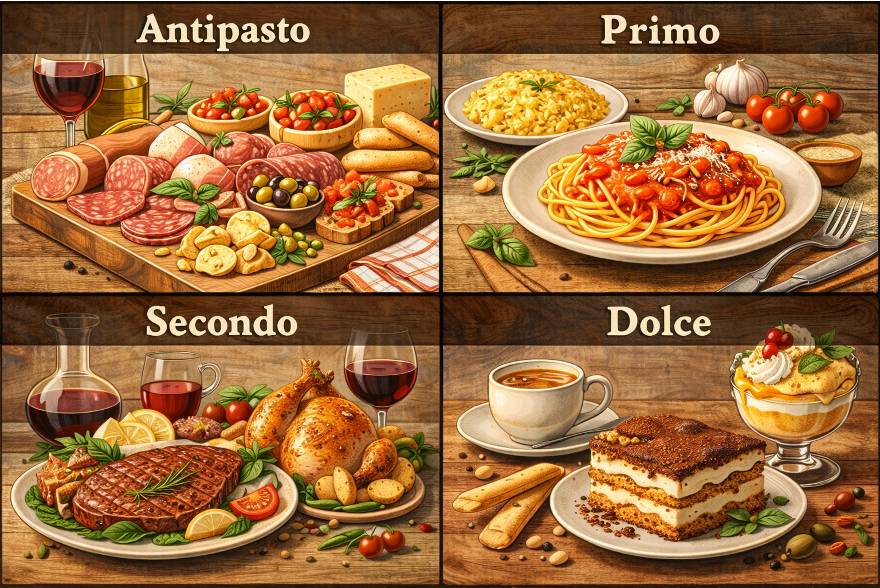
Antipasti do not “start” the meal so much as open a conversation. They are meant to sharpen perception: the briny snap of olives, the bright acidity of marinated vegetables, the silky fat of prosciutto. Nothing here is meant to fill you up. It is a reminder that eating is sensory before it is satiating.
The primi is where Italian cooking reveals its emotional core. Pasta, risotto, or soup are not simply carbohydrates — they are vehicles for memory. A bowl of minestrone carries the garden with it; a plate of ragù speaks of long Sundays and patient simmering. This is why so many iconic dishes belong to this course, and why so many Italian chefs still see pasta as the soul of their cooking. (You might later link this to posts on Ragù alla Bolognese, Risotto technique, or Minestrone across regions.)
Secondi shifts the register. The focus narrows to a single protein — a fish grilled simply, a chicken roasted with lemon, a steak cooked over wood. Italian cooks rarely drown these dishes in sauce; the confidence lies in quality and restraint. What accompanies them is just as important: the contorni. Vegetables here are not garnish but counterpoint, cutting richness, adding bitterness, or bringing freshness back into the meal.
Dessert completes the circle. It is often soft, creamy, or cold — tiramisu, panna cotta, gelato — designed to soothe rather than overwhelm. Coffee follows not as an afterthought but as closure, a final punctuation mark that signals the meal is over.
What this meal structure ultimately teaches is that eating, in Italy, is temporal. Each course has a job, a mood, and a pace. When you understand this, you stop thinking about dishes in isolation and start thinking about meals as stories with a beginning, middle, and end.
This is why structure matters: it shapes not only what Italians eat, how they distribute their meals, but how they feel while eating.