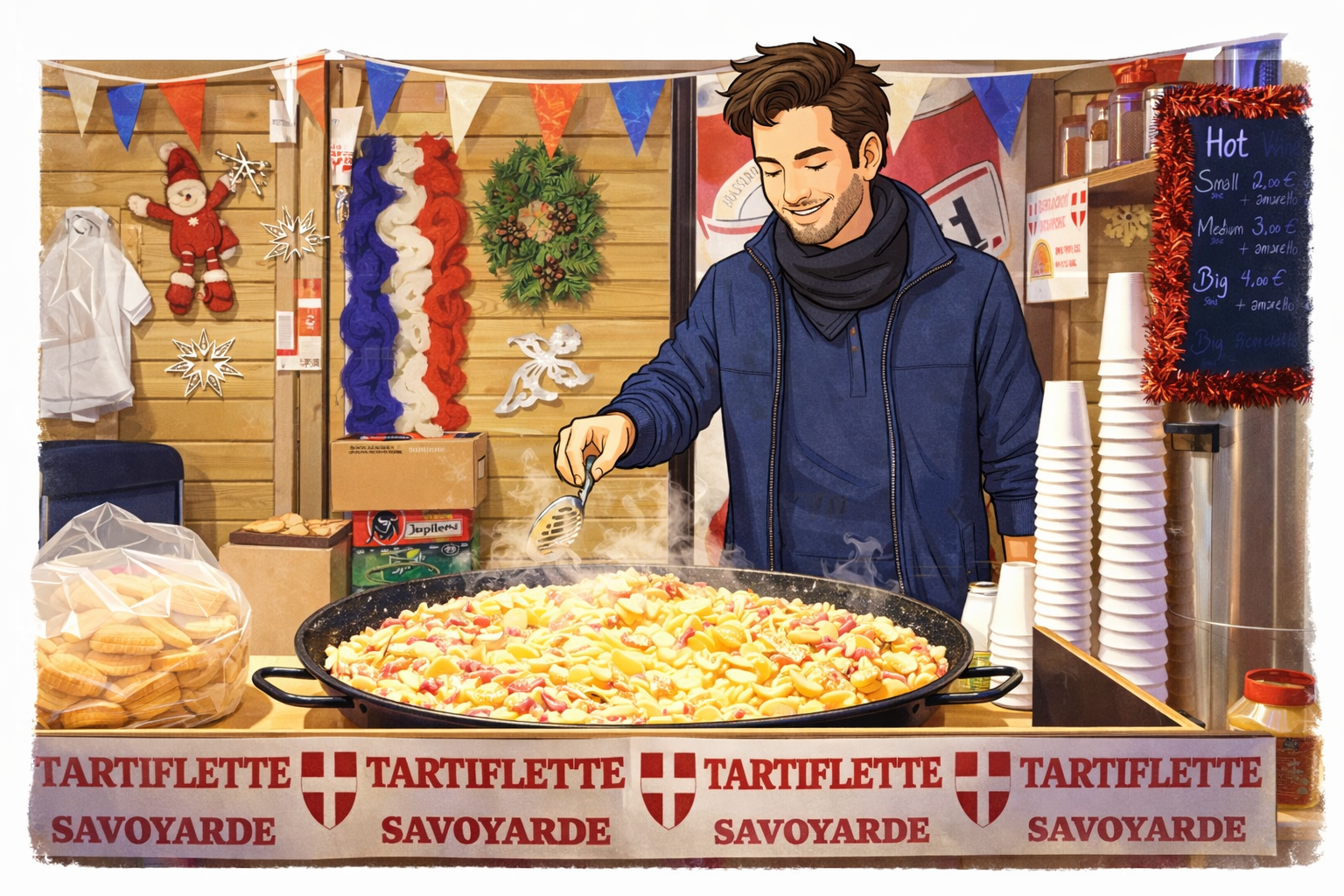
Cold teaches you what food is really for. Dishes like tartiflette are the perfect example of comforting meals designed to warm you up.
That’s how I came to understand tartiflette—not as a recipe, but as an answer to winter. The first time was in London, cooked by a friend on a night so cold no one bothered opening a window. The second was in Paris, eaten standing at a Christmas market, steam fogging the air. Different places. Same reaction. This dish didn’t try to impress. It wanted to keep you going.
Tartiflette belongs to the Alps, specifically to Savoie, where food is shaped by the cold, labor, and long winters. It’s built from potatoes, onions, bacon, cream, and reblochon cheese—nothing rare, nothing delicate. But together, they do something purposeful. This is food designed to warm bodies, slow time, and gather people around a table.
People often call tartiflette “traditional,” but its modern form is younger than you’d expect. While Savoyard cooking has always relied on potatoes, pork, and cheese, tartiflette rose to prominence in the late twentieth century, partly to champion reblochon. Its name likely comes from tartiflâ, a local word for potato. That origin doesn’t weaken the dish. It proves something better: food doesn’t need centuries of mythology to feel inevitable. It just needs to make sense.
And tartiflette makes sense the moment reblochon hits the oven. This washed-rind cheese doesn’t collapse when heated—it loosens. The rind holds its shape while the inside softens, soaking into the potatoes and cream below, forming a gentle crust above. This isn’t a garnish. It’s the engine of the dish.
Culturally, tartiflette lives in winter. Après-ski meals. Long tables. Cold cheeks. A dry white wine cuts through the richness. It’s shared food. Heavy food. The kind you eat slowly because standing up afterward feels optional.
Cooking it teaches restraint. Waxy potatoes keep their structure. Onions soften, not sweeten. Bacon brings salt and smoke. Cream enriches without overwhelming. Once layered, the dish asks you to stop interfering. Heat does the rest.
Recipe
Ingredients
- 1 kg waxy potatoes
- 2 tbsp butter
- 2 shallots, thinly sliced
- 250 g smoked bacon lardons
- 100 ml white wine
- 200 ml double cream
- 1 reblochon
- 1 clove garlic
Method
- Place the peeled potatoes in a large pan of well-salted water and bring to a boil. Cook until they are just tender when pierced with a knife, but still hold their structure. Drain thoroughly and set aside to cool slightly.
- Set a frying pan over medium heat and cook the bacon lardons until the fat has rendered and the edges begin to colour. Add the finely sliced shallots and cook gently until soft and translucent.
- Pour in the white wine and let it bubble, reducing until almost completely evaporated. Take the pan off the heat and stir in the double cream to form a cohesive sauce.
- Preheat the oven to 200°C (180°C fan). Once cool enough to handle, slice the potatoes into thick rounds.
- Rub the inside of an ovenproof dish with the cut garlic clove. Arrange half the potatoes in an even layer, season lightly with salt and pepper, then spoon over half of the bacon and cream mixture.
- Lay half the sliced reblochon over the potatoes, then repeat the layering with the remaining potatoes, sauce, and cheese, finishing with reblochon on top.
- Transfer to the oven and bake until the dish is bubbling and the surface is golden and lightly blistered. Serve immediately with a green salad and dry white wine.