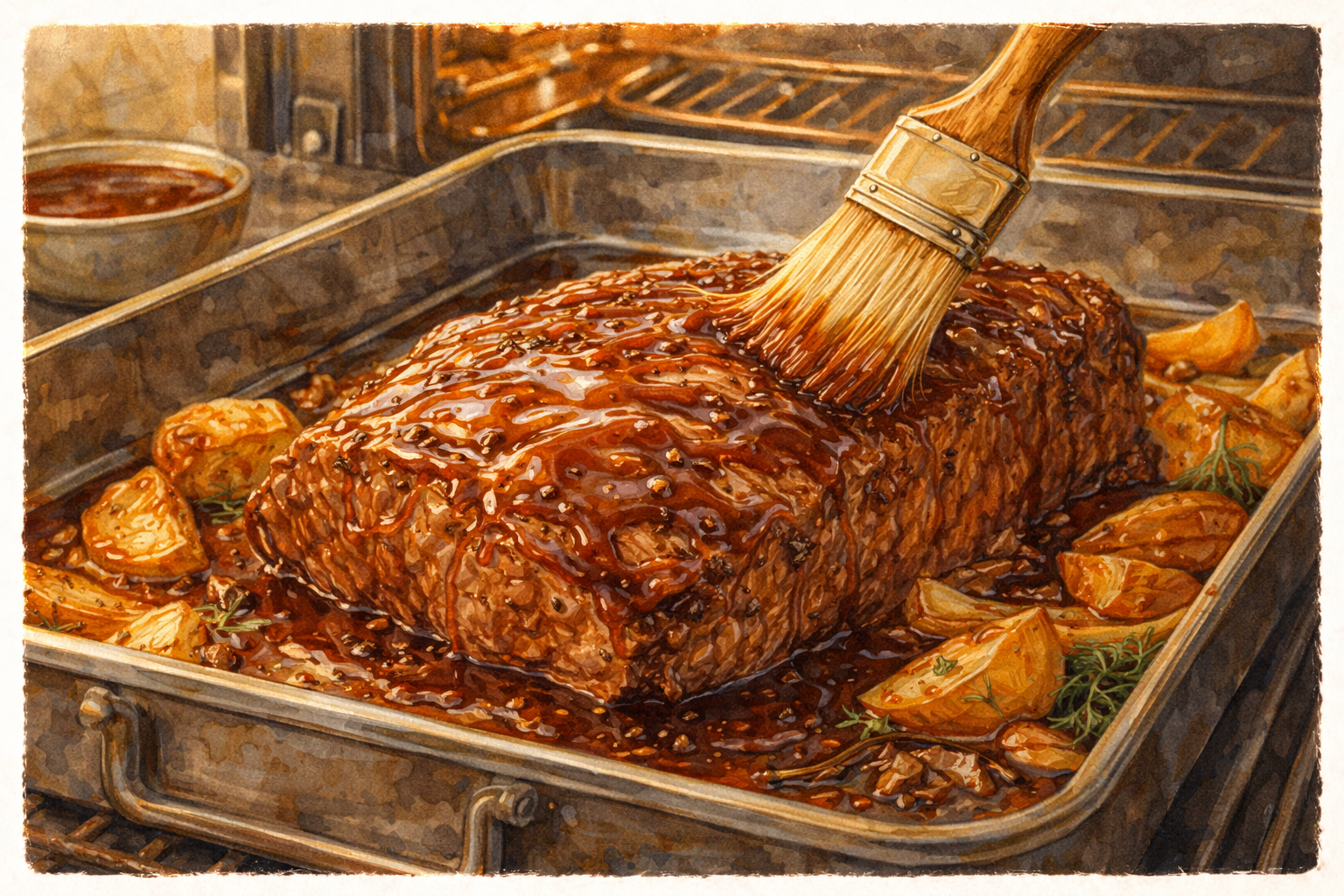
In classical French cooking, a glaze—glace—is the result of reducing a stock until it becomes thick, sticky, glossy, and almost syrup-like. It is stock with the water driven off and the flavour condensed into something close to culinary ink. Chefs often describe it as a flavour “concentrate,” but that undersells its magic. A good glace clings to the back of a spoon like it doesn’t want to leave.
There are three traditional types:
- Glace de viande (meat glaze)
- Glace de volaille (chicken glaze)
- Glace de poisson (fish glaze)
They start as clear stocks, simmered, skimmed, then reduced to 1/10 or even 1/20 of the original volume. What you get is intensity: savouriness turned up to eleven, body from gelatin, and a sheen that makes sauces feel alive.
Why Use It? (The Purpose Behind the Gloss)
A glaze deepens flavour without diluting anything—no added liquid, no extra cooking time, no fuss. Just a drop will:
- Boost a pan sauce
- Give roasted meats a lacquer
- Add backbone to soups
- Enrich braises or stews
- Finish vegetables with a restaurant-level savouriness
It’s essentially umami in a tiny spoonful, built from bones, slow heat, and patience.
Does a Glaze Belong in Indian or Southeast Asian Cooking?
Yes—if you treat it as an ingredient, not as a cultural intruder. Glace is technique, not tradition, and techniques travel well. A glaze can slip into Indian or Southeast Asian cooking in several ways without fighting the existing flavour architecture.
Think of it as a silent boost—like switching on under-cabinet lighting. Everything tastes clearer, brighter, more dimensional.
How to Adapt a Glaze to Indian Flavours
French glazes are neutral in terms of spices but heavy on depth and gelatin. In Indian cooking, this opens doors:
1. Add Glace to Onion-Garlic-Ginger Bases
A teaspoon of chicken or meat glaze folded into a masala while it bhunas creates extraordinary richness—almost like the flavours have more gravity.
Great for:
- Rogan josh
- Kosha-style gravies
- South Indian kurmas with meat
- North Indian restaurant-style gravies
2. Finish Lentils and Kadhis with Vegetable Glaze
A vegetable glace—carrot, celery, onion, mushroom—melds beautifully with dals, giving them a subtle fullness without changing their character.
Use sparingly: just a half-teaspoon at the end.
3. Spice-Infused Glazes
This is where things get creative:
- Reduce chicken stock with black cardamom, pepper, bay leaf, star anise, then strain and finish the reduction.
- Add a few curry leaves or a piece of pandan to a Southeast Asian-leaning glaze.
- Infuse with galangal, lemongrass, or turmeric for a Southeast Asian tilt.
This creates hybrid glazes that feel at home in biryanis, Thai curries, or Malay braises.
How to Use Glazes in Southeast Asian Cooking
Southeast Asian cuisines love concentrated, sticky, umami-rich liquids—just from different sources (palm sugar, fish sauce, shrimp paste, tamarind). A French-style glaze can act like another member of that clan.
Ideas:
- Add glaze to stir-fries for body.
- Use it in noodle broths to give roundness without heaviness.
- Mix with soy, fish sauce, and lime for an explosive dipping glaze.
- Whisk into coconut milk curries for extra savouriness.
It behaves like a friendly ghost—present, but not announcing itself.
A Technique, Not a Passport
A glaze is simply concentration. Whether it’s supporting a French steak, a Bengali mutton stew, or a Thai green curry, the principle remains the same: reduce patiently, use sparingly, and let it do the quiet work of deepening everything it touches.
Indian Meat Glaze (Glace de Yakhni)
Makes: ~120–150 ml concentrated glaze
Use: 1–2 teaspoons at a time to enrich curries, gravies, pulao, kebab marinades, or to finish pan sauces
1. Build the Base Yakhni (Broth)
Ingredients
- 1 kg mutton or chicken bones (preferably with some meat attached)
- 1 medium onion, halved
- 6 cloves garlic, crushed
- 1-inch piece ginger, sliced
- 1 small carrot, roughly chopped (optional but good for sweetness)
- 1 tsp salt
- 3 litres water
Spices (Whole)
- 2 bay leaves
- 6–8 black peppercorns
- 3 green cardamom pods
- 1 black cardamom
- 1 small cinnamon stick
- 2 cloves
- 4 kabab chini peppercorns
These are neutral enough for most Indian dishes but aromatic enough to give the glaze a recognisable identity.
Method: Make the Yakhni
- Blanch the bones (optional but cleaner):
Cover bones with cold water, bring to boil, discard water, rinse bones.
This keeps the final glaze clear, not muddy. - Simmer the broth:
Put bones, vegetables, spices, salt, and 3 litres water in a deep pot.
Bring to a gentle boil, then reduce heat to the softest simmer. - Cook 2.5–3 hours:
Skim scum and excess fat occasionally.
The broth should remain clear and quietly burbling. - Strain:
Use a fine-mesh strainer or muslin.
Discard solids. You should have ~1.5–1.8 litres of clear, aromatic yakhni.
2. Reduce into a Glaze
Method
- Return the strained yakhni to a wide pan (the more surface area, the faster and better the reduction).
- Simmer gently—not a rolling boil—for 45–90 minutes, depending on heat.
- Reduction markers:
- It begins watery → becomes lightly syrupy → finally coats the back of a spoon.
- Volume goes from ~1.7 litres → 150–180 ml.
- Do not add salt at this stage.
Salt concentrates massively; you want a versatile glaze.
3. Optional Aromatic Finish
Just before the glaze reaches final thickness, add one of the following finishes to customise its personality:
- Kashmiri: 1 cracked black cardamom + ½ tsp fennel seeds (remove after 2–3 minutes)
- Awadhi/Lucknowi: a small pinch of mace + a sliver of cinnamon
- South Indian: 1 sprig curry leaves + 1 smashed garlic clove (30 seconds only)
- Southeast Asian tilt: one piece pandan + 1 slice galangal
Strain again, if needed.
4. Storage
- Cool completely.
- Portion into ice cube trays.
- Freeze.
- Store cubes in a zip bag for 3 months.
Each cube = 1 tablespoon of pure flavour.
How to Use This Indian Glaze
To enrich curries
Stir in 1–2 tsp at the end of cooking—kosha mangsho, rogan josh, chicken rezala, malai curry.
To deepen dals & kadhis
Use ½ tsp only; it adds savouriness without changing their identity.
To finish pulao or biryani
Add 1–2 tsp into the rice water or fold a little into the final dum.
For kebabs
Whisk a teaspoon into marinades for seekh, chapli, galouti, reshmi, or grilled chicken legs.
For sautéed vegetables
A touch gives mushrooms, beans, cabbage, or okra an unexpected depth.
The Idea Behind It
This glaze behaves like a French glace, but the bones, spices, and aromatics root it firmly in the subcontinent. It’s quiet, powerful, and infinitely useful—a little ladle of culinary gravity that pulls the flavours of a dish into sharper focus.
If you’d like, I can also give you:
- a vegetarian version,
- a fish-based glaze for Bengali dishes, or
- a regional variation (Awadhi, Hyderabadi, Chettinad, or Sri Lankan).