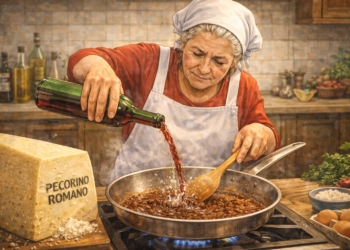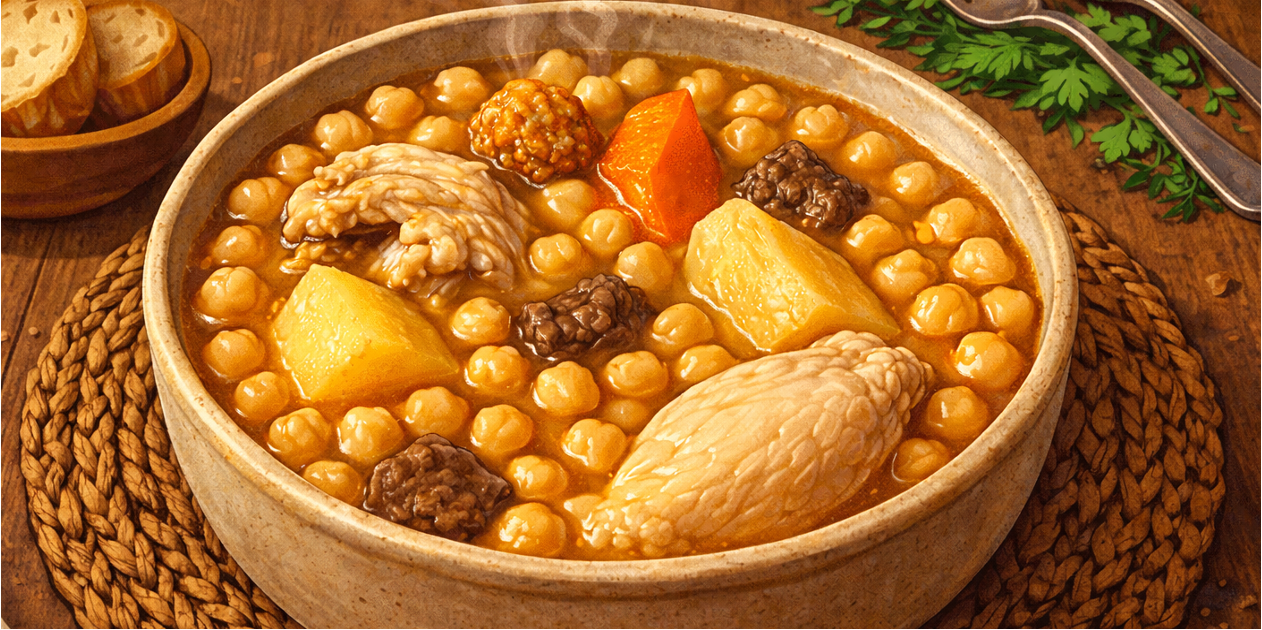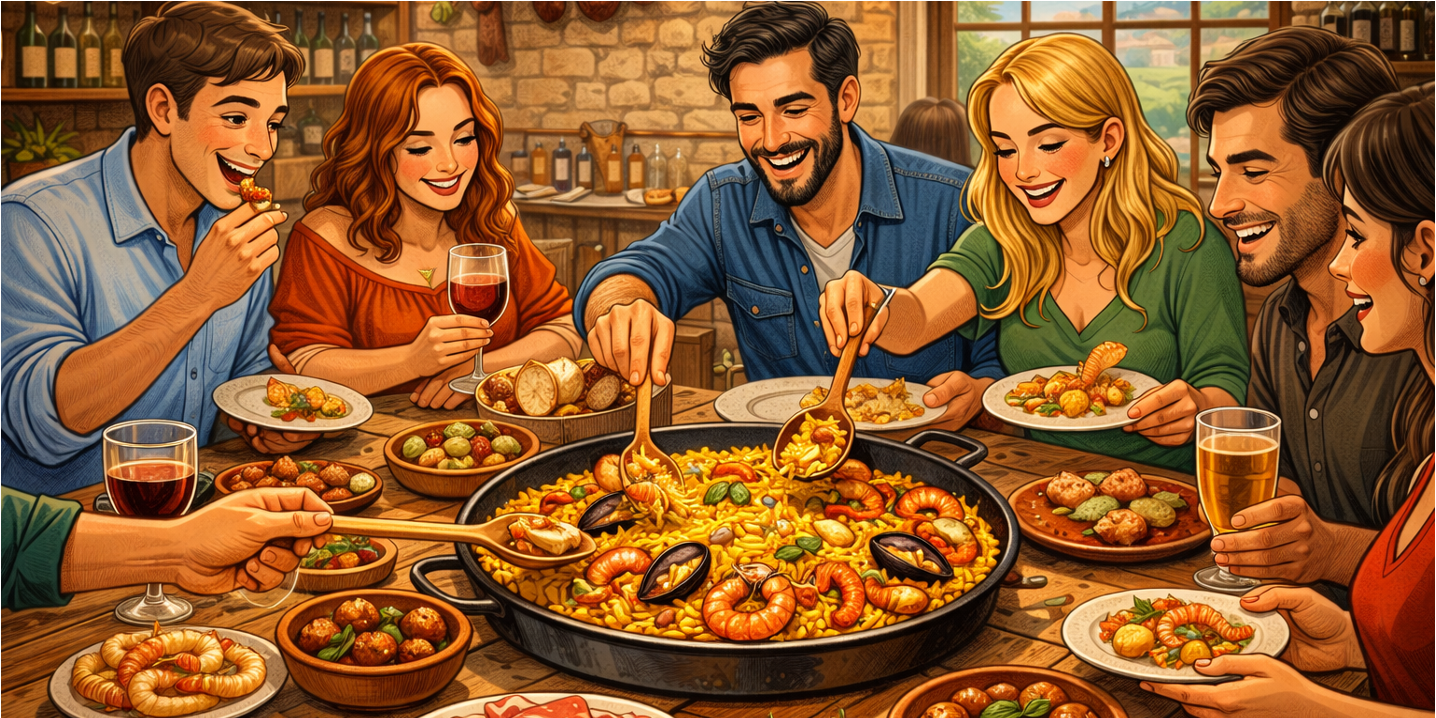
In Spain, the table is not just where food is placed — it is where relationships are performed. Nowhere is this clearer than in the culture of shared pans and communal eating, a way of dining that blurs the line between cooking and social life. Food arrives not as individual plates but as collective vessels: a wide paella pan, a deep cazuela, a clay cassola, or a rusted steel tray set in the middle of the table. Everyone leans in, serves themselves, and participates in the same dish. In fact, Spanish communal eating is central to the way people socialise and connect.
This style of eating has deep roots in agrarian Spain. For centuries, families worked together in fields, vineyards, and orchards; it made sense that they also ate together from the same pot. Cooking was done in large quantities — one fire, one pot, one meal — and sharing was practical as much as emotional. Over time, this practicality hardened into tradition: to eat alone felt not just lonely, but somehow incorrect, especially when compared to the values of Spanish communal eating.
The pan as a social object
In Spain, the pan is never treated as neutral cookware. A paella pan, for instance, carries far more meaning than its practical function suggests. It becomes a centrepiece around which people gather, observe, and comment, often with strong opinions. Control of the heat frequently turns into a friendly contest, while the exact moment the rice is declared ready invites debate rather than agreement.
Another layer of excitement appears when the socarrat begins to form at the bottom of the pan. The caramelised crust is not simply eaten; it is anticipated, discussed, and sometimes claimed in advance. Decisions about who receives this prized portion often spark teasing and laughter, turning a simple meal into a shared performance.
Through these moments, food becomes a catalyst for interaction rather than just nourishment. Conversation flows naturally, humour emerges easily, and small rivalries remain light-hearted. Most importantly, Spanish communal eating thrives on these rituals, using shared dishes to strengthen connection and transform cooking into a collective experience.
Similarly, a large cazuela of stewed beans, seafood, or chicken is passed around so that each person ladles their portion. No one is passive. You participate — you reach in, you choose your piece, you balance your plate.
Why sharing changes flavour
Communal eating subtly alters how food is cooked and seasoned. Dishes meant for sharing tend to be bolder, more generous, and more forgiving. Flavours deepen over time as people return for second helpings; sauces get mopped up with bread; edges of pans become treasured. A shared dish must satisfy many palates at once, so it leans toward balance rather than extremes. Moreover, Spanish communal eating often leads to dishes that are both robust and welcoming.
Contrast with other food cultures
In much of Northern Europe, meals are often plated individually, reinforcing ideas of portion control and personal preference. In fine dining, this is taken to an art form. Spain takes the opposite approach: the beauty lies not in individual perfection, but in collective experience.
Italy shares some of this spirit — think of passing bowls of pasta — but Spanish cooking pushes it further with wide pans placed directly on the table. France, by contrast, traditionally emphasises service and sequence, with dishes arriving in courses rather than being shared simultaneously.
The role of bread and conversation
Bread is inseparable from communal eating. It becomes a shared tool: tearing, dipping, scraping the pan clean. As hands move, so does conversation. Arguments, laughter, stories, and gossip all flow alongside the food. In this sense, a shared pan is less a meal than a social ritual. Clearly, Spanish communal eating embodies more than just the act of dining—it represents connection and tradition.
Modern life, same instinct
Even as lifestyles change and kitchens shrink, Spaniards still seek out this communal style — at beachside chiringuitos, family gatherings, and weekend lunches. Restaurants often serve paella only for two or more people, reinforcing the idea that some foods are simply meant to be shared.
The deeper lesson
Shared pans remind us that cooking is not only about feeding bodies; it is about binding people together. To eat from the same dish is to accept the same flavours, the same risks, the same joys. In Spain, you do not just sit at a table — you enter a circle.
And in that circle, the pan in the middle is not just metal or clay. It is the heart of the meal.