Few kitchen sounds are as satisfying as the sharp sizzle of food hitting a hot pan. That instant reaction signals the start of searing — known in French as saisir. It is a bold, high-heat technique that creates deep colour, intense aroma, and rich flavour in a matter of minutes.
Searing is often misunderstood. Many believe it “locks in juices.” In reality, it builds flavour and texture through browning. When done properly, searing forms a savoury crust that transforms the character of meat, fish, and even vegetables.
Understanding how and why searing works allows you to cook with confidence and precision.
What Is Searing?
Searing (Saisir) is a dry-heat cooking method that uses high temperature to brown the surface of food quickly. It typically takes place in a hot pan with a small amount of fat, though it can also occur on a grill.
The goal is not to cook food fully in one step. Instead, searing creates a deeply browned exterior before the food finishes cooking through another method, such as roasting or braising.
The hallmark of good searing is a dark golden crust — not burnt, but richly caramelised.
The Science Behind Searing
The magic of searing lies in the Maillard reaction. When proteins and sugars in food are exposed to high heat, they react chemically, forming hundreds of flavour compounds. This reaction begins around 140°C and intensifies as the heat increases.
The result is a complex, savoury flavour, often described as nutty, roasted, or umami-rich. This is why a seared steak tastes dramatically different from one that is simply boiled.
Searing does not seal moisture inside the meat completely, but it enhances flavour while contributing to texture contrast.
Preparing for a Perfect Sear
Successful searing begins before the pan even heats.
Dry the Surface
Moisture prevents browning. Pat meat or vegetables dry with kitchen paper. Water on the surface turns into steam, lowering the pan’s temperature and blocking the Maillard reaction.
Bring to Room Temperature
Allow meat to rest outside the refrigerator for a short time before cooking. This promotes more even cooking.
Season Properly
Salt enhances flavour and helps draw moisture to the surface initially. However, drying the surface again before cooking ensures effective browning.
Choosing the Right Pan
A heavy pan retains heat better and prevents temperature drops when food is added. Cast iron and stainless steel are ideal for searing because they distribute heat evenly and allow proper crust formation.
Non-stick pans are less effective for deep browning. They also limit the formation of fond — the browned bits left in the pan that later enhance sauces.
Preheating the pan thoroughly is essential. A hot pan ensures immediate contact and rapid browning.
Step-by-Step: How to Sear
- Heat a heavy pan over medium-high to high heat.
- Add a small amount of high smoke-point oil.
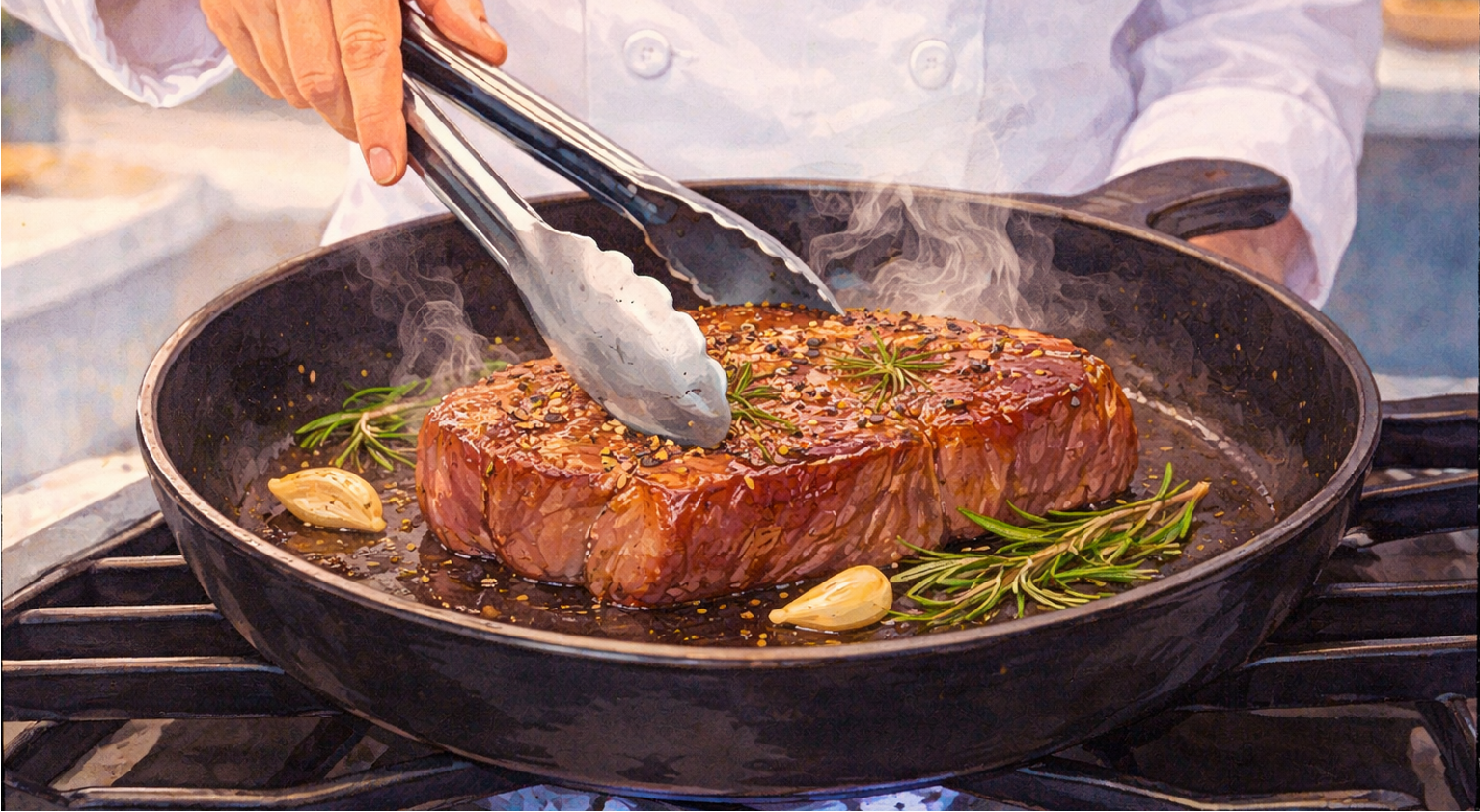
- Place the food carefully into the pan.
- Avoid moving it immediately; allow crust to form.
- Flip once a rich brown surface develops.
- Finish cooking as needed (in pan or oven).
Resist the urge to move the food constantly. Letting it sit undisturbed helps develop an even crust.
Searing (Saisir) Meat
Steak is perhaps the most famous example of searing. A properly seared steak has a dark crust outside and a juicy interior.
For thicker cuts, chefs often use a technique called “reverse searing,” where the meat is cooked gently first and then seared at high heat for final browning.
Poultry, lamb, pork, and even fish benefit from searing. In braising, searing meat before adding liquid builds a flavourful base for the dish.
Searing (Saisir) Vegetables
Vegetables such as mushrooms, courgettes, aubergines, and scallops (often grouped with seafood but treated similarly) develop remarkable flavour when seared.
The key is not overcrowding the pan. Too many pieces lower the temperature and cause steaming instead of browning.
Allow space between ingredients, so heat circulates effectively.
Common Mistakes to Avoid
Although straightforward, Searing (Saisir) requires attention.
Overcrowding the Pan – This traps moisture and prevents browning.
Using Low Heat – Insufficient heat results in pale, soft surfaces.
Flipping Too Soon – Crust needs time to form.
Using the Wrong Oil – Oils with low smoke points burn quickly.
Skipping Resting Time – After cooking, meat should rest to redistribute juices.
Careful control ensures better results.
Searing (Saisir) and Sauce Making
One hidden advantage of searing is the flavour left behind in the pan. The browned bits, known as fond, hold concentrated savoury compounds.
After removing the meat, adding wine, stock, or another liquid to the hot pan loosens these bits. This process, called deglazing, creates the foundation for rich pan sauces.
Thus, searing connects directly to classical sauce-making techniques.
Searing vs. Grilling
Both methods rely on high heat, but grilling uses open flame or radiant heat from below, while searing usually occurs in a pan.
Pan searing offers more control and allows the cook to collect flavourful fond for sauces. Grilling, on the other hand, introduces smoky notes from flame and charcoal.
Each method offers distinct advantages.
Why Searing (Saisir) Remains Essential
Searing builds flavour quickly and effectively. It provides contrast between the crisp exterior and the tender interior. It elevates simple ingredients without requiring complex preparation.
In professional kitchens, searing often marks the first step in layered cooking. It creates depth before roasting, braising, or finishing in sauce.
Learning to sear properly teaches control over heat, patience, and observation.
Final Thoughts: Heat with Purpose
Searing (saisir) represents cooking at its boldest. It demands high heat and confident timing. Yet when done correctly, it rewards with flavour, texture, and aroma that define memorable meals.
By understanding the science, preparing ingredients carefully, and respecting the importance of heat, you can transform ordinary dishes into deeply savoury creations.
In the end, Searing (Saisir) is not just about colour. It is about unlocking the full potential of flavour through purposeful heat.