What Is Sauce Tomate?
Sauce tomate is one of the five classical mother sauces of French cooking. Although many people associate tomato sauce with Italian cuisine, French chefs developed their own refined version centuries ago. In classical kitchens, sauce tomate forms a structured, carefully layered preparation rather than a quick simmer of tomatoes and herbs.
Unlike rustic tomato sauces, traditional sauce tomate combines tomatoes with stock, aromatics, and sometimes salt pork to create a balanced, savoury foundation. It acts as a base for numerous secondary sauces and cooked dishes.
In French cooking, even something as familiar as tomato sauce follows technique and precision.
The Historical Evolution of Sauce Tomate
Tomatoes arrived in Europe in the 16th century after Spanish exploration of the Americas. Initially, many Europeans viewed them with suspicion. Over time, however, cooks embraced their bright acidity and vibrant colour.
By the 18th and 19th centuries, French chefs incorporated tomatoes into structured sauce-making systems. Marie-Antoine Carême and later Auguste Escoffier formalised sauce tomate as one of the five mother sauces.
Unlike the fresh, olive oil–based Italian versions, French sauce tomate reflected the broader philosophy of French cooking: build flavour through stock, roux, and controlled simmering.
The Core Ingredients
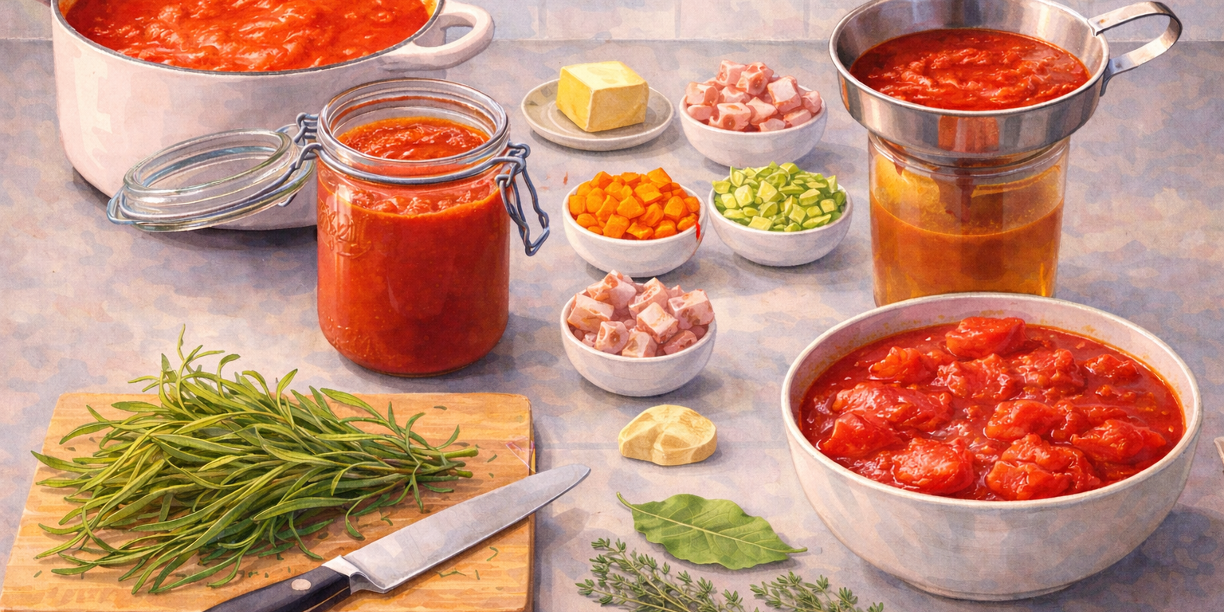
Traditional sauce tomate relies on several foundational components:
- Tomatoes (fresh or preserved)
- Mirepoix (onion, carrot, celery)
- Stock (often veal or pork)
- Salt pork or fat
- Bouquet garni
- Sometimes a light roux
Each ingredient contributes balance. Tomatoes bring acidity and sweetness. Mirepoix softens sharpness and adds aromatic depth. Stock enriches the sauce with savoury body. Herbs in a bouquet garni provide subtle fragrance.
In classical preparation, nothing overwhelms. Every element works together to create harmony.
The Role of Stock in French Cooking
One key distinction between French sauce tomate and simpler tomato sauces lies in the use of stock. French cooking often integrates stock into sauces to add structure and depth.
By adding veal or pork stock, chefs create a fuller, more rounded flavour. The stock also supports slow reduction, which concentrates taste without harsh acidity.
This technique demonstrates how French cooking transforms basic ingredients into refined preparations.
Mirepoix and Aromatics
As with many classical sauces, mirepoix plays an essential role. Onions, carrots, and celery soften gently in fat before tomatoes enter the pot. This step releases natural sugars and builds a savoury foundation.
Bouquet garni — typically thyme, bay leaf, and parsley stems — infuses herbal complexity during simmering. After cooking, chefs remove the bundle, leaving only its subtle fragrance behind.
This layered approach reflects the structured discipline of French cooking.
Thickening and Texture
Some classical recipes include a small amount of roux to stabilise and thicken sauce tomate. This addition ensures a smooth, cohesive texture that clings well to meats and vegetables.
However, modern interpretations often rely on reduction rather than flour. Slow simmering evaporates excess liquid, naturally intensifying flavour and thickening the sauce.
The finished texture should feel smooth and balanced — neither watery nor overly heavy.
Differences from Italian Tomato Sauce
Although both cuisines celebrate tomatoes, their approaches differ significantly. Italian tomato sauces often highlight freshness, olive oil, garlic, and basil. They usually cook quickly and maintain bright acidity.
French sauce tomate, by contrast, emphasises depth and structure. It incorporates stock, mirepoix, and longer simmering. The flavour profile leans toward savoury richness rather than sharp brightness.
Both styles offer beauty, but they reflect distinct culinary philosophies.
Derivative Sauces and Uses
As a mother sauce, sauce tomate gives rise to several derivative preparations. Chefs may enrich it with mushrooms, olives, or herbs to complement specific dishes.
In French cooking, sauce tomate often accompanies braised meats, stuffed vegetables, and certain poultry dishes. It can also serve as a base for stews and ragouts.
Its versatility makes it an essential component in both professional and home kitchens.
Modern Interpretations
Contemporary chefs sometimes simplify classical sauce tomate by omitting salt pork or roux. They may rely on high-quality tomatoes and controlled reduction to achieve balance.
Others adapt the sauce for vegetarian cooking by using vegetable stock instead of veal stock.
Despite these variations, the fundamental principle remains the same: build flavour through layering and careful technique.
Why Sauce Tomate Still Matters
In today’s fast-paced kitchens, ready-made sauces dominate supermarket shelves. Yet classical sauce tomate teaches valuable lessons about patience, balance, and structure.
French cooking does not treat tomato sauce as a quick afterthought. Instead, it transforms it into a carefully constructed foundation. By combining acidity, sweetness, savoury depth, and herbal fragrance, sauce tomate achieves harmony.
Understanding this sauce offers insight into the broader architecture of French cuisine.
Basic Classical Sauce Tomate Recipe
Ingredients
- 1 kg ripe tomatoes (peeled and chopped) or good-quality canned tomatoes
- 1 small onion, finely chopped
- 1 small carrot, finely chopped
- 1 celery stalk, finely chopped
- 1 tablespoon tomato paste
- 750 ml light stock (veal or vegetable)
- 50 g salt pork or butter
- 1 bouquet garni (thyme, bay leaf, parsley stems)
- Salt and pepper to taste
Method
- Melt the salt pork or butter in a heavy saucepan.
- Add the onion, carrot, and celery. Cook gently until softened but not browned.
- Stir in tomato paste and cook briefly to deepen flavour.
- Add chopped tomatoes, stock, and bouquet garni.
- Bring to a gentle simmer and cook for 45–60 minutes, stirring occasionally.
- Remove the bouquet garni.
- Blend or pass through a sieve for a smooth texture if desired.
- Adjust seasoning with salt and pepper.
The result is a balanced, savoury tomato sauce rooted in the traditions of French cooking — refined, structured, and deeply satisfying.