What Is Sauce Hollandaise?
Sauce Hollandaise is one of the five classical mother sauces of French cooking. Rich, buttery, and delicately tangy, it stands apart from the others because it does not rely on stock or roux. Instead, it is an emulsion — a careful blending of egg yolks and melted butter stabilised with acid.
Silky and pale yellow, Hollandaise feels luxurious on the palate. Its smooth texture and balanced flavour make it a favourite accompaniment for vegetables, seafood, and eggs. Despite its elegance, the sauce requires precision and patience, which is why culinary schools treat it as a test of technical skill.
When properly prepared, Hollandaise embodies refinement and control.
The Origins of Hollandaise
Although the name suggests Dutch origins, Sauce Hollandaise is firmly rooted in French culinary tradition. Historians believe French chefs created it in the 17th century. Some suggest that wartime butter shortages led cooks to import butter from Holland, which inspired the name.
Over time, classical French chefs such as Escoffier formalised Hollandaise as one of the five mother sauces. Unlike heavier brown sauces, it represents a lighter, more delicate branch of French cooking.
Its continued presence in fine dining demonstrates its enduring appeal.
The Science of Emulsification
Hollandaise depends on emulsification — the process of combining two ingredients that normally do not mix, such as fat and water. In this case, egg yolks act as the stabilising agent.
Egg yolks contain lecithin, a natural emulsifier. When whisked gently with heat, they thicken and create a stable base. Gradually adding melted butter while whisking allows tiny droplets of fat to disperse evenly throughout the mixture.
The result is a smooth, unified sauce rather than separated butter and egg. Temperature control remains critical. Too much heat causes the eggs to scramble; too little prevents proper thickening.
The Core Ingredients
Traditional Sauce Hollandaise uses just a few ingredients:
- Egg yolks
- Clarified butter
- Lemon juice or white wine vinegar
- Salt
- White pepper or cayenne (optional)
Each element plays a role. Egg yolks provide structure. Clarified butter offers richness without milk solids. Lemon juice or vinegar adds brightness and balance.
French cooking emphasises harmony, so no ingredient should overpower the others.
The Role of Heat and Technique
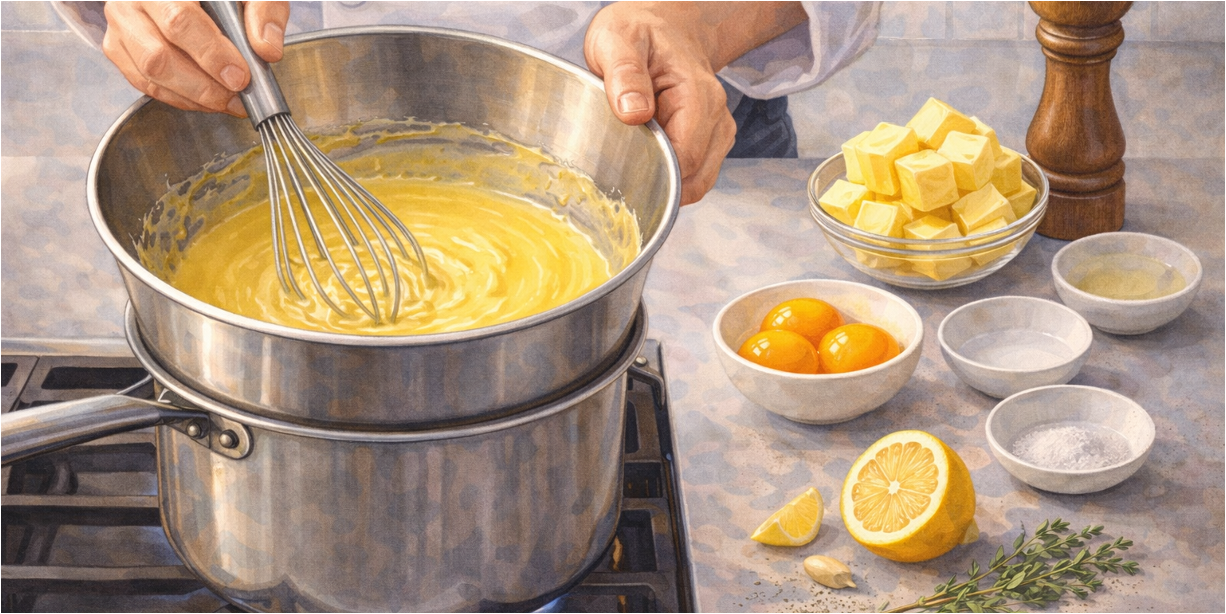
Preparing Hollandaise requires careful control of heat. Cooks typically whisk egg yolks over a gentle bain-marie (a bowl placed over simmering water). This indirect heat allows gradual thickening without scrambling.
As the yolks thicken slightly, melted butter flows in slowly while the
whisking continues constantly. The sauce begins to expand, becoming pale, glossy, and airy.
If the sauce thickens too much, a small spoonful of warm water can loosen it. If it begins to separate, adding a teaspoon of warm water while whisking vigorously often restores stability.
Mastery of Hollandaise teaches cooks discipline and attentiveness.
Classic Pairings
Hollandaise pairs beautifully with ingredients that benefit from its richness and acidity.
Eggs Benedict remains one of the most famous applications. The sauce drapes over poached eggs and toasted muffins, creating a balance between creamy yolk and tangy butter.
Steamed asparagus also welcomes Hollandaise, as its grassy freshness contrasts with the sauce’s richness.
Fish such as salmon or sole gains elegance from a spoonful of this silky emulsion. In French cooking, Hollandaise often appears with delicate proteins rather than heavy meats.
Derivative Sauces
As a mother sauce, Hollandaise gives rise to several variations.
Add tarragon and shallots, and it becomes Béarnaise sauce, perfect for steak. Stir in whipped cream, and you create Mousseline sauce, lighter and airier. Blend in tomato purée, and Choron sauce emerges.
These derivatives demonstrate the adaptability of Hollandaise within French culinary tradition.
Common Mistakes and Solutions
Hollandaise can intimidate cooks, but most problems stem from temperature mismanagement.
Overheating causes curdling. Prevent this by using gentle, indirect heat and whisking constantly.
Adding butter too quickly can break the emulsion. Pour slowly and maintain steady whisking.
If separation occurs, start with a fresh egg yolk in a clean bowl and gradually whisk in the broken sauce. This technique often rescues it successfully.
Patience and control remain the keys.
Hollandaise in Modern Cooking
Modern chefs sometimes simplify Hollandaise using blenders or immersion blenders. While these tools reduce effort, the principle of emulsification remains the same.
Some lighter versions replace part of the butter with yoghurt or reduce overall fat content. However, traditional French cooking values the full richness and balance of classic preparation.
Despite evolving trends, Hollandaise continues to symbolise culinary craftsmanship.
Why Sauce Hollandaise Still Matters
Sauce Hollandaise teaches more than a recipe. It demonstrates how technique transforms a few basic ingredients into something refined and luxurious.
In French cooking, sauces form the soul of a dish. Hollandaise represents the lighter, brighter side of that tradition. Its smooth texture, gentle acidity, and balanced richness elevate simple ingredients into memorable experiences.
Mastering Hollandaise builds confidence, precision, and appreciation for classical technique. Through careful heat control and steady whisking, cooks create a sauce that feels both delicate and indulgent — a true expression of French culinary artistry.
Basic Sauce Hollandaise Recipe
Ingredients
- 3 egg yolks
- 150 g clarified butter, warm
- 1 tablespoon lemon juice
- Salt to taste
- A pinch of white pepper or cayenne (optional)
Method
- Place egg yolks and lemon juice in a heatproof bowl.
- Set the bowl over a saucepan of gently simmering water (do not let the bowl touch the water).
- Whisk continuously until the mixture thickens slightly and becomes pale.
- Slowly drizzle in the warm clarified butter while whisking constantly.
- Continue whisking until the sauce becomes smooth and thick.
- Season with salt and white pepper or cayenne.
Serve immediately while warm. The sauce should appear glossy, airy, and velvety — the hallmark of perfectly prepared Sauce Hollandaise in French cooking.