Sauce béchamel stands as one of the five mother sauces of classical French cooking. The classic sauce bechamel is smooth, pale, and delicately creamy, and it forms the base for countless other sauces and dishes. At its core, béchamel combines just three ingredients: butter, flour, and milk. Yet when prepared correctly, it transforms into a velvety sauce that carries remarkable versatility.
Unlike rich meat-based sauces, béchamel relies on technique rather than intensity. It does not aim to dominate a dish. Instead, it provides structure, softness, and balance. From gratins to lasagne, this understated sauce quietly shapes some of the most beloved comfort foods in European cuisine.
The Origins of Bechamel
Historians trace the name “béchamel” to Louis de Béchameil, a steward in the court of King Louis XIV during the 17th century. Although chefs likely prepared similar milk-based sauces before his time, French culinary tradition formalised and refined it.
As classical French cooking developed, chefs such as Marie-Antoine Carême and Auguste Escoffier codified béchamel as a mother sauce. They recognised its structural importance and its ability to branch into numerous variations.
Over centuries, béchamel moved beyond royal kitchens and into homes across Europe, becoming a symbol of comfort and technique combined.
The Science Behind the Sauce
Béchamel begins with a roux — a cooked mixture of butter and flour. When you melt butter and stir in flour, the starch granules in the flour absorb fat. As you cook the mixture gently, you remove the raw flour taste.
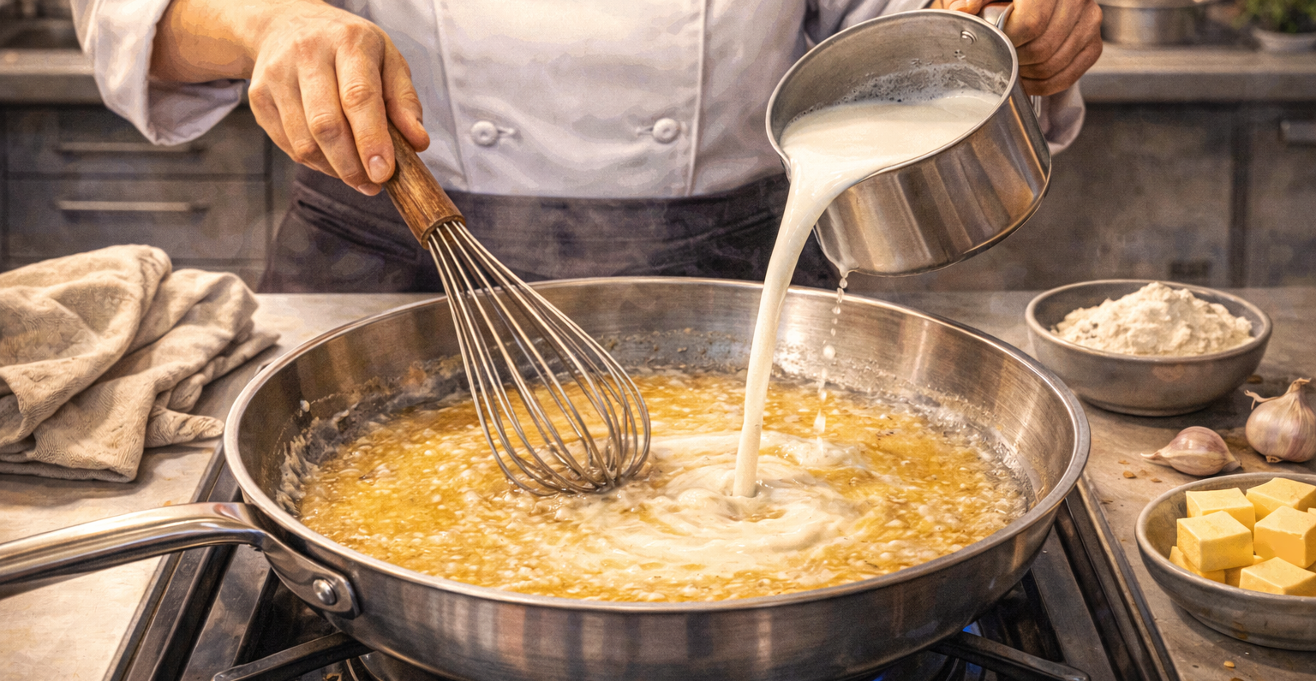
When warm milk enters the roux, the starch granules swell and thicken the liquid. This process, known as gelatinisation, creates the sauce’s smooth consistency.
Control plays a crucial role. If you add milk too quickly or neglect stirring, lumps may form. However, with steady whisking and moderate heat, the sauce becomes silky and uniform. French cooking emphasises precision, and béchamel demands that attention.
Texture and Consistency
One of the most important skills in preparing béchamel involves controlling thickness. The ratio of butter, flour, and milk determines the final texture.
A thinner béchamel suits light sauces or soups. A thicker version works better for gratins or croquettes, where the sauce must hold its structure.
The ideal béchamel should coat the back of a spoon smoothly without appearing gluey or heavy. It should feel creamy but not overly thick. Achieving this balance requires patience and constant stirring.
Seasoning and Subtle Flavour
Although béchamel appears simple, seasoning defines its character. Salt enhances the milk’s natural sweetness. White pepper adds gentle warmth without dark specks.
Many traditional recipes infuse the milk with onion, bay leaf, or clove before adding it to the roux. This step introduces delicate aromatic depth without overpowering the sauce.
Nutmeg often appears as the finishing touch. A small pinch adds warmth and complexity, especially in dishes like lasagne or moussaka. However, restraint remains key. Béchamel should taste refined, not spiced.
Derivative Sauces: Bechamel as a Mother Sauce
As one of the mother sauces of French cooking, béchamel gives rise to many secondary sauces.
Add grated cheese, and it becomes Mornay sauce — perfect for vegetables, pasta, and gratins. Stir in mustard, and you create a sharp, elegant sauce for fish or poultry. Blend in herbs or puréed vegetables, and the sauce transforms again.
This adaptability explains why chefs consider béchamel foundational. It provides a neutral canvas upon which other flavours can build.
Bechamel Beyond French Cooking
Although rooted in French tradition, béchamel influences cuisines across Europe and beyond. Italian cooks use it in lasagne and cannelloni. Greek cuisine features it in moussaka. British cooking incorporates it into cauliflower cheese and pies.
In each case, the sauce performs the same role: binding ingredients together, adding moisture, and creating a creamy texture. Its universality demonstrates the strength of classical technique.
Common Mistakes and How to Avoid Them
Many cooks fear lumpsin bechamel, yet they can prevent them easily. Use warm milk rather than cold. Add it gradually while whisking constantly. Maintain moderate heat to avoid scorching.
If lumps appear, whisk vigorously or strain the sauce through a sieve.
Another common mistake involves overcooking. Excessive heat thickens the sauce too much and can create a pasty texture. Keep the heat gentle and stop cooking once the sauce reaches the desired consistency.
Why Bechamel Still Matters
In an era of quick sauces and shortcuts, béchamel remains relevant because it teaches essential skills. It requires an understanding of heat control, thickening techniques, and seasoning balance.
French cooking values foundational knowledge, and béchamel embodies that principle. Once mastered, it opens the door to countless dishes and variations.
More importantly, it reminds us that elegance often lies in simplicity. With just butter, flour, and milk, cooks create something both comforting and refined.
Basic Sauce Béchamel Recipe
Ingredients
- 50 g butter
- 50 g plain flour
- 500 ml warm milk
- Salt to taste
- White pepper to taste
- A pinch of grated nutmeg (optional)
Method
- Melt the butter in a saucepan over medium heat.
- Add the flour and whisk continuously for 2–3 minutes to form a pale roux. Avoid browning.
- Gradually pour in the warm milk while whisking constantly.
- Continue stirring until the sauce thickens and becomes smooth.
- Season with salt, white pepper, and a small pinch of nutmeg.
- Simmer gently for 5–8 minutes, stirring to prevent sticking.
The finished sauce should feel silky and coat the back of a spoon evenly.