Some foods are here to comfort. They wrap themselves around you like a warm blanket—think of mashed potatoes, a bowl of soup, a slice of plain toast. On the other hand, there are other foods. The ones that don’t just sit with you quietly. The ones that sit up straight, look you in the eye, and demand your attention. They challenge you.
Roquefort is that kind of food. Remarkably, it comforts and challenges you, all in the same breathtaking bite.
A Cheese Shaped by Cave and Wind
It comes from a dramatic corner of the world, the south of France, from a place called Roquefort-sur-Soulzon. However, it isn’t made in a tidy kitchen or a stainless-steel factory. It is born in caves. Ancient, natural caves carved into a collapsing mountain. Furthermore, these caves aren’t just a romantic backdrop for a label; they are the engine of the flavour. Cold air flows through cracks in the rock, a natural ventilation system that breathes life into the wheels of cheese resting inside. This air carries a specific, ancient mould—Penicillium roqueforti—that settles into the curds and begins its work.
But unlike Camembert, where the mould grows on the surface and works its way in, Roquefort’s magic happens from within. The cheesemaker introduces the mould, and then, as the cheese ages, the oxygen from those mountain breezes fans the flames, encouraging the mould to bloom into vivid blue veins that run through the paste like rivers on a map.
Consequently, this single detail changes everything about how the cheese tastes.
The Taste of Contrast
Where most cheeses soften and mellow with time, rounding off their sharp edges, Roquefort does the opposite. It sharpens, intensifies, and becomes more itself. In fact, inside that one small piece, you will find a whole universe of flavours that refuse to blend into a boring, uniform paste. Salt sits next to sweetness. Fat swirls around acidity. Creaminess rubs shoulders with a mineral, almost spicy bite. You taste butter, and you taste earth, all at the very same moment.
This is Roquefort’s great lesson for any cook:
Balance is not always about smoothing things over. Instead, sometimes, balance is about contrast.
A tiny crumble of this cheese feels complete on its own. It lands on your tongue, spreads its flavour quickly and confidently, and then fades away, leaving behind a clean, almost shocking finish. This lightness is a gift from the sheep. After all, sheep’s milk is richer than cow’s milk, yes, but it also has a certain brightness, a high mountain clarity that keeps the whole experience from feeling heavy or overwhelming.
The Art of the Perfect Pairing
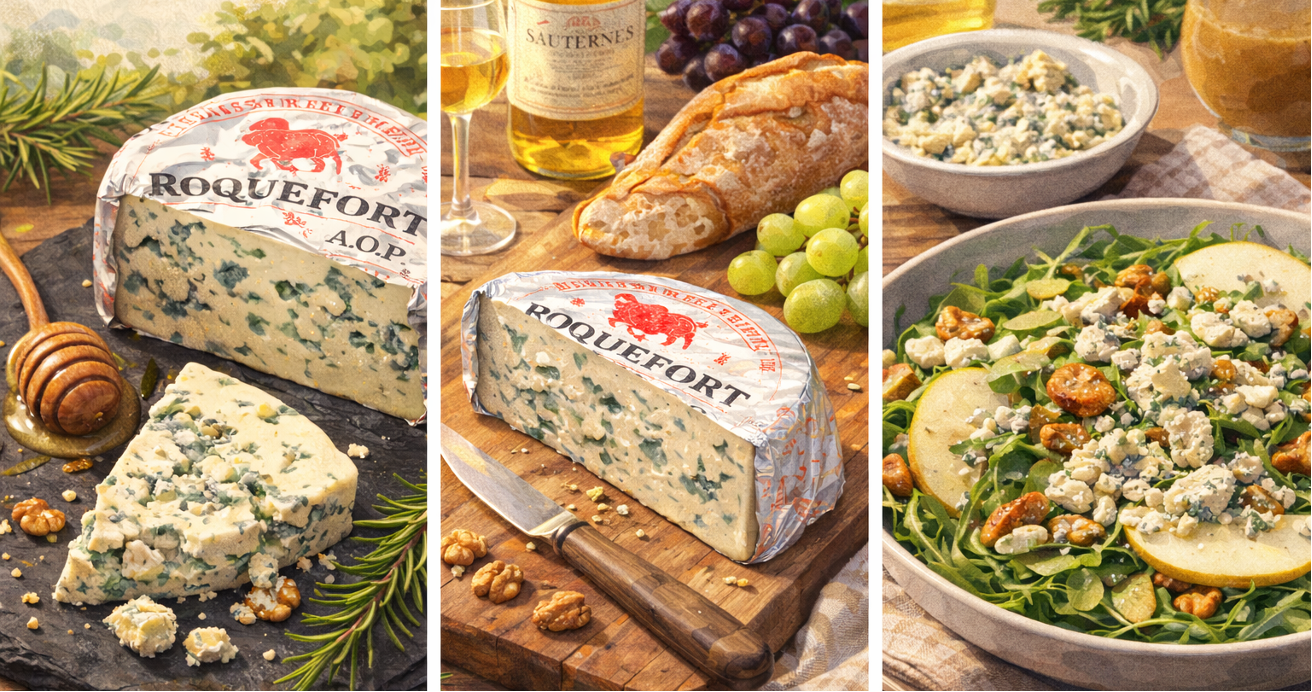
Because its voice is so strong, Roquefort is rarely the star of a large platter. It is an accent, a supporting actor who steals every scene they are in. It is at its best when paired with things that can hold their own against it, or, better yet, respond to it. A good bread softens its salt. A slice of pear sweetens its bite. A toasted walnut deepens its earthy notes. A drizzle of honey rounds off its sharp edges without dulling its spirit.
The French, with their instinct for these things, often serve it near the end of the meal, just before dessert takes over completely. It doesn’t compete with the sweetness to come; it prepares the palate for it. This is why Roquefort is a classic partner for pears or dried figs. The sugar doesn’t hide the cheese. Instead, it acts like a key, unlocking hidden notes inside it that you never noticed before.
Cooking with Roquefort
In the kitchen, good cooks use Roquefort the same way. Not as bulk, but as a secret weapon. A small amount, just a whisper, can season an entire sauce. Melted gently into warm cream, it becomes something deeply savoury yet still lively. Crumpled over a simple green salad, it replaces both salt and dressing in one fell swoop.
This idea appears everywhere in cooking, if you look for it:
- A squeeze of lemon sharpens a whole pan of butter.
- A dash of vinegar wakes up a stew that has been simmering for hours.
- A handful of fresh herbs lifts a heavy piece of meat.
- Finally, a touch of bitterness clarifies a mouthful of sweetness.
Roquefort works just like these elements. It creates edges, draws lines, and makes the other flavours visible.
To truly meet Roquefort, serve it slightly cool, never straight from the coldest part of the fridge. Too cold, and it becomes hard, defensive, just a salty lump. However, give it a few minutes at room temperature, and it relaxes. It opens up. Suddenly, the air around it fills with the scent of grass, of wool, of nuts, and of a distant sea breeze. You can smell the landscape of the sheep’s high pasture and the damp, ancient cave, all mingled together.
Roquefort is a beautiful, edible reminder that harmony does not mean uniformity. In the end, sometimes, a dish works not because everything melts together, but because everything stays beautifully, brilliantly different.
Recipe 1: Pear, Walnut & Roquefort Salad
This is a classic for a reason. It is a conversation between sweet, sharp, bitter, and creamy. Every element keeps its own identity, and the result is perfect harmony.
Ingredients
- 2 ripe pears, cored and thinly sliced
- 60 g Roquefort, crumbled into generous pieces
- 40 g walnuts, toasted until fragrant
- A handful of mixed leaves or one small, soft lettuce
- For the dressing: 2 tbsp olive oil, 1 tsp cider vinegar, 1 tsp honey, a good crack of black pepper
Method
- First, in a small bowl or jar, whisk together the olive oil, cider vinegar, honey, and black pepper. Taste it. It should be bright and friendly.
- Next, arrange the leaves and the sliced pears on a plate, like you are setting a small stage.
- Scatter the crumbled Roquefort and the toasted walnuts over the top, letting them fall where they may.
- Drizzle the dressing over everything just before you are ready to eat. Don’t drown it; just wake it up.
- Toss it all together very gently. The warmth of your hands and the slight acidity of the dressing will cause the Roquefort to soften, partly melting into the olive oil and coating the pears. This is the moment you are looking for.
Recipe 2: Roquefort Cream Sauce
This sauce is proof that a small amount of a bold ingredient can transform an entire dish. It is luxurious without being heavy, and it comes together in minutes.
Ingredients
- 150 ml double or heavy cream
- 60 g Roquefort, crumbled
- 1 tsp butter
- A generous crack of black pepper
- A small splash of dry white wine (optional, but lovely)
Method
- Melt the butter in a small saucepan over a low, gentle heat. Don’t let it brown; just let it melt and feel welcome.
- Pour in the cream and warm it through slowly. Be patient. Do not let it boil—a boil would break the spell.
- Stir in the crumbled Roquefort. Watch as it surrenders to the warmth, melting into the cream and turning it a pale, beautiful blue-grey.
- Add the black pepper and the splash of wine, if you are using it.
- Let it simmer ever so gently for just a minute or two, until it thickens slightly and coats the back of a spoon.
- Serve it immediately. It is magnificent over a grilled steak, spooned over roasted mushrooms, or simply allowed to pool next to a pile of steamed potatoes. It is an edge that makes everything else taste more like itself.