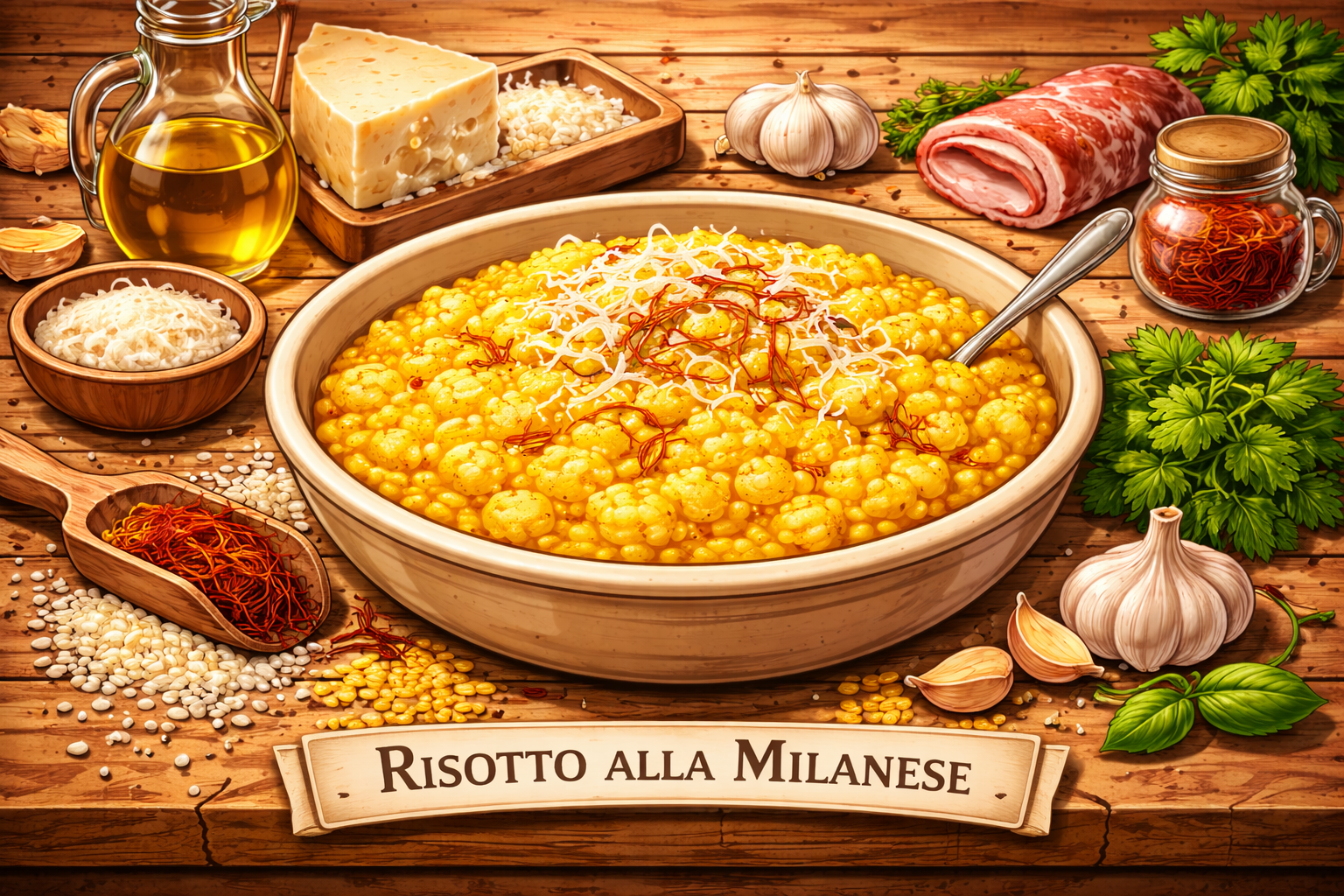
If there is one dish that captures the soul of Lombardy, it is Risotto alla Milanese. On the surface it looks simple — rice, broth, butter, cheese, and saffron — but beneath that creamy exterior lies a deeply technical dish that rewards patience, attention, and rhythm. It is not a recipe you rush; it is one you listen to.
In Milan, risotto is not a side dish. It is a first course, eaten slowly, with reverence, and often followed by Osso Buco, whose marrow-rich sauce was historically spooned onto the rice. Together, they form one of Italy’s most iconic pairings: earthy, luxurious, and profoundly comforting.
Why this risotto is yellow
The signature colour comes from saffron, one of the world’s most precious spices. Introduced to northern Italy through medieval trade routes, saffron found a natural home in Milanese cooking. In Risotto alla Milanese, it is not used for heat or sharpness but for perfume and hue — a subtle floral bitterness that balances the richness of butter and cheese.
The technique that matters more than the ingredients
What makes this risotto truly Italian is how it is cooked. The rice is first toasted in fat — called tostatura — which coats each grain and helps it release starch gradually rather than collapsing into mush. Warm broth is then added ladle by ladle, with constant stirring. This is not busywork; it is how you coax out creaminess without cream.
The final stage, mantecatura, is where the magic happens. Off the heat, cold butter and grated cheese are beaten into the rice so it becomes glossy, loose, and almost saucy — never stiff, never gluey. A good risotto should gently spread when spooned onto a plate.
Texture over speed
Great risotto should be all’onda — “like a wave.” If you tilt the pan, it should ripple slowly. If it stands upright in a mound, it is overworked or too dry. Many home cooks fear this looseness, but it is the hallmark of authenticity.
When to serve it
Traditionally, Risotto alla Milanese appears on Sundays, at family lunches, or on celebratory occasions. It is food that slows you down — ideal for winter evenings, candlelit tables, or when you want to cook something technically precise yet emotionally generous.
Recipe (serves 4)
Ingredients
- 320g Carnaroli or Arborio rice
- 1 litre hot light chicken or vegetable stock
- 1 small onion, very finely chopped
- 60g unsalted butter (divided: 30g + 30g)
- 60g Parmigiano Reggiano, finely grated
- ½ tsp saffron threads (or a generous pinch)
- 100ml dry white wine
- 2 tbsp olive oil
- Fine salt
Method
- Warm the stock in a saucepan and keep it gently simmering.
- Soak the saffron in 2 tbsp hot stock for 10 minutes.
- In a wide pan, heat olive oil with 30g butter over low heat. Add the onion and cook gently for 6–8 minutes until soft but not coloured.
- Add the rice and toast for 1–2 minutes, stirring constantly, until the grains look slightly translucent at the edges.
- Pour in the white wine and let it bubble away completely.
- Begin adding hot stock, one ladle at a time, stirring frequently. Wait until most of the liquid is absorbed before adding the next ladle.
- After about 12 minutes, stir in the saffron infusion. Continue adding stock for another 5–6 minutes until the rice is creamy but still al dente.
- Remove from the heat. Add the remaining 30g butter and the grated cheese. Beat vigorously for 30–40 seconds to create a silky, loose texture.
- Taste and adjust with a pinch of salt. Rest for 1 minute, then serve immediately on warm plates.