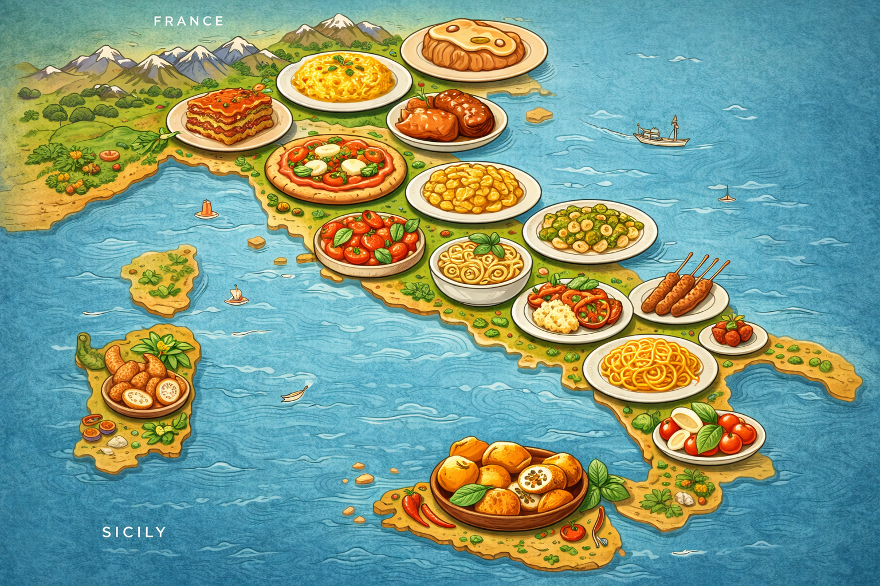
Italy’s map is not just political; it is edible. Every region tastes like its landscape, climate, and history — and to understand Italian cooking, you must learn to taste geography.
In the south, the Mediterranean dominates the palate. Sicily is bright, citrusy, and layered with influences from Arab, Greek, and Spanish rule. Almonds appear in sweets, tomatoes in abundance, and seafood everywhere. The cooking feels sun-drenched, aromatic, and open to the sea. (This could branch into posts on Sicilian street food, Capers of Pantelleria, or Citrus in Southern Italy.)
Move north to Campania and you meet Naples — home of pizza, tomatoes, and basil. Here, simplicity becomes iconic. The Margherita is not just a dish; it is a statement of identity: red, white, and green on a plate.
Central Italy shifts tone. Tuscany is spare and agrarian: beans, bread, olive oil, and bitter greens define its cooking. Meat appears, but often grilled simply. Umbrian and Lazio cuisines revolve around pork, pecorino, and rustic pasta like amatriciana or carbonara — hearty, direct, and deeply rooted in rural life.
Further north, the flavour palette changes again. Emilia-Romagna is Italy’s gastronomic powerhouse: butter, Parmigiano Reggiano, prosciutto di Parma, and egg pasta. This is where richness becomes cultural memory, embodied in dishes like tortellini, tagliatelle al ragù, and lasagne al forno.
In Lombardy and the Veneto, rice replaces pasta as the starch of choice. Risotto alla milanese, with saffron, tells a story of trade routes and luxury ingredients filtering into everyday cooking. In the Alpine regions of Trentino and Valle d’Aosta, butter, cheese, and hearty stews reflect colder climates and mountain life.
Liguria, hugging the coast, tastes green and herbaceous — pesto, olive oil, and seafood shaped by the sea. Friuli in the northeast carries echoes of Austria and Slovenia, blending Italian technique with Central European restraint.
What ties these differences together is not uniformity but shared respect for ingredients. Each region cooks what its land gives best, without apology or imitation.
To eat across Italy is therefore to travel without moving — a journey through soil, climate, history, and memory.