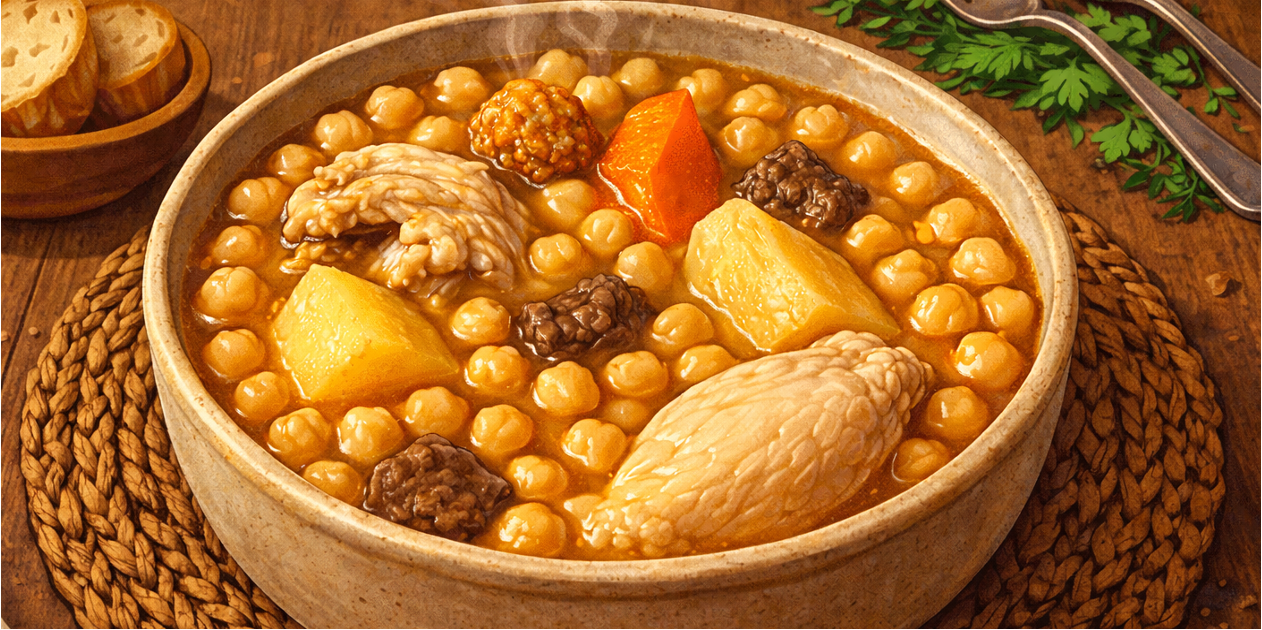
If paella is Spain’s showpiece dish, puchero is its quiet soul. It is not designed to impress; it is designed to sustain. In that sense, puchero is less a recipe and more a philosophy of cooking — one rooted in the tradition of one pot cooking, and one that values patience, thrift, and transformation.
At its simplest, puchero is a slow-simmered pot of meat, chickpeas, vegetables, and aromatics. But this simplicity conceals deep culinary intelligence. Spanish cooks historically did not think in terms of “one dish”; they thought in terms of one pot becoming many meals. Puchero is the classic expression of that mindset.
The process begins with cold water, not hot. Meat — often chicken, beef shin, and sometimes a little pork — is placed in a large pot with soaked chickpeas, carrots, leek, onion, and bay. As the water heats gradually, flavours are drawn out gently rather than aggressively. Foam is skimmed. The heat is lowered. The pot murmurs rather than boils.
What emerges after two or three hours is not one thing, but three. First comes the sopa: a golden, restorative broth that might be served with fine noodles or rice. Then come the garbanzos y verduras, tender chickpeas and vegetables dressed simply with olive oil and vinegar. Finally, the cooked meats are eaten separately with bread, salt, and perhaps a drizzle of good oil. One act of cooking feeds a family across courses — and sometimes across days.
This logic is deeply Spanish. It reflects a pre-refrigeration world in which nothing could be wasted and everything had to stretch. Bones give flavour to broth; broth gives life to soup; soup gives comfort to the table.
Regionally, puchero shifts character. In Madrid, it becomes cocido madrileño, served in three distinct “vuelcos” (turns). In Andalucía, it is lighter, often with mint and lemon. In Murcia, vegetables take a more prominent role. But everywhere, the underlying lesson is the same: time is the most important ingredient.
There is also a subtle technical point here that modern cooks often overlook. By cooking everything together slowly, flavours migrate across ingredients — fat carries aroma, starch from chickpeas lightly enriches the broth, and vegetables soften without disintegrating. The pot builds harmony rather than contrast.
In many Spanish households, puchero is still a Sunday ritual. The house fills with the smell of bay leaf and simmering legumes; children wander in asking when dinner will be ready; the cook resists the urge to hurry.
Classic Andalusian-style puchero (home version)
Ingredients
- 400g dried chickpeas, soaked overnight
- 1 whole chicken (or chicken joints)
- 500g beef shin or brisket
- 2 whole carrots
- 1 whole leek
- 1 onion, halved
- 1 bay leaf
- 1 tsp salt (plus more to finish)
- Cold water to cover
Method
- Place chickpeas, meat, vegetables, bay leaf, and salt in a large heavy pot. Cover generously with cold water.
- Bring slowly to a gentle simmer over medium-low heat. Do not rush this stage.
- Skim any foam that rises to the surface.
- Reduce to the barest simmer and cook 2–3 hours until chickpeas are tender and meat is soft.
- Strain the cooking liquid for sopa (add a handful of fine noodles and simmer 6–8 minutes).
- Serve chickpeas and vegetables separately with olive oil and sherry vinegar.
- Serve the meat with salt, pepper, and crusty bread.
Puchero teaches a simple but profound truth: when cooking is slow and thoughtful, one pot can feed both body and memory.