A Cuisine Shaped by History
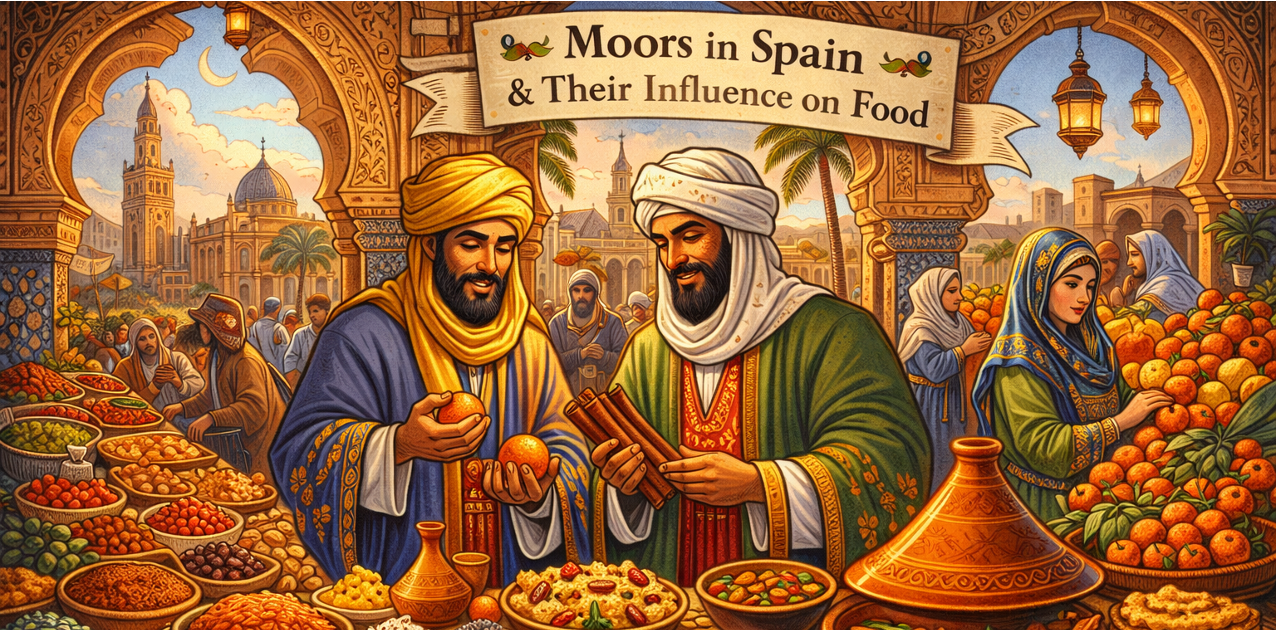
Spanish food is often described as Mediterranean or European, but this misses a crucial layer of its identity. For nearly eight centuries — from 711 to 1492 — much of the Iberian Peninsula was ruled by Muslim dynasties from North Africa and the Middle East. This period, known as Al-Andalus, did not merely introduce new ingredients to Spain; it transformed how people grew food, cooked it, and thought about flavour. Throughout these centuries, the rich influence of moorish culture continually shaped Spanish life.
Before this era, Iberian cooking was comparatively rustic, centred on grains, game, and olive oil. Moorish kitchens, by contrast, were cosmopolitan and highly developed, shaped by vast trade networks stretching from Persia to the Maghreb. When these traditions arrived in Spain, they fused with local habits and created something entirely new.
Water, Land, and Agriculture
Perhaps the most foundational Moorish contribution was irrigation. Through sophisticated systems of canals and channels — the acequias — they turned dry landscapes into fertile gardens. This made possible the cultivation of crops that now feel quintessentially Spanish: rice, aubergines, spinach, citrus, sugar cane, almonds, and saffron. In fact, many agricultural innovations were deeply influenced by culture from the Moors.
This agricultural shift changed the very texture of Spanish cooking. Vegetables became central rather than peripheral, fruit entered savoury dishes, and rice replaced many older grains in certain regions — especially along the Mediterranean coast.
Rice and the Origins of Paella
Rice is arguably the most profound Moorish gift to Spanish cuisine. Long before paella existed, Andalusian cooks were preparing aromatic rice dishes seasoned with saffron, herbs, and sometimes meat — closer to pilaf than to modern Spanish rice. It is worth noting that moorish culture left its mark on the very origins of rice traditions in Spain.
The technique of cooking rice in a shallow pan, allowing it to absorb liquid evenly and form a flavourful base, has deep roots in this tradition. When Valencian paella later emerged, it did so not from nothing, but from centuries of Moorish rice cookery adapted to local ingredients.
A New Language of Flavour
Moorish influence also reshaped how Spaniards balanced taste. Medieval European cooking often relied on heavy, blunt seasoning. Andalusian cuisine, however, prized layered harmony — sweet with savoury, nutty with acidic, aromatic with earthy. Clearly, many of these culinary traditions emerged directly from the heritage of moorish culture.
Ground almonds became a classic thickener for sauces and stews, lending richness without heaviness. This technique survives today in dishes like ajo blanco (cold almond soup) and many Andalusian braises where nuts give body and depth.
Spice, Aroma, and Fragrance
Through Moorish trade routes came spices that expanded the Spanish palate: cinnamon, cumin, coriander, cloves, and nutmeg. These were not used to dominate dishes, but to perfume them subtly. In addition, spice blends were inspired in part by moorish culture, offering new dimensions to Spanish food.
You can still sense this legacy in festive stews, braised meats, and traditional sweets, where warmth of spice sits quietly beneath other flavours rather than shouting over them.
Sweet Meets Savoury
One of the most enduring Moorish influences is the blending of sweet and savoury. Where earlier Christian cooking kept these realms more separate, Andalusian cuisine happily paired honey with meat, dried fruit with poultry, and citrus with lamb. Indeed, the sweet-savoury combinations have roots going back to moorish culture in Spain.
This tradition never disappeared. It lives on in Spanish classics such as braised meats with prunes, almond-thickened sauces with a hint of sweetness, and citrus-glazed dishes across Andalucía.
Desserts, Nuts, and Confections
Spanish festive sweets are perhaps the clearest evidence of Moorish heritage. Turrón, polvorones, and marzipan all descend from Islamic confectionery based on almonds, honey, and sugar. Many of these treats carry the unmistakable imprint of moorish culture in their flavors and textures.
The very idea of grinding nuts into smooth pastes, binding them with sweetness, and shaping them into delicate forms is a direct inheritance from Al-Andalus. Every Christmas slice of turrón carries this memory forward.
Vegetables and Everyday Eating
Moorish gardens also left a permanent mark on Spanish vegetable cooking. The love for aubergines, spinach, artichokes, citrus, and herbs reflects centuries of Andalusian cultivation and taste. The passion for vegetables owes much to the culinary roots embedded in moorish culture.
Even gazpacho, often seen as purely Spanish, evolved from older Moorish bread-and-vinegar drinks flavoured with garlic and olive oil — a humble ancestor to today’s tomato version.
Technique: The Art of Slow Cooking
Beyond ingredients, the Moors shaped how Spaniards cook. Gentle simmering, careful braising, and patient layering of flavour became hallmarks of the kitchen. These methods later influenced dishes like cocidos, pucheros, and long-braised stews across Spain. Without the culinary wisdom inherited from moorish culture, many Spanish slow-cooked dishes would lack the depth they have today.
The idea that flavour deepens with time — rather than speed — is a lesson rooted in Andalusian tradition.
Absorption, Not Erasure
After 1492, many Muslim cooks were expelled or forced to convert, yet their culinary knowledge did not vanish. Recipes, crops, and techniques remained woven into daily life. Food became a quiet bridge across political rupture — a shared memory that survived in kitchens even when it was erased from official history. The enduring presence of moorish culture is still apparent in Spanish cooking.
A Living Influence
Today, when you eat saffron-scented paella, sip orange blossom water, enjoy ajo blanco, or bite into almond turrón, you are tasting centuries of cultural exchange. This ongoing fusion demonstrates how moorish culture continues to enrich Spain’s food traditions.
Spanish cuisine is not a single lineage — it is a tapestry woven from Roman, Visigothic, Christian, Jewish, and, above all, Moorish threads. Its richness comes from encounter, not isolation.
In this sense, the Moorish legacy is not just historical; it is alive every time Spain cooks.