The humble legume is perhaps the most underrated hero in the history of human civilization. From the “three sisters” of Mesoamerican agriculture to the lentil stews of the Roman Empire, legumes have provided the reliable protein and soil-enriching nitrogen that allowed societies to flourish. But what exactly defines this category, and why do they behave so uniquely in the kitchen?
The Botanical Blueprint
Botanically, a legume refers to any plant within the family Fabaceae (or Leguminosae). The defining characteristic is the fruit: a seed pod that dehisces, or splits open, along two seams.+1
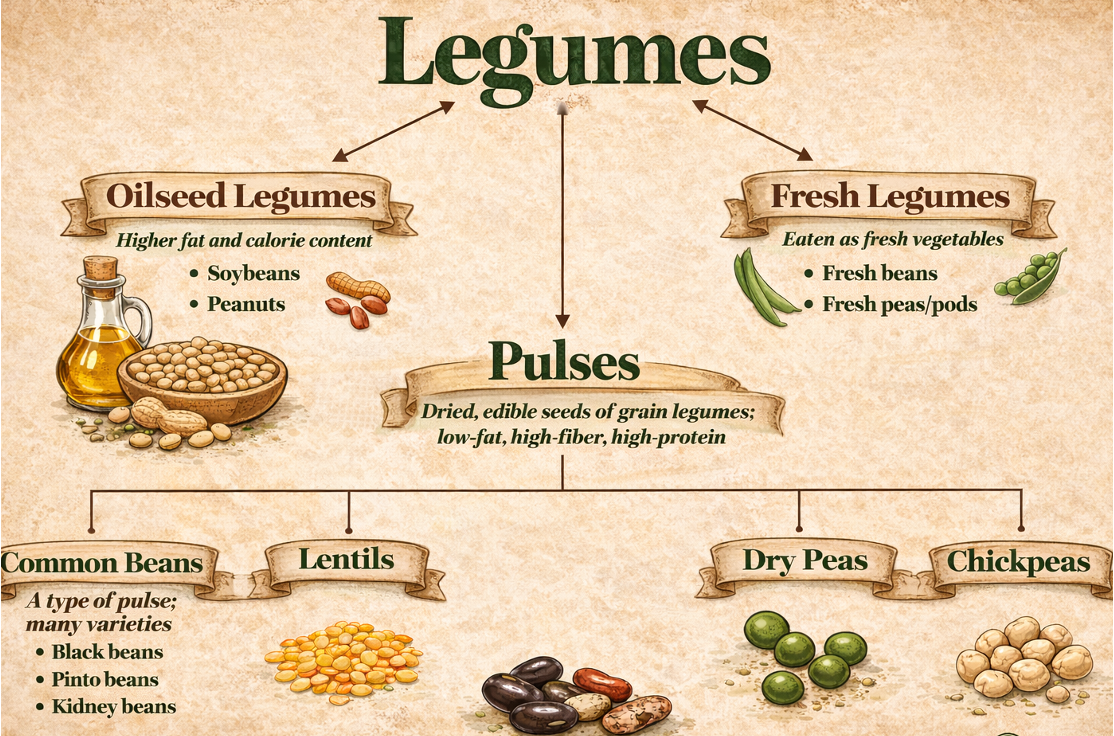
While we often use “legume,” “pulse,” and “bean” interchangeably, there is a technical hierarchy:
- Legumes: The entire plant family (including soy, alfalfa, and even clover).
- Pulses: The subset of legumes harvested solely for their dry seeds (like dried peas, lentils, and chickpeas).
- Beans and Lentils: Specific genera within that family.
Biologically, legumes are famous for their “underground superpower.” Through a symbiotic relationship with Rhizobium bacteria in their root nodules, they “fix” nitrogen from the air into the soil. This makes them a natural fertilizer, reducing the need for synthetic inputs and making them a cornerstone of sustainable crop rotation.+1
Beans vs. Lentils: A Structural Split
While they share a family tree, beans and lentils differ significantly in their physical architecture and kitchen utility.
- Beans (The Heavyweights): Generally larger and kidney-shaped or oval, beans possess a thick seed coat (the testa). This requires long soaking or extended cooking times to hydrate the interior starch granules.
- Lentils (The Quick-Study): Lens-shaped and much smaller, lentils lack the heavy protective coat of a kidney bean. This allows water to penetrate the seed much faster, often eliminating the need for soaking entirely.
A McGee Perspective
In his seminal work On Food and Cooking, Harold McGee delves into the fascinating chemistry of the legume. He explains that the challenge of cooking a bean is essentially a battle against its cellular structure.
The Softening Secret
Legume cell walls are held together by pectins, which are strengthened by calcium and magnesium ions. McGee points out two critical factors that influence how they soften:
- Salt and Soda: Adding salt to the soaking water actually helps beans soften faster. The sodium ions replace the magnesium and calcium in the cell walls, making the pectins more soluble. Conversely, a pinch of baking soda raises the pH; an alkaline environment breaks down hemicellulose (a cell wall component) much more rapidly.
- The Acid Trap: This is why you should never add tomatoes or vinegar to your pot until the beans are already tender. Acid firms the cell walls by making the pectins insoluble, potentially keeping your beans “crunchy” forever, no matter how long you boil them.
The Gas Factor
McGee also addresses the infamous “musical” quality of beans. This is caused by oligosaccharides (like raffinose), complex sugars that our small intestines cannot digest. They pass into the large intestine, where bacteria ferment them, producing gas. Soaking and rinsing beans thoroughly can help leach some of these sugars away, making the legume as gentle on the stomach as it is rich in flavor.+1