French charcuterie represents one of the oldest and most respected traditions in French food culture. At its heart, it is the art of preparing and preserving meat through curing, smoking, salting, and slow cooking. What began as a necessity before refrigeration eventually became a craft celebrated for precision and flavour.
Today, French charcuterie appears in markets, bistros, and home kitchens across France. From rustic countryside terrines to delicately sliced saucisson, it reflects both practicality and refinement.
French Charcuterie and Its Culinary Origins
French charcuterie developed from rural life, where preserving meat was essential for survival. Farmers needed ways to store pork safely through winter months. As a result, techniques such as curing and smoking became common practice.
Over time, these preservation methods evolved into specialised skills. Butchers trained specifically in charcuterie learned how to balance salt, fat, and time. Eventually, the craft became recognised as an essential branch of French gastronomy.
Although modern refrigeration has reduced the need for preservation, the tradition continues because of its flavour and cultural importance.
Traditional French Cured Meats Explained
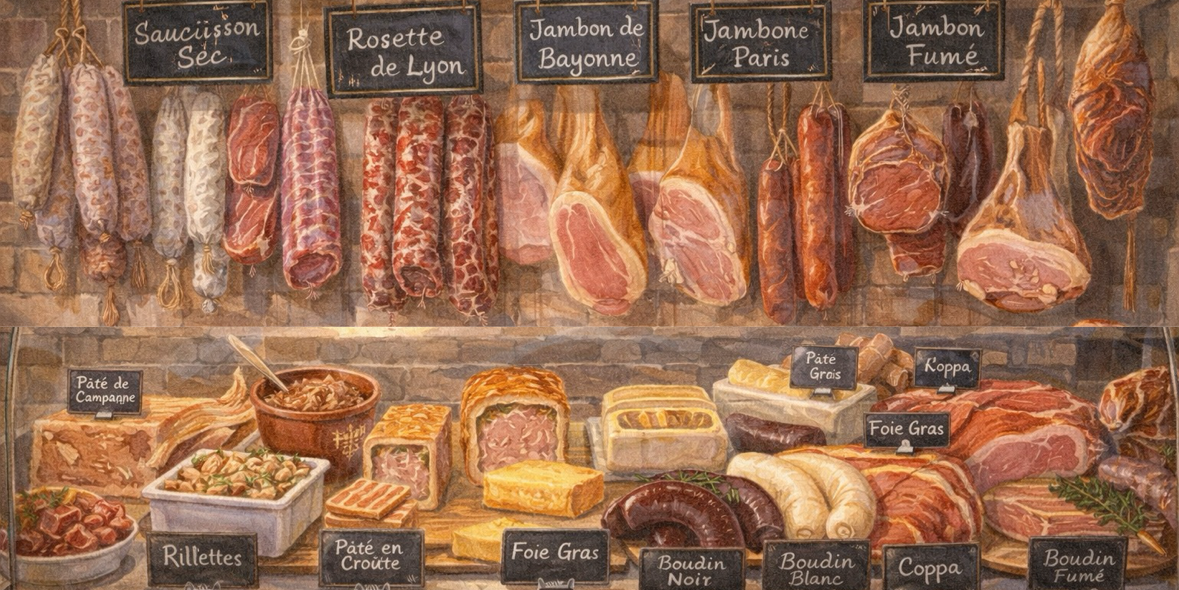
Traditional French cured meats include a wide variety of products, each with its own technique and identity. Saucisson sec, for example, is a dry-cured sausage made from pork and seasoned simply with salt and pepper. It is hung to dry slowly, allowing flavour to develop naturally.
Jambon cru, similar to other European cured hams, relies on salt and air-drying rather than cooking. Rillettes involve slow-cooked meat shredded and preserved in its own fat. Pâtés and terrines use careful seasoning and structure to create sliceable preparations.
Despite differences, these items share a focus on balance rather than excess seasoning.
Why French Charcuterie Focuses on Technique
French charcuterie depends more on technique than on complex ingredients. Salt must be measured carefully. Fat content must be balanced to prevent dryness. Temperature and humidity affect curing results.
For example, too much salt can overpower flavour, while too little can affect preservation. Similarly, incorrect drying conditions may cause spoilage.
Because of this precision, charcutiers train for years to master their craft. The goal is consistency, not novelty.
The Role of French Cured Meats in Everyday Eating
French cured meats are not reserved only for special occasions. In many regions, they form part of everyday meals.
A simple lunch may include sliced saucisson, crusty bread, cornichons, and mustard. In rural homes, rillettes spread on bread provide a satisfying meal with little effort. Even casual gatherings often feature a small charcuterie plate.
This accessibility keeps the tradition alive across generations.
French Charcuterie in Modern Cuisine
Modern chefs continue to reinterpret French charcuterie while respecting its foundations. Some experiment with game meats or lighter seasoning. Others focus on heritage breeds and artisanal methods.
However, the core principles remain unchanged. Preservation, balance, and structure define quality. Even contemporary restaurants often feature classic pâtés or cured sausages alongside innovative dishes.
Tradition adapts without disappearing.
What French Charcuterie Teaches About Food Culture
French charcuterie teaches that great flavour often comes from patience rather than complexity. Through time, salt, and careful handling, simple meat transforms into something deeply satisfying.
It also shows how necessity can evolve into artistry. What began as a survival method became a culinary identity.
By valuing technique and restraint, French charcuterie continues to represent both heritage and skill in French cooking.